





Intelligent Automation & AI Workflows Designed for Operational Stability
We help organizations embed AI into real workflows without disrupting what already works. Execution at this stage shapes cost control, reliability, and trust in automation. Designed for leaders moving beyond demos who need controlled deployment, visibility, and measurable operational impact.
Execution Challenges in the Shift From Pilot to Production
Most AI pilots succeed in isolation. Problems begin when automation enters daily operations.
Hard-coded assumptions
Workflows expect clean inputs and fixed formats. Small changes cause breakdowns.
AI outputs treated as final decisions
Model responses move downstream without validation. Errors reach customers or financial systems.
No designed exception path
Edge cases either fail silently or create manual overload.
Brittle workflow chains
A minor upstream change disrupts the entire sequence.
Limited visibility into failures
Operations cannot see why automation failed or how often.
No operational ownership
Automation is launched, but control and tuning are unclear.
The Biggest Risk Is When Automation Appears Stable but Isn’t
Risk at this stage is operational, not technical.
Organizations often face:
Hidden fragility in automated processes
Automation debt from undocumented logic
False efficiency gains erased by exception handling
Compliance exposure from uncontrolled decisions
Erosion of trust when staff revert to manual overrides
AI capability is rarely the issue. Workflow design and control determine long-term stability.
Effective intelligent automation focuses on containment, observability, and managed growth.
How This Translates Into Execution
Execution focuses on suitability first, then stabilization, then measured scaling.
Phase 01
Automation Opportunity Discovery
Risk addressed: Automating processes that are unstable or unsuitable.
Identify high-friction operational workflows
Quantify effort, cycle time, and error rates
Assess variability and exception frequency
Define automation suitability
The objective is clarity before build.Phase 02
Workflow Decomposition
Risk addressed: Brittle workflow chains that fail under change.
Break processes into atomic decision units
Identify deterministic vs probabilistic steps
Define confidence thresholds
Map exception routes
Workflows are structured to prevent cascading failures.Phase 03
Pilot Deployment
Risk addressed: Hidden instability appearing in live conditions.
Deploy in a limited dataset or controlled environment
Enable live monitoring
Maintain controlled human oversight
Log edge cases
The goal is hardening, not speed.Phase 04
Hardening & Stabilization
Risk addressed: Scaling before resilience is proven.
Improve edge-case handling
Tune confidence thresholds
Refine fallback design
Document operational playbooks
Expansion begins only after stability is validated.Phase 05
Scaled Rollout
Risk addressed: Expansion introducing operational fragility.
Gradual traffic increase
Performance tracking
Governance integration
Continuous monitoring
Automation scales without becoming unstable.
Proven in Real-World Intelligent Automation Deployments
We transform fragmented processes into resilient automation systems built for governance and visibility.
Closing the Feedback Loop With AI-Driven Workflow Automation
A fragmented feedback process relied on manual coordination across quarters and departments. Insights were buried in unstructured text.
- Manual follow-ups and inconsistent tracking
- No consolidated view of feedback data
- Disconnected automation tools
- Limited use of qualitative insights
- Redesigned the lifecycle into defined stages from quarter activation to reporting
- Integrated external workflows through API-based orchestration
- Implemented AI-driven summarization using structured extraction
- Introduced scheduled automation with execution tracking
- Enabled role-based access and centralized dashboards
- Reduced follow-up workload by 40%
- Faster insight generation by approximately 50%
- Standardized lifecycle across clients and quarters
- Improved reliability through monitored automation
- The organization moved from reactive coordination to a controlled automation lifecycle.

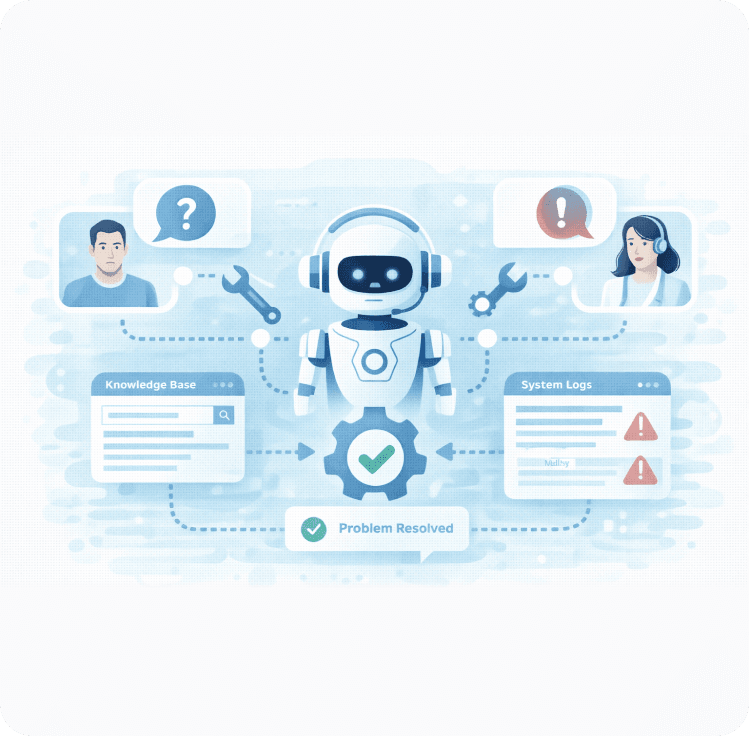
Automating L1 Support Resolution Using Context-Aware AI Agents
High L1 ticket volume, combined with fragmented knowledge sources, created inconsistency and compliance risk.
- Manual repetitive responses
- No single source of truth
- Uncontrolled AI outputs
- Loss of unanswered query insights
- Built validated knowledge datasets
- Grounded AI in curated data
- Enabled tracking and access control
- Reduced L1 effort by 45%
- Improved consistency by 40%
- Expanded dataset coverage by 35%
Start With Clarity Before Expanding Automation
Free Automation Resilience Assessment
A focused review designed to identify where automation may fail and where guardrails are required.
What we assess
- Workflow variability
- Exception frequency
- Manual dependencies
- Automation suitability
What you receive
- Clear risk visibility
- Defined control points
- Guidance on safe next steps
Who This Is For
- Organizations exploring AI-driven automation need clarity before deployment
Free Automation Resilience Assessment
A focused review designed to identify where automation may fail and where guardrails are required.
What we assess
- Workflow variability
- Exception frequency
- Manual dependencies
- Automation suitability
What you receive
- Clear risk visibility
- Defined control points
- Guidance on safe next steps
Who This Is For
- Organizations exploring AI-driven automation need clarity before deployment
Collaborate with Bobcares
Get actionable solutions for your business