





Systems Integration & Workflow Orchestration for Coordinated Execution
We connect platforms and align workflows so systems function as one. Decisions at this stage influence data accuracy, decision speed, and execution without manual effort. Designed for organizations moving from tool-level efficiency toward coordinated execution that requires shared data, clear ownership, and structured workflows.
Execution Challenges in Cross-System Operations
Most organizations do not struggle because systems fail individually. Problems arise when disconnected tools are expected to function as a single operating environment.
Fragile integration between systems
Quick connections often form chains that break when one system changes.
Automation exists in silos
Individual tools run automated tasks, yet workflows stop at system boundaries.
Undefined data ownership causes confusion
Systems exchange information without shared definitions.
Manual orchestration slows execution
People act as the link between platforms.
Limited monitoring delays response
Integration failures remain unnoticed until operations are affected.
The Biggest Risk Is When System Gaps Become Business Risk
Risk shifts once operations depend on data moving reliably across platforms. What once appeared manageable can directly affect decision quality and execution speed.
Organizations often face challenges such as:
Decision risk from delayed or inconsistent information
Operational risk caused by manual handoffs
Scalability risk as each new system increases coordination complexity
Compliance risk due to inconsistent data handling
People risk when critical flows rely on individual knowledge
Technical gaps matter, yet the larger threat is allowing fragmented systems to shape daily operations.
Effective systems integration focuses on enabling the organization to operate as one connected environment as complexity grows.
How This Translates Into Execution
Execution emphasizes stability first, followed by speed and structured expansion.
Phase 01
Assessment-led Start
Risk addressed: System gaps remaining hidden and continuing to slow execution.
Identify high-impact system handoffs and bottlenecks
Map dependencies across platforms
Reveal workflows that rely on manual coordination
Clarify where delays originate
The objective is to understand how work actually moves before introducing integrations.Phase 02
Prioritized Integration Backlog
Risk addressed: Integration efforts expand without clear operational value.
Sequence integration work based on operational impact
Focus on workflows that influence speed and visibility
Distinguish critical integrations from lower-priority connections
Direct effort toward outcomes that improve execution
Work progresses in a deliberate, coordinated order.Phase 03
Incremental Delivery
Risk addressed: Large integration efforts increase disruption and uncertainty.
Introduce integrations in small, testable units
Deploy workflows gradually to limit operational risk
Evaluate performance after each release
Adjust direction based on observed results
Progress remains steady while minimizing disruption to daily work.Phase 04
Shared Validation
Risk addressed: Misalignment between technical output and operational needs.
Validate outcomes jointly across business and technical teams
Confirm workflows function as intended in real scenarios
Ensure data moves accurately between systems
Establish confidence before expanding integrations
Alignment improves adoption and reduces rework.Phase 05
Continuous Monitoring
Risk addressed: Integration failures remain unnoticed until operations are affected.
Maintain visibility into failures and delays
Enable faster response to integration issues
Strengthen ownership for ongoing reliability
Support informed operational decisions
Execution becomes more predictable as integrations remain observable and actionable.
Proven in Complex Operational Environments
We transform disconnected platforms into coordinated systems prepared to support structured execution and visibility.
Customized ERPNext Platform for Finance, Payroll & Workforce Management
ERPNext provided a strong base, yet gaps existed between standard capabilities and real operational workflows. Manual payroll handling, limited flexibility in leave and attendance, accounting validations, and reliance on spreadsheets increased error risk and slowed execution.
- Gaps between ERP features and business workflows
- Manual payroll and shift calculations
- Dependency on external tools
- Accounting processes requiring custom logic
- Increased inconsistencies
- Designed custom modules for accounts, payroll, shift, and leave management
- Implemented financial workflows with validations
- Automated payroll calculations and deductions
- Built flexible shift definitions and attendance logic
- Customized leave policies with automated approvals
- Integrated modules with core ERPNext features while maintaining stability
- Fully customized ERP platform aligned to operational needs
- Manual processing effort reduced by 50%
- Payroll accuracy increased by 35%
- Operational efficiency improved by 40%
- Data consistency strengthened
- Dependency on spreadsheets eliminated
- Scalable ERP foundation established for future growth

Project Management & Operations Orchestration Platform
Teams relied on separate tools, emails, and manual follow-ups to manage projects and reporting. Coordination overhead increased as the organization expanded.
- Project tracking spread across spreadsheets and informal communication
- No standardized task logging
- Manual follow-ups to monitor activity
- Limited visibility into productivity
- Lack of centralized collaboration
- Developed a centralized web application for project and task management
- Structured task lifecycle with ownership and status tracking
- Introduced daily work logging and time tracking
- Automated alerts and generated productivity reports
- Enabled collaboration, documentation, and knowledge sharing
- Integrated leave records with operational workflows
- Unified operational workflows into a single platform
- The reporting preparation effort was reduced
- Work tracking visibility improved
- Manual follow-ups decreased
- Coordination overhead lowered
- Structured collaboration supported operational scaling
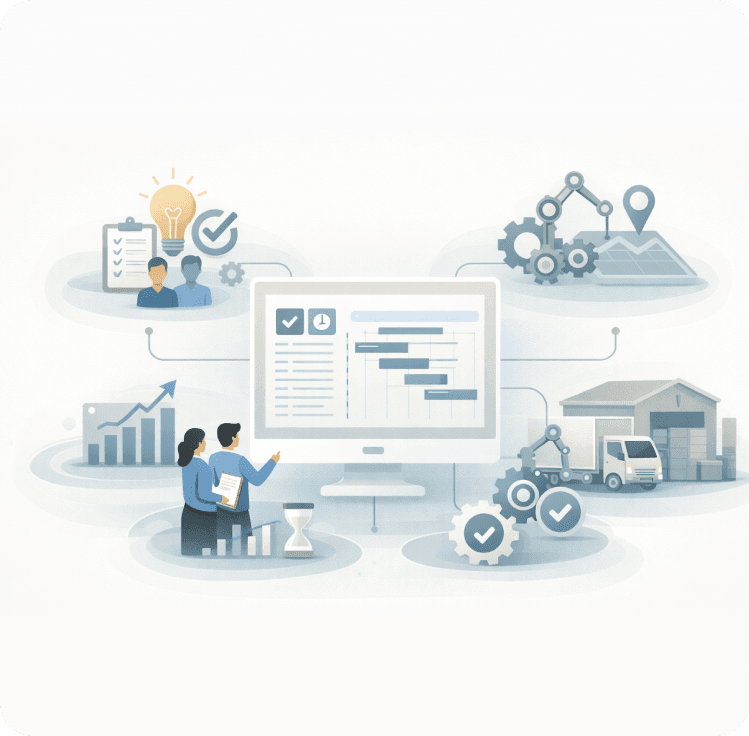
Start With Clarity Before Connecting More Systems
Before expanding integrations, a structured evaluation helps identify where workflows break and what should be prioritized.
Free Integration & Orchestration Assessment
A focused review designed to uncover system gaps and define what should be connected first.
What we assess
- System silos and manual coordination points
- Workflows that break across tools
- Integrations that matter most for speed and visibility
- Differences between integration and process issues
What you receive
- Clear view of operational flow risks
- Prioritized recommendations
- Guidance on next steps
Who This Is For
Organizations that:
- Operate on multiple systems
- Experience fragmented workflows
- Need clarity before expanding integrations
Clear direction with no commitment required.
Free Integration & Orchestration Assessment
A focused review designed to uncover system gaps and define what should be connected first.
What we assess
- System silos and manual coordination points
- Workflows that break across tools
- Integrations that matter most for speed and visibility
- Differences between integration and process issues
What you receive
- Clear view of operational flow risks
- Prioritized recommendations
- Guidance on next steps
Who This Is For
Organizations that:
- Operate on multiple systems
- Experience fragmented workflows
- Need clarity before expanding integrations
Clear direction with no commitment required.
Collaborate with Bobcares
Get actionable solutions for your business