





Transformation Execution & Delivery Enablement That Drives Adoption
We support organizations that know what must change but struggle to deliver outcomes that are adopted and sustained. Execution at this stage determines whether the transformation produces value or becomes an ongoing cost. Designed for environments where delivery capacity is stretched, dependencies slow progress, and change competes with operational priorities.
Execution Challenges That Slow Transformation
Transformation rarely fails due to poor strategy. Delivery systems often lack the structure required to sustain change.
Overloaded delivery teams
Transformation efforts compete directly with operational responsibilities.
Unclear ownership
No single team carries accountability for outcomes from backlog through adoption.
Dependency paralysis
Cross-team and system dependencies delay progress.
Release-driven success metrics
Projects are labeled complete at deployment instead of active usage.
Inconsistent delivery rhythm
Planning, estimation, and execution cycles vary, creating uncertainty.
The Greatest Risk Is When Execution Weakness Undermines Transformation
Risk accelerates when initiatives fail to reach usable outcomes. Investments increase while confidence declines.
Organizations frequently encounter challenges such as:
Execution risk when critical initiatives miss timelines
Adoption risk when delivered systems see limited usage
Financial risk as spending outpaces business return
Credibility risk that weakens confidence in future initiatives
Opportunity risk when efficiency and growth remain out of reach
Technical capability matters, yet the larger threat is allowing stalled execution to redefine transformation as a recurring expense.
How This Translates Into Execution
Execution is structured to complement internal development efforts while advancing transformation work steadily.
Phase 01
Assessment
Risk addressed: Initiatives stall when scope, dependencies, and success metrics remain undefined.
Clarify scope and expected outcomes
Identify dependencies early
Establish measurable success metrics
The objective is to create direction before execution begins.Phase 02
Dedicated Delivery Pods
Risk addressed: Delivery momentum weakens when teams are spread across competing priorities.
Assign dedicated delivery pods aligned to specific initiatives
Maintain consistent execution focus
Strengthen accountability
The objective is to sustain progress through concentrated ownership.Phase 03
Sprint-based Execution
Risk addressed: Unpredictable cycles reduce confidence in delivery timelines.
Operate through sprint-based execution
Maintain predictable delivery cycles
Validate progress frequently
The objective is to advance work with consistency and visibility.Phase 04
Integrated Delivery
Risk addressed: Transformation work disrupts core engineering when it operates separately from established practices.
Align work with existing CI/CD pipelines
Support current engineering workflows
Maintain continuity across teams
The objective is to enable progress without interrupting ongoing delivery.Phase 05
Adoption Checkpoints
Risk addressed: Deployment occurs without sustained usage or operational stability.
Track usage, feedback, and system stability
Confirm readiness after release
Support transition into daily operations
The objective is to ensure that delivered systems create measurable value.
Proven Across Complex Transformation Initiatives
Results consistently show restored delivery momentum, stronger adoption, and improved confidence in execution.
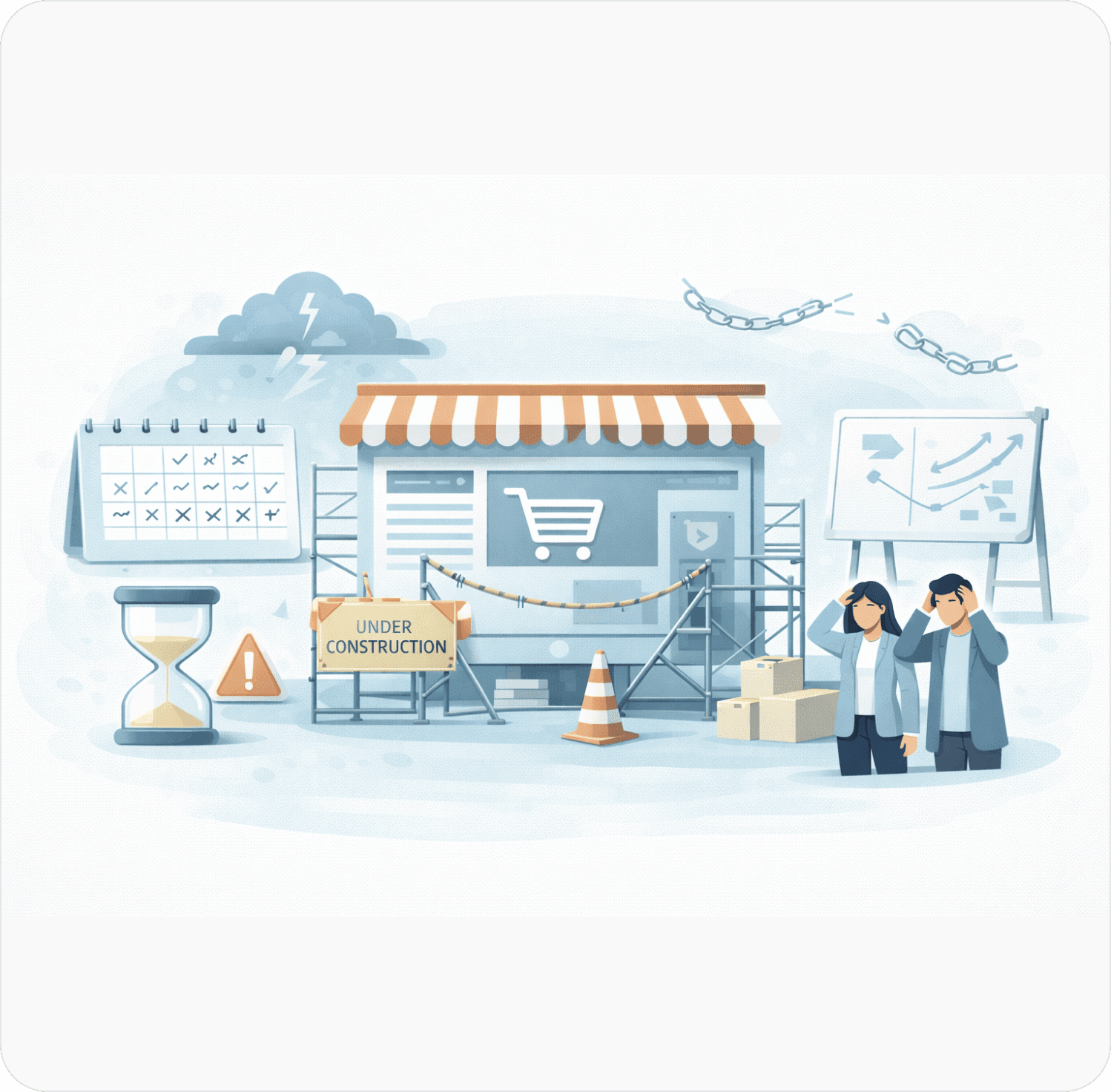
Stalled E-commerce Transformation Recovery – Delivery Rescue & Completion
A commerce platform investment remained incomplete after repeated delays, instability, and coordination challenges prevented production adoption.
- Incomplete modules and unstable workflows
- Multiple failed production releases
- Data migration errors
- Business teams are unable to operate the system reliably
- Limited internal capacity to troubleshoot inherited code
- Declining confidence in the initiative
- Audited the inherited codebase and deployment environment
- Identified integration failures and incomplete components
- Stabilized data handling and transaction workflows
- Coordinated application, infrastructure, and database teams
- Structured testing cycles with business users
- Planned phased deployment with monitored rollout
- Implemented rollback and recovery procedures
- Assisted operational teams during early usage
- Completed and stabilized the commerce platform
- Successful production deployment
- Coordinated cross-team delivery
- Restored operational usability
- Recovered a failing transformation investment
- Renewed stakeholder confidence
Operations Portal Rollout – Execution Governance & Adoption Support
An internal operations portal required a structured rollout and accountability after previous tools saw limited adoption.
- Tools deployed but rarely used
- Continued reliance on spreadsheets and email workflows
- No structured onboarding process
- Unclear ownership and expectations
- Limited visibility into adoption
- Change fatigue across departments
- Implemented sprint-based delivery cycles
- Provided weekly progress visibility
- Defined a departmental rollout plan
- Assigned usage ownership
- Tracked activity and adoption patterns
- Delivered targeted support where usage lagged
- Fully rolled out operations portal
- Increased user adoption
- Reduced spreadsheet dependency
- Improved delivery predictability
- Strengthened stakeholder confidence
- Improved operational consistency

Start With Clarity Before Advancing Transformation
A structured review helps identify why initiatives stall and what must change to restore progress.
Free Transformation Delivery Readiness Assessment
A focused evaluation designed to uncover execution barriers and define the path forward.
What we assess
- Execution bottlenecks and capacity gaps
- Points where initiatives lose momentum
- Dependency and governance constraints
- Initiatives positioned for realistic progress
What you receive
- Clear perspective on delivery readiness
- Prioritized recommendations
- Guidance on immediate next steps
Who This Is For
Organizations that:
- Experience delayed or incomplete initiatives
- Face adoption challenges after deployment
- Require clearer execution direction
Free Transformation Delivery Readiness Assessment
A focused evaluation designed to uncover execution barriers and define the path forward.
What we assess
- Execution bottlenecks and capacity gaps
- Points where initiatives lose momentum
- Dependency and governance constraints
- Initiatives positioned for realistic progress
What you receive
- Clear perspective on delivery readiness
- Prioritized recommendations
- Guidance on immediate next steps
Who This Is For
Organizations that:
- Experience delayed or incomplete initiatives
- Face adoption challenges after deployment
- Require clearer execution direction
Collaborate with Bobcares
Get actionable solutions for your business