





Always-On Infrastructure Management with Clear Ownership
We manage cloud and server environments that require constant attention. Stability does not happen by chance. Many infrastructure issues begin unnoticed. They build over time and surface as outages, security incidents, or performance failures that affect customers and revenue. Designed for organizations that need controlled, continuously managed infrastructure instead of reactive fixes.
Execution Challenges in Infrastructure Operations
Daily infrastructure management often appears stable on the surface, but hidden gaps and neglected tasks slowly create risk beneath it.
Infrastructure rarely collapses overnight
Problems grow slowly when no one owns them fully.
Cloud environments evolve without structure
Systems expand without clear standards or documentation.
Servers falling behind on security patches
Critical updates get postponed due to unclear responsibility.
Performance degrades as usage increases
Resources saturate gradually and impact applications.
Backup failures discovered during emergencies
Backups exist, but restore processes are never tested.
The Real Risk Is Not Downtime — It’s Operational Drift
Outages are only symptoms. The real issue is environments drifting away from a controlled state.
Organizations often experience:
Revenue impact from downtime
Security exposure due to patch gaps
Data loss risk from untested backups
Rising costs caused by inefficiencies
Confidence in reliability drops
Infrastructure doesn't fail because it is complex. It fails because it is unmanaged over time.
How This Translates Into Ongoing Operations
Execution focuses on control first, then structured ownership, then steady improvement.
Phase 01
Infrastructure Assessment
Risk addressed: Hidden instability and unknown gaps.
Full review of systems and dependencies
Identification of risks and weak spots
Clear operational baseline
The objective is to establish visibility and control.Phase 02
Stabilization and Risk Reduction
Risk addressed: Accumulating exposure and fragile systems.
Resolve security gaps
Address performance constraints
Strengthen backup reliability
The environment becomes stable and predictable.Phase 03
Structured Ownership
Risk addressed: Drift caused by lack of accountability.
Continuous monitoring
Ongoing patch management
Documented operational practices
Stability becomes consistent rather than reactive.Phase 04
Continuous Optimization
Risk addressed: Gradual degradation over time.
Performance refinements
Cost adjustments
Capacity planning aligned with growth
Infrastructure improves steadily instead of declining.
Proven Infrastructure Stability in Live Environments
A financial services provider in Malaysia delivers online payments, mobile recharges, and wallet management to thousands of users daily. Growth exposed weaknesses in legacy infrastructure. Security breaches, unstable servers, and limited mobile access threatened customer trust and expansion.
- Frequent security breaches and stolen funds
- Server crashes and high resource loads
- Weak database configurations
- Slow queries and timeout errors
- Limited mobile accessibility
- Migration risks due to legal requirements
- Hacks were cleaned, passwords reset, and malware removed.
- Firewalls were deployed and protection upgraded to Cloudflare
- Proactive monitoring was introduced.
- MySQL was optimized, and slow queries were corrected.
- Redis caching improved responsiveness.
- PHP-FPM was tuned to handle peak demand.
- Workloads were migrated to AWS EC2 and RDS.
- Migration completed with zero downtime.
- ATOP and Netdata monitored usage spikes.
- Audits, patching, and ongoing support strengthened system health.
- Secure APIs synchronize backend data in real time.
- Security breaches have been reduced to zero
- Website load time improved by 50%
- Mobile traffic increased by 50%
- User engagement increased by 28%
- Conversion rates increased by 32%
- Infrastructure downtime reduced by 90%.
- Platform prepared to handle peak loads.
- Migration completed without data loss.

Appraise Cloud Solutions is a cloud hosting provider serving web applications, SaaS platforms, and e-commerce businesses in the United States. Its platform supports performance-critical workloads that require steady uptime, fast response times, and secure operations. As demand increased, the existing infrastructure struggled during peak usage.
- Frequent downtime during traffic surges
- Performance degradation under high demand
- Delayed incident detection due to limited monitoring
- Security exposure from unmanaged secrets and outdated deployment pipelines
- Inefficient resource usage is limiting future growth
- Azure Application Gateway and NGINX Ingress managed SSL termination and routed traffic across container workloads.
- AKS hosted containerized applications. Auto-scaling adjusted resources dynamically during peak demand.
- PostgreSQL on Azure strengthened transaction reliability and speed.
- Prometheus and Grafana delivered real-time metrics and alerts for early issue detection.
- Azure DevOps and Terraform enabled controlled and consistent deployments.
- Uptime improved to 99.99%
- Application response time improved by 45%
- Incident resolution improved by 60%
- Scaling became 2× faster
- Monitoring shifted to real-time visibility
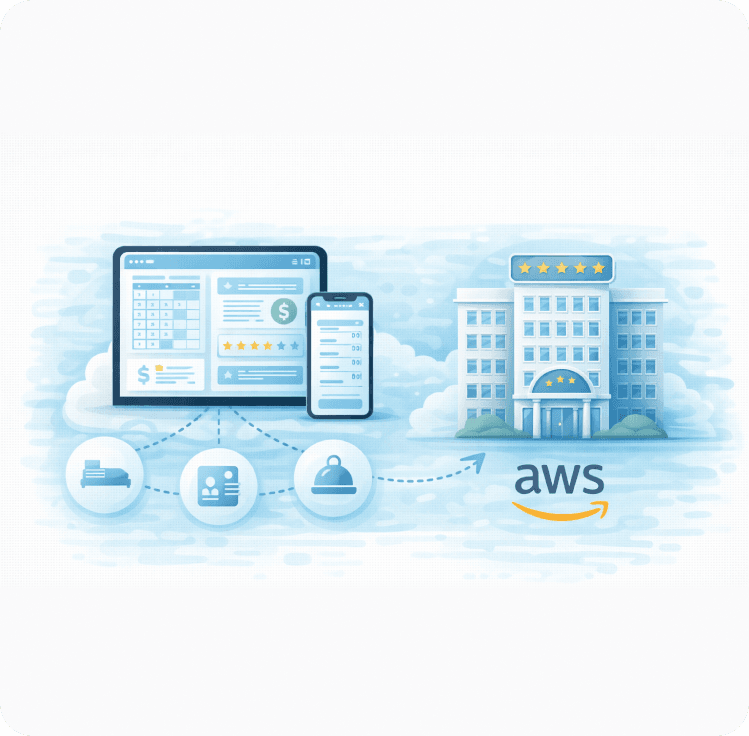
A hospitality technology provider in the United States wanted to build a SaaS platform to manage hotel operations. The goal was to support real-time analytics, protect sensitive data, and handle growing customer demand.
- Inability to scale as hotel customers increased
- Slow performance during real-time analytics
- Exposure of sensitive hotel and guest data
- Deployment delays are causing downtime
- Rising infrastructure costs
- EC2 instances configured with auto-scaling and Elastic Load Balancers.
- RDS is deployed with Multi-AZ support.
- S3 configured for secure storage, versioning, and lifecycle management.
- VPC is designed with AWS WAF and Shield for network security.
- Elasticache Redis reduced database load.
- RDS read replicas handled traffic distribution.
- S3 Transfer Acceleration improved upload and download speed.
- IAM roles and MFA secured access control.
- AWS Cost Explorer monitors expenses.
- Deployment time reduced by 40%
- Operational costs reduced by 25%
- System uptime maintained at 99.9%
Start with the Right Level of Operational Ownership
Choose the engagement model that matches your infrastructure complexity and coverage needs.
Shared Infrastructure Management
Starting at $39–$117 per server/month
Who it's for
- Small to mid-sized environments
- Startups or cost-conscious teams
- Teams without dedicated DevOps staff
- Businesses needing stable day-to-day operations
- Organizations early in cloud maturity
What it does
- OS patching and security updates
- Resource and uptime monitoring
- Backup monitoring and validation checks
- Configuration reviews and drift detection
- Standard incident response and remediation
What you get
- Reliable infrastructure health coverage
- Reduced downtime and operational surprises
- Consistent maintenance without internal effort
- Improved system stability over time
- Predictable, low-cost operational support
Shared Infrastructure Management
Starting at $39–$117 per server/month
Who it's for
- Small to mid-sized environments
- Startups or cost-conscious teams
- Teams without dedicated DevOps staff
- Businesses needing stable day-to-day operations
- Organizations early in cloud maturity
What it does
- OS patching and security updates
- Resource and uptime monitoring
- Backup monitoring and validation checks
- Configuration reviews and drift detection
- Standard incident response and remediation
What you get
- Reliable infrastructure health coverage
- Reduced downtime and operational surprises
- Consistent maintenance without internal effort
- Improved system stability over time
- Predictable, low-cost operational support
Collaborate with Bobcares
Get actionable solutions for your business