



Ecommerce Consulting Services


What is Ecommerce Consulting?
Online companies frequently struggle to decide which platform to use, how to integrate their systems, and why their stores aren't achieving the desired outcomes. Technology investments may become ineffective and fail to support business growth if they are not guided by proper ecommerce consultancy services.
Ecommerce consulting service offers professional advice to assess online selling strategy, platform selection, system structure, performance, and operations. Before starting any significant build or migration, it focuses on comprehending the current system, spotting gaps, and creating a clear plan. Companies use ecommerce consulting services and ecommerce software consulting to ensure that every decision minimizes unnecessary risk and supports quantifiable results.

Businesses use ecommerce consulting for several needs
When to Consider Ecommerce Consulting
The need for ecommerce consulting services becomes clear when platform decisions, performance issues, and system complexity begin limiting growth. Uncertainty at this stage can lead to costly mistakes. An experienced ecommerce consulting company provides structured assessments, practical recommendations, and a clear roadmap for confident business decisions.
Indicators that point to a need for ecommerce consulting support
Traffic grows, but sales fail to keep pace consistently
Platform limits required features and integrations
High-risk platform migration needs careful planning
Disconnected systems become difficult to manage
Cart abandonment remains high without clear insights
Performance issues hurt SEO and user experience
Key Benefits
Avoid costly platform mistakes
Incorrect platform decisions can cost five to ten times more to fix later
Identify conversion improvement opportunities
Store audits reveal 3-7 high-impact areas for conversion growth
Reduce risk during platform migration
Structured planning lowers the chances of migration failure
Faster problem identification
Expert analysis delivers root cause insights in days instead of weeks
Improve clarity across systems and tools
Identifies gaps and overlaps in the integration stack before they scale
Strengthen decision-making
Helps stakeholders align quickly with clear expert recommendations

Why Choose Our Ecommerce Consulting Services
Our ecommerce consulting services are built on extensive experience across platform development, migration, and store optimization. At Bobcares, every recommendation is shaped by hands-on work with leading ecommerce platforms, ensuring it can be applied effectively in real scenarios without gaps between strategy and execution.
Key Reasons Clients Choose Bobcares
Platform-neutral advisory across WooCommerce, Shopify, Magento, OpenCart, and custom builds
Recommendations backed by real implementation experience across major platforms
Focus on improving conversions, platform performance, and operational efficiency
ISO 9001:2015 and ISO 27001:2022 certified ecommerce consulting processes
Seamless transition from consulting to implementation with complete project context
Expertise in platform selection, audits, migration, and integration assessments
Connect With Our Engineering Specialists
Talk to Bobcares experts to explore the right solution for your business

Our Ecommerce Consulting Services
A focused set of ecommerce consulting services designed to guide platform decisions, improve store performance, and align your technology setup with business growth objectives.
Ecommerce Platform Selection & Advisory
Ecommerce Store Performance Audit
Conversion Rate Optimization Audit & Recommendations
Replatforming Strategy & Migration Roadmap
Ecommerce Technology Architecture Review
Third-Party Integration Stack Assessment
Marketplace Expansion Strategy
Ecommerce SEO & Core Web Vitals Advisory
Checkout Optimization & Cart Abandonment Analysis
Ecommerce Security & Compliance Advisory
Retained Ecommerce Consulting
Partners
We support businesses worldwide with reliable, expert-driven solutions. Trusted for our consistency, speed, and commitment to quality.





Supplementary Services
Additional capabilities that support deeper analysis, performance evaluation, and structured planning across your ecommerce ecosystem.
Store audits across different parameters
Platform capability assessment
Total cost of ownership analysis
Integration mapping
Competitor benchmarking
Analytics audit with GA4 and funnel insights
PCI DSS compliance gap assessment
Core Web Vitals and performance benchmarking
Customer Testimonials
Bobcares has been an extension of our team at DNN4Less. We're a small shop running a big mix of platforms (cPanel/Linux, Windows/IIS, Plesk, DNN, email, and more), and their engineers handle our customer support with the technical depth and responsiveness we need. The team takes ownership of issues, knows when to escalate, and communicates clearly with our customers. Having Bobcares in our corner lets us focus on infrastructure and growth, knowing our customers are in good hands.

Jessie Haggerty
Hosting Manager, DNN4Less
Bobcares helped me with the configuration of server side settings that allowed for our development team to use Github with cPanel. Bobcares also guided me to another solution which may be better for my purposes. As always, Bobcares is looking out for my best interests and proactively offering ideas and recommendations. I highly recommend Bobcares for all of your technology support needs!

Matthew Owen
Founder, FastTrack CEO
We had a quick turnaround support from Ameer from BobCares team to fix a Cname issue we were facing with email delivery. This was rectified by Ameer instantly. We appreciate BC's support at all times and trust them and their expertise! 5 Stars and always reliable!

Shamil Abdul Latheef
Sr. Manager - Digital Biz, Chrysalis Digital

Bobcares provides comprehensive end-to-end product lifecycle support for ReformRX. From developing and maintaining the mobile app to handling customer support and Azure operations, no task was too small or too complex for their team. Their responsiveness to change, consistent high-quality deliverables, and can-do attitude helped us significantly scale the ReformRX app’s functionality. Bobcares’ team and leadership are engaged, reliable, and trusted partners for our IT services.
Kripa Krishnan
Product Lead, Reform RX

I wholeheartedly advise any company that needs an exceptional support team to take care of their internet and mail server to get in touch with Bobcares. They will experience exceptional, swift, and efficient service. Don’t wait—just go ahead and join them!
Cherif Bedran
Founder and CEO, Information Management Limited

Bobcares is a great service! I've been a user for nearly two years and whether it's regular server monitoring or responding to unexpected downtime, Bobcares has been there and done a good job. Most recently, we had an unexpected downed SQL server that Bobcares noticed through monitoring and brought back up to functioning in under an hour. Great work!
Ibrahim Chishti
Director of Technology, IMC DIGITAL UNIVERSE, INC
We have had many urgent issues with our Moodle instance and the team at Bobcares came to our rescue. This specific issue was no exception. Our production site was not loading, instead we were receiving this message, "error reading from database". However, I reached out to the techs at Bobcares and they rescued us in a short period of time! Our site is up and running again!

Sergio Estridge
E-Learning Manager, H. Lavity Stoutt Community College

Bobcares has allowed me to focus on serving my own clients and growing my business rather than worrying about server administration and security. Knowing that experienced professionals are constantly monitoring and maintaining my server gives me tremendous peace of mind. After more than a decade of working together, I consider Bobcares a trusted partner rather than just a service provider.
William Mills
Designer / Partner, Toucan Graphics
Bobcares has been an extension of our team at DNN4Less. We're a small shop running a big mix of platforms (cPanel/Linux, Windows/IIS, Plesk, DNN, email, and more), and their engineers handle our customer support with the technical depth and responsiveness we need. The team takes ownership of issues, knows when to escalate, and communicates clearly with our customers. Having Bobcares in our corner lets us focus on infrastructure and growth, knowing our customers are in good hands.
Jessie Haggerty
Hosting Manager, DNN4Less
Bobcares helped me with the configuration of server side settings that allowed for our development team to use Github with cPanel. Bobcares also guided me to another solution which may be better for my purposes. As always, Bobcares is looking out for my best interests and proactively offering ideas and recommendations. I highly recommend Bobcares for all of your technology support needs!
Matthew Owen
Founder, FastTrack CEO
We had a quick turnaround support from Ameer from BobCares team to fix a Cname issue we were facing with email delivery. This was rectified by Ameer instantly. We appreciate BC's support at all times and trust them and their expertise! 5 Stars and always reliable!
Shamil Abdul Latheef
Sr. Manager - Digital Biz, Chrysalis Digital
Bobcares provides comprehensive end-to-end product lifecycle support for ReformRX. From developing and maintaining the mobile app to handling customer support and Azure operations, no task was too small or too complex for their team. Their responsiveness to change, consistent high-quality deliverables, and can-do attitude helped us significantly scale the ReformRX app’s functionality. Bobcares’ team and leadership are engaged, reliable, and trusted partners for our IT services.
Kripa Krishnan
Product Lead, Reform RX
I wholeheartedly advise any company that needs an exceptional support team to take care of their internet and mail server to get in touch with Bobcares. They will experience exceptional, swift, and efficient service. Don’t wait—just go ahead and join them!
Cherif Bedran
Founder and CEO, Information Management Limited
Bobcares is a great service! I've been a user for nearly two years and whether it's regular server monitoring or responding to unexpected downtime, Bobcares has been there and done a good job. Most recently, we had an unexpected downed SQL server that Bobcares noticed through monitoring and brought back up to functioning in under an hour. Great work!
Ibrahim Chishti
Director of Technology, IMC DIGITAL UNIVERSE, INC
We have had many urgent issues with our Moodle instance and the team at Bobcares came to our rescue. This specific issue was no exception. Our production site was not loading, instead we were receiving this message, "error reading from database". However, I reached out to the techs at Bobcares and they rescued us in a short period of time! Our site is up and running again!
Sergio Estridge
E-Learning Manager, H. Lavity Stoutt Community College
Bobcares has allowed me to focus on serving my own clients and growing my business rather than worrying about server administration and security. Knowing that experienced professionals are constantly monitoring and maintaining my server gives me tremendous peace of mind. After more than a decade of working together, I consider Bobcares a trusted partner rather than just a service provider.
William Mills
Designer / Partner, Toucan Graphics
Our Ecommerce Consulting Framework
A structured approach designed to turn insights into clear, actionable outcomes aligned with your business goals.
STEP 01
Discovery
Understand your business goals, current challenges, and priorities to define the consulting scope clearly.STEP 02
Audit
Review analytics, platform setup, integrations, and store performance to identify issues and gaps.STEP 03
Root Cause Analysis
Identify the underlying causes behind performance, conversion, and operational challenges.STEP 04
Recommendations & Roadmap
Deliver prioritized recommendations and a practical roadmap based on business goals and findings.STEP 05
Walkthrough
Review findings with stakeholders, answer questions, and align on priorities and recommended next steps.STEP 06
Handover
Transfer all findings and documentation to the implementation team for smooth project execution.
What Makes Our Approach Different
Many ecommerce consulting engagements are shaped by platform sales positioning or high-level strategy, but lack implementation context. This often results in recommendations that do not accurately reflect the platform's behavior. Our approach is based on direct experience with building and optimizing stores across major platforms, similar to a specialized ecommerce solutions consultant model.
Engineering Led
Expertise across leading ecommerce platforms
Vendor Neutral
Objective platform recommendations
Cost Aware
Full lifecycle cost considerations
Data Driven
Analytics and funnel-based insights
Clear Priorities
Phased roadmap with defined actions
Team Continuity
Consulting through implementation
Common Ecommerce Consulting Risks and How We Handle Them
Risk
How We Handle It
The platform recommendation does not fit the budget or the implementation scope
Total cost and implementation effort are evaluated during platform selection, not after
Generic recommendations with no clear action path
Every finding is tied to specific platform data, metrics, and user journey insights
Misalignment between stakeholders on priorities
Effort and impact-based prioritization helps teams align on what to act on first
Loss of context between consulting and development
Structured handover ensures all insights carry forward into implementation
Incomplete or unreliable analytics data
Analytics review is conducted first to identify and document data gaps
Unclear scope and deliverables at the start
Scope and outcomes are defined and agreed upon before the engagement begins
Risk
The platform recommendation does not fit the budget or the implementation scope
Generic recommendations with no clear action path
Misalignment between stakeholders on priorities
Loss of context between consulting and development
Incomplete or unreliable analytics data
Unclear scope and deliverables at the start
How We Handle It
Total cost and implementation effort are evaluated during platform selection, not after
Every finding is tied to specific platform data, metrics, and user journey insights
Effort and impact-based prioritization helps teams align on what to act on first
Structured handover ensures all insights carry forward into implementation
Analytics review is conducted first to identify and document data gaps
Scope and outcomes are defined and agreed upon before the engagement begins


Technologies & Tools We Use


Analytics & User Behavior
Google Analytics 4 / Universal Analytics, Hotjar / Microsoft Clarity


SEO & Performance
Google Search Console, Lighthouse / PageSpeed Insights, Screaming Frog


Platform Assessment
WooCommerce, Shopify, Magento, OpenCart


Payments & Security
Stripe, PayPal, payment gateway dashboards


Documentation & Planning
Jira, Notion, Google Docs
Engagement Models
Flexible consulting options designed to match different business needs, from focused assessments to ongoing strategic support.
One-Time Store Audit
A detailed review of your ecommerce store covering performance, UX, conversion, SEO, security, and integrations. Delivered as a structured report with prioritized recommendations and next steps.
Platform Selection Advisory
Compare platform options based on business goals, technical needs, and budget. Experienced ecommerce website consultants provide recommendations with cost, scalability, and migration considerations.
Replatforming Strategy Engagement
Develop a phased migration strategy covering platform selection, data mapping, integration planning, risk assessment, and an implementation roadmap to reduce transition challenges.
Retained Ecommerce Consulting
Ongoing advisory support for evolving ecommerce businesses. Ideal for organizations looking to hire ecommerce consultants for continuous technology guidance and long-term growth.
Industries We Serve
Case Studies
A growing online retailer needed to modernize its outdated WordPress store to improve customer engagement, mobile usability, and conversions without rebuilding the platform.
- Outdated user experience
- Poor mobile performance
- Low customer engagement
- Weak product discovery
- Limited customer retention
- Redesigned the storefront and navigation
- Improved product search and filtering
- Added interactive brand elements
- Introduced a loyalty rewards program
- Optimized responsiveness across devices
- Increased customer engagement
- Improved conversion rates
- Higher repeat purchases
- Better mobile experience
- Stronger brand credibility
- Modernized platform ready for future growth
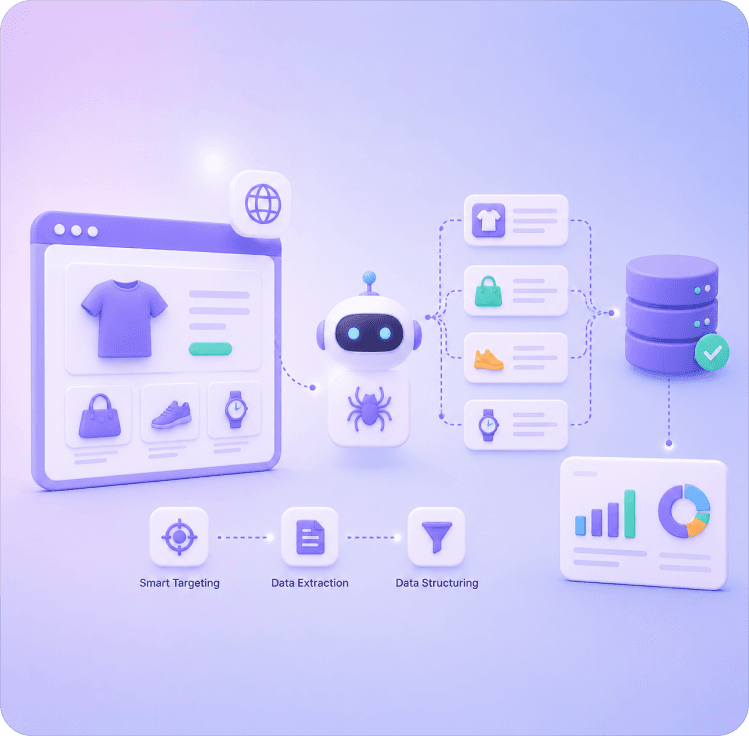
A retail technology company needed a scalable solution to extract accurate product data from dynamic ecommerce websites with complex SKU-level variations.
- Unreliable data extraction
- Frequent scraper failures
- High maintenance effort
- Difficulty scaling data collection
- Inconsistent product data
- Built an AI-powered extraction platform
- Automated SKU-level data capture
- Added centralized validation and control
- Enabled high-volume batch processing
- Designed a modular, scalable architecture
- Reduced manual data processing
- Improved SKU-level accuracy
- Faster product onboarding
- Lower maintenance effort
- Scalable platform supporting long-term growth
An online retailer needed a modern ecommerce platform to improve customer experience, automate operations, and support business growth.
- Limited online visibility
- Poor user experience
- Manual order management
- Inefficient inventory processes
- Lost sales opportunities
- Built a responsive WordPress website
- Integrated WooCommerce
- Automated order and inventory management
- Improved navigation and checkout experience
- Optimized the platform for growth
- Increased website traffic by 45%
- Grew sales revenue by 19%
- Reduced cart abandonment by 22%
- Improved customer satisfaction
- Increased operational efficiency through automation
A growing online retailer needed to modernize its outdated WordPress store to improve customer engagement, mobile usability, and conversions without rebuilding the platform.
- Outdated user experience
- Poor mobile performance
- Low customer engagement
- Weak product discovery
- Limited customer retention
- Redesigned the storefront and navigation
- Improved product search and filtering
- Added interactive brand elements
- Introduced a loyalty rewards program
- Optimized responsiveness across devices
- Increased customer engagement
- Improved conversion rates
- Higher repeat purchases
- Better mobile experience
- Stronger brand credibility
- Modernized platform ready for future growth
A retail technology company needed a scalable solution to extract accurate product data from dynamic ecommerce websites with complex SKU-level variations.
- Unreliable data extraction
- Frequent scraper failures
- High maintenance effort
- Difficulty scaling data collection
- Inconsistent product data
- Built an AI-powered extraction platform
- Automated SKU-level data capture
- Added centralized validation and control
- Enabled high-volume batch processing
- Designed a modular, scalable architecture
- Reduced manual data processing
- Improved SKU-level accuracy
- Faster product onboarding
- Lower maintenance effort
- Scalable platform supporting long-term growth
An online retailer needed a modern ecommerce platform to improve customer experience, automate operations, and support business growth.
- Limited online visibility
- Poor user experience
- Manual order management
- Inefficient inventory processes
- Lost sales opportunities
- Built a responsive WordPress website
- Integrated WooCommerce
- Automated order and inventory management
- Improved navigation and checkout experience
- Optimized the platform for growth
- Increased website traffic by 45%
- Grew sales revenue by 19%
- Reduced cart abandonment by 22%
- Improved customer satisfaction
- Increased operational efficiency through automation
Trending Blogs
View All
Ecommerce
5-Step Guide to Building a Multi-Vendor Ecommerce Business

Ecommerce
Ecommerce Readiness for Economic Uncertainty: A CEO’s Guide

Ecommerce
Top Ecommerce Payment Problems That Hurt Sales

Ecommerce
Cross-Border Ecommerce Payment Gateways
Ecommerce
What is Headless Ecommerce and Should You Consider It?
Frequently Asked Questions
Collaborate with Bobcares
Get actionable solutions for your business