


Accelerate Telecom Recharge Operations with End-to-End Automation
Telecom recharge platforms must process transactions quickly and reliably to meet customer expectations. Manual recharge handling worked in the early stages. However, as transaction volumes increased, delays, verification errors, and coordination challenges began to slow operations. Limited visibility and manual payment validation led to inefficiencies that affected service delivery and customer satisfaction. To scale efficiently, the platform needed a fully automated recharge workflow that could deliver faster execution, reduce operational effort, and improve transaction reliability.
Business Challenge
Manual verification, limited payment gateway integration, and telecom provider coordination caused delays, errors, and scalability challenges as transaction volumes increased.
Tech Stack
Blueprint
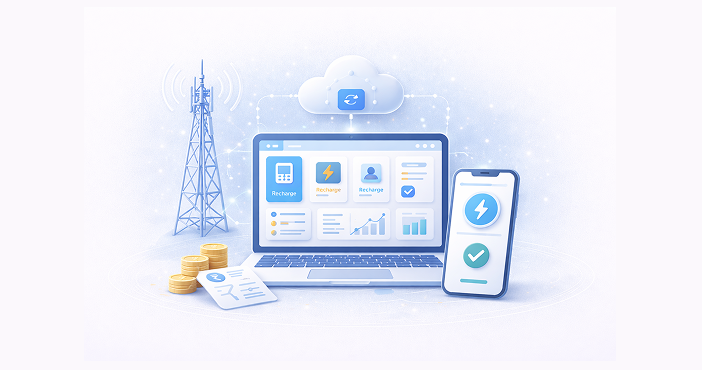
Requests entered OpenCart, payment gateways confirmed transactions, telecom APIs activated services, and MySQL stored transaction status and recharge history.


The Client
Telecom recharge services were delivered through a digital service system. However, recharge processing, payment validation, and telecom provider coordination relied on manual workflows. This resulted in slower operations, higher resource dependency, and limited scalability.
The Challenge
Recharge requests required manual handling, which delayed service activation and increased dependency on support teams. Limited payment gateway integration led to transaction failures and reduced completion rates.
Payment validation and recharge execution were not connected automatically, creating gaps in the workflow. Support teams had to manually verify transactions and coordinate with telecom providers. As recharge volume increased, these manual processes became inefficient and difficult to manage.
The primary challenges were:
- Manual recharge processing delays
- Limited payment gateway support
- No centralized recharge visibility
- High dependency on support teams
Why Bobcares
Workflow automation, payment integration, and API-driven system expertise were essential to streamline recharge operations. Strong backend integration and automation capabilities enabled a faster, more reliable, and scalable recharge process.
The solution enabled the following capabilities:
- Telecom API integration for real-time activation
- Automated payment validation workflow
- Centralized monitoring and reporting dashboard
- Reliable backend workflow for scalable growth
This helped the business transition from manual recharge handling to a faster and fully automated operational system.
What We Delivered
We developed a fully automated telecom recharge platform that streamlined requests, payments, and service activation.
- Integrated telecom provider APIs for instant recharge execution
- Connected payment gateways with automated validation workflows
- Built a centralized admin dashboard for recharge monitoring
- Created backend workflows that eliminated manual intervention
- Organized recharge and transaction data in MySQL for easy tracking
- Enabled real-time recharge processing and reporting
This solution improved speed, reliability, and operational efficiency across recharge operations.
The Results
Metric |
Before |
After |
| Transaction success rate | Lower completion rate | 40 percent increase |
| User retention | Moderate | 30 percent increase |
| Operational cost | Higher operational overhead | 25 percent reduction |
| Recharge processing speed | Delayed | Real-time execution |
| Manual effort | High dependency on support teams | Eliminated |
The Business Impact
- Automated recharge workflows improved service delivery speed.
- Reduced operational workload and manual dependency.
- Improved transaction reliability and completion rates.
- Enhanced customer satisfaction and retention.
- Enabled scalable growth without increasing support staff.
Conclusion
Automation of recharge processing and payment validation improved transaction reliability, reduced operational effort, and enabled real-time service execution. The platform now supports higher transaction volumes efficiently while ensuring consistent performance and scalable growth. This case study demonstrates how targeted workflow automation and API integration can strengthen operational stability and support long-term telecom service expansion.

