


Hybrid Cloud Migration: Modernizing 400+ Legacy Dedicated Servers Without Downtime
The client ran a SaaS and e-commerce hosting platform on more than 400 dedicated servers, spread across several hardware generations with no virtualization layer underneath. Every time traffic grew past current capacity, the only option was buying more hardware. That lag between demand and provisioning started showing up in uptime numbers, and older nodes still running legacy OS versions left compliance and security gaps that needed closing.
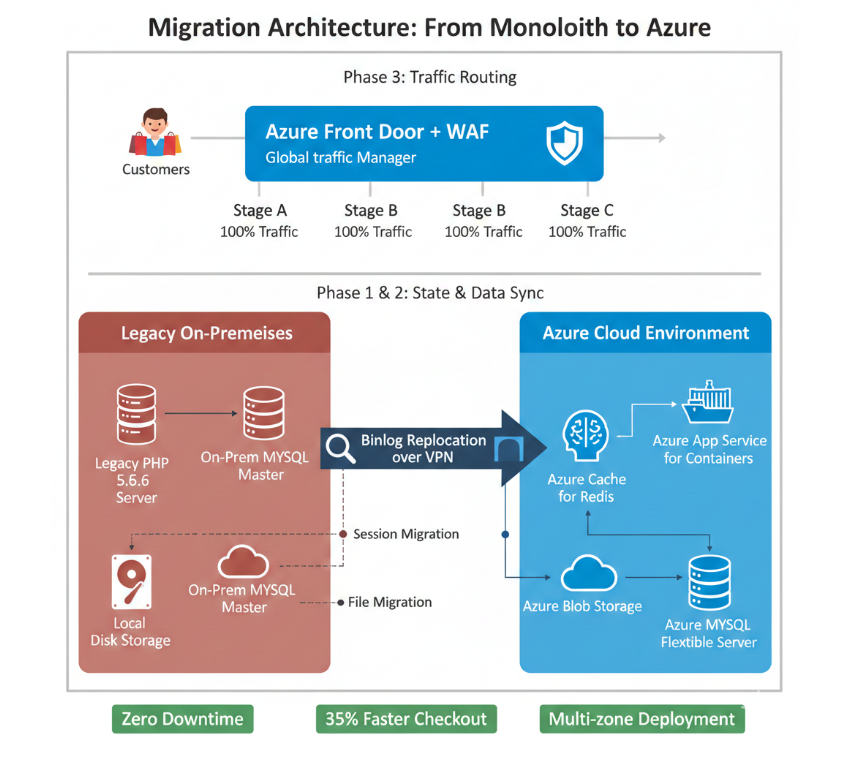
Bobcares split the environment into two tiers instead of moving everything at once. Latency-sensitive workloads stayed on dedicated servers. Everything that could scale horizontally moved to public cloud compute, with a site-to-site VPN and dedicated interconnect linking the two sides.
Business Challenge
The client needed to modernize a fragmented, multi-generation server estate while staying compliant with ISO and GDPR across a multi-tenant customer base. Scaling also needed to happen without a hardware order sitting between demand and capacity.
Technology Used
Blueprint
Stateless application tiers went to autoscaling cloud compute, and latency-sensitive workloads stayed on dedicated hardware, with live database replication holding both environments in sync through the transition. Cutover happened in low-traffic windows using phased DNS switching, so the change didn't require taking anything offline.


Key Outcomes
- Improved application performance
- Higher uptime after adding cloud load balancing and failover
- Faster provisioning through automated cloud workflows
- Lower operational overhead
- Faster disaster recovery cutover
- Stronger security posture from automated patching and cloud IAM
Customer Profile
The Challenges
- Aging dedicated servers were degrading application performance
- Scaling ran through manual hardware procurement, with no built-in elasticity
- Infrastructure was fragmented across datacenters, adding to operational overhead
- Single-point failures created a high risk of outages
- Disaster recovery had no cross-region architecture
- Legacy OS versions and end-of-life software left security and compliance gaps open
- Any migration carried a risk of downtime that could affect revenue
Why Bobcares?
- On-premise servers stayed in place for latency-sensitive workloads
- Public cloud compute absorbed variable demand without new hardware purchases
- Live database replication meant cutover didn’t require taking systems offline
- Infrastructure as code made the new environment reproducible and auditable
- Multi-region object storage gave the client cross-region disaster recovery for the first time
What We Delivered
- Mapped dependencies, databases, storage, firewalls, and network flows
- Benchmarked performance to decide which workloads stayed on-prem versus moved to cloud
- Multi-tier hybrid architecture, designed around that audit
- Site-to-site VPN and dedicated interconnect linking the two environments
- Cloud VPCs, subnets, security groups, and NACLs, built out for the cloud side
- Autoscaling compute clusters for stateless applications
- Containerization for applications where lift-and-shift alone wasn’t enough
- Live database sync using Percona XtraBackup and Cloud SQL replication
- File sync from on-prem to cloud through rsync and S3 sync
- Traffic cutover during low-traffic windows, using phased DNS switching
- Terraform and Ansible for infrastructure as code
- Cloud load balancers with automated failover
- CI/CD pipelines, centralized across environments
- Backup and disaster recovery, redesigned around multi-region object storage
The Results
Application Performance
- Before: aging dedicated hardware was degrading performance as demand grew
- After: 65% improvement in application performance
Availability
- Before: single-point failures put uptime SLAs at risk
- After: 99.99% uptime after cloud load balancing and failover went in
Provisioning
- Before: scaling depended on manual hardware procurement
- After: 70% faster provisioning through automated cloud workflows
Operational Overhead
- Before: fragmented infrastructure across datacenters added to daily operational work
- After: 40% reduction in operational overhead
Disaster Recovery
- Before: DR cutover could take up to 4 hours, with no cross-region architecture
- After: DR cutover time fell to under 10 minutes
Security
- Before: legacy OS versions and end-of-life software left compliance and security exposure
- After: cloud-native IAM and automated patching addressed both
System Architecture
The Business Impact
- Hardware lifecycle and procurement timelines no longer dictate scaling speed
- Better SLA reliability from higher uptime and faster failover
- Lower disaster recovery risk, with cutover time down from hours to minutes
- Closed compliance gaps tied to legacy software under ISO and GDPR
- Onboarding new customers no longer triggers additional hardware procurement
- 400+ servers and 100+ applications modernized without customer-facing downtime
Ongoing Collaboration
work with the client on:
- Monitor cloud spend and adjust autoscaling thresholds
- Revisit workload placement as latency requirements change
- Test disaster recovery failover on a set schedule
- Track patching and compliance status across on-prem and cloud
- Extend containerization to the remaining lift-and-shift workloads
Conclusion
The migration replaced a fragmented, hardware-bound estate with a hybrid architecture that keeps latency-sensitive workloads separate from elastic application tiers, linked by VPN and dedicated interconnect rather than run as two disconnected systems.
MySQL and MariaDB data never left the client’s direct control. Cloud infrastructure took over the scaling and failover work that manual provisioning used to handle by hand, and the client can now absorb customer growth without going back to the hardware procurement cycle that caused the original bottleneck.

