


Zero-Downtime Application Releases Using Blue/Green Deployment on AWS
Business Challenge
Deployments caused brief outages, slow rollbacks, and inconsistent releases due to manual processes and limited monitoring.
Technology Used
Blueprint
Bobcares introduced Blue/Green deployments on AWS, enabling zero-downtime releases, faster rollbacks, and reliable updates through automation and real-time monitoring.


The Client
The Challenge
• Rollback procedures depended on manual redeployment, extending recovery time.
• Differences between environments caused unpredictable release behavior.
• Partial updates introduced API and schema mismatches.
• Monitoring and validation relied heavily on human intervention.
Why Bobcares
Bobcares brought experience in:
• Designing zero-downtime deployment workflows on AWS
• Building automated CI/CD pipelines with controlled traffic shifting
• Implementing fast, reliable rollback mechanisms
• Integrating monitoring and alerting to support safe releases
• Managing database compatibility during parallel environment deployments
What We Delivered
Key Components and Implementation Highlights
Deployment Model & Traffic Switching
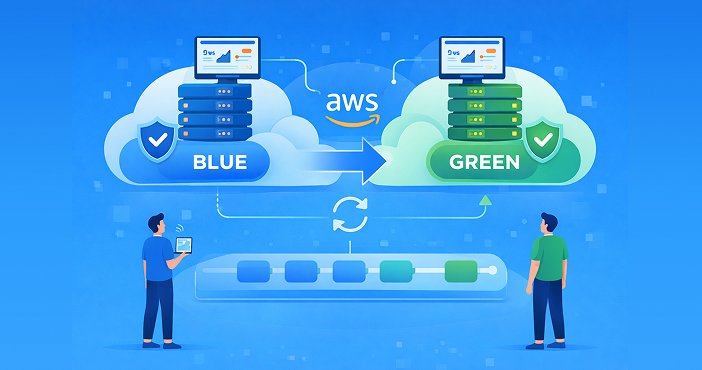
Two identical environments were maintained. One served live traffic, while the other hosted new releases for validation. Traffic was switched using AWS load balancers only after successful verification.
Compute & Scaling Layer
Application workloads ran on Amazon EC2 or ECS, backed by Auto Scaling Groups to maintain capacity and fault tolerance across both environments.
CI/CD Automation
AWS CodePipeline coordinated build, test, and deployment stages. CodeBuild handled compilation and testing, while CodeDeploy managed environment updates and traffic transitions.
Monitoring & Rollback Controls
Amazon CloudWatch tracked latency, error rates, and resource usage. Automated alarms triggered immediate traffic reversal when anomalies appeared.
Database Handling Strategy
Both environments shared an Amazon RDS database. Schema changes followed backward-compatible practices, supported by versioned migrations and feature flags to prevent conflicts during coexistence.
Key Aspects and Modules
• Automated validation and health checks before traffic cutover.
• Gradual traffic shifting and instant rollback capability.
• Backward-compatible database migrations and controlled cleanup.
• Continuous monitoring with automated failure response.
The Results
Key Metric |
Before |
After Implementation |
| Deployment Downtime | 30–60 seconds | 0 seconds |
| Rollback Time | 15 minutes (manual) | Under 2 minutes |
| Deployment Frequency | Once per week | 3–5 times per week |
| SLA Uptime | 99.9% | 99.99% |
| Customer Impact | Noticeable outages | None reported |
The Business Impact
- Releases now occur without customer-visible disruption.
- Rollback speed reduced operational risk during updates.
- Automation improved release confidence and developer productivity.
- Higher deployment frequency supported faster feature delivery.
- SLA compliance strengthened trust and reliability.
Technologies Used
- Amazon EC2 / ECS
- Elastic Load Balancer
- Auto Scaling Groups
- AWS CodePipeline
- AWS CodeBuild
- AWS CodeDeploy
- Amazon CloudWatch
- Amazon RDS
- Amazon Route 53

