


Build a reliable load balancing setup with HAProxy, Nginx, and Cloudflare. Our Nginx Support team is here to help.
Modern web applications are expected to be fast, reliable, and always available, regardless of traffic spikes or geographic location. A load balancer plays a crucial role in achieving this by intelligently distributing incoming requests across multiple backend servers. Without load balancing, a single server can quickly become a bottleneck or a single point of failure.
This article explains how load balancers work at a technical level and demonstrates real-world implementations using HAProxy, Nginx, and Cloudflare. Instead of focusing on theory alone, we walk through practical configurations that are commonly used in production environments.
An Overview
Understanding Load Balancing
Load balancing is the process of spreading client requests across a pool of servers to improve performance, availability, and fault tolerance. The load balancer sits in front of application servers and acts as a reverse proxy, receiving client traffic and forwarding it to a suitable backend server.
In real-world systems, load balancing improves response times by preventing any single server from being overloaded. It also enables horizontal scaling, where additional servers can be added to the pool without changing the application architecture. Most importantly, load balancers continuously monitor backend health and automatically stop sending traffic to failed servers.
Load Balancing Layers and Algorithms
Load balancers typically operate at Layer 4 or Layer 7 of the OSI model. Layer 4 load balancing works at the transport level and routes traffic based on IP addresses and ports, making it extremely fast and efficient. Layer 7 load balancing operates at the application level and understands HTTP requests, URLs, headers, and cookies, allowing more intelligent routing decisions.
Traffic distribution is controlled using algorithms such as round robin, least connections, IP hash, and weighted round robin. In production systems, least-connections and weighted algorithms are commonly used to account for differences in server capacity and runtime load.
HAProxy: High-Performance Load Balancing in Practice
HAProxy is widely used in high-throughput environments due to its efficiency and precise traffic control. It supports both Layer 4 and Layer 7 load balancing and is commonly deployed in front of APIs, microservices, and enterprise applications.
In a typical production environment, HAProxy sits in front of multiple web servers and distributes HTTP traffic using the least-connections algorithm. Health checks ensure that only healthy servers receive traffic, while session persistence can be enabled for applications that require it.
Real-World HAProxy Configuration
Below is a production-style HAProxy configuration that load balances traffic across three backend web servers while performing HTTP health checks and maintaining session stickiness using cookies.
global

log /dev/log local0

maxconn 50000

user haproxy

group haproxy

daemon

defaults

log     global

mode    http

option  httplog

option  dontlognull

timeout connect 5s

timeout client  50s

timeout server  50s

frontend http_front

bind *:80

default_backend web_servers

backend web_servers

balance leastconn

cookie SERVERID insert indirect nocache

option httpchk GET /health

server web1 10.0.0.11:80 check cookie web1

server web2 10.0.0.12:80 check cookie web2

server web3 10.0.0.13:80 check cookie web3
In this setup, HAProxy listens on port 80 and forwards requests to the backend server with the fewest active connections. Each server exposes a /health endpoint that HAProxy checks periodically. If a server fails the health check, it is automatically removed from rotation until it recovers. Session cookies ensure that returning users are consistently routed to the same backend when required.
Nginx: Application-Aware Load Balancing
Nginx is commonly used as a web server and reverse proxy, but it is also a reliable Layer 7 load balancer. It is especially popular for web applications, CMS platforms, and Node.js or PHP-based services.
In production environments, Nginx often performs SSL termination, header forwarding, request buffering, and load balancing simultaneously. This makes it a flexible choice for frontend traffic management.
Real-World Nginx Configuration
The following example demonstrates how Nginx load balances traffic across multiple application servers while providing automatic failover.
upstream app_backend {

least_conn;

server 10.0.0.21:3000 max_fails=3 fail_timeout=30s;

server 10.0.0.22:3000 max_fails=3 fail_timeout=30s;

server 10.0.0.23:3000 backup;

}

server {

listen 80;

server_name example.com;

location / {

proxy_pass http://app_backend;

proxy_set_header Host $host;

proxy_set_header X-Real-IP $remote_addr;

proxy_set_header X-Forwarded-For $proxy_add_x_forwarded_for;

proxy_http_version 1.1;

proxy_set_header Connection "";

}

}
Here, Nginx distributes traffic using the least-connections algorithm. Two primary servers handle normal traffic, while a third backup server is used only if the primary servers become unavailable. Client IP addresses are preserved using forwarded headers, which is critical for logging, rate limiting, and security analysis.
Cloudflare: Global Load Balancing at the Edge
Cloudflare provides load balancing as a managed, cloud-based service that operates on a global Anycast network. Unlike self-hosted load balancers, Cloudflare routes traffic through its worldwide edge locations, ensuring users are directed to the nearest and healthiest origin server.
Cloudflare load balancing is often used in multi-region deployments where availability, latency optimization, and security are critical. Health checks, automatic failover, DDoS protection, and TLS management are built into the platform.
Real-World Cloudflare Load Balancing Example
A common production setup involves multiple origin pools located in different regions. For example, an application may use one pool in India and another in Europe. Cloudflare continuously checks each origin using HTTPS health probes and automatically routes traffic based on geographic proximity and server health.
When a user makes a request, DNS resolution is handled by Cloudflare’s Anycast network. The request reaches the nearest Cloudflare edge, which then forwards it to the optimal backend origin. If an entire region becomes unavailable, traffic is instantly failed over to the next healthy pool without manual intervention.
A Common Real-World Architecture
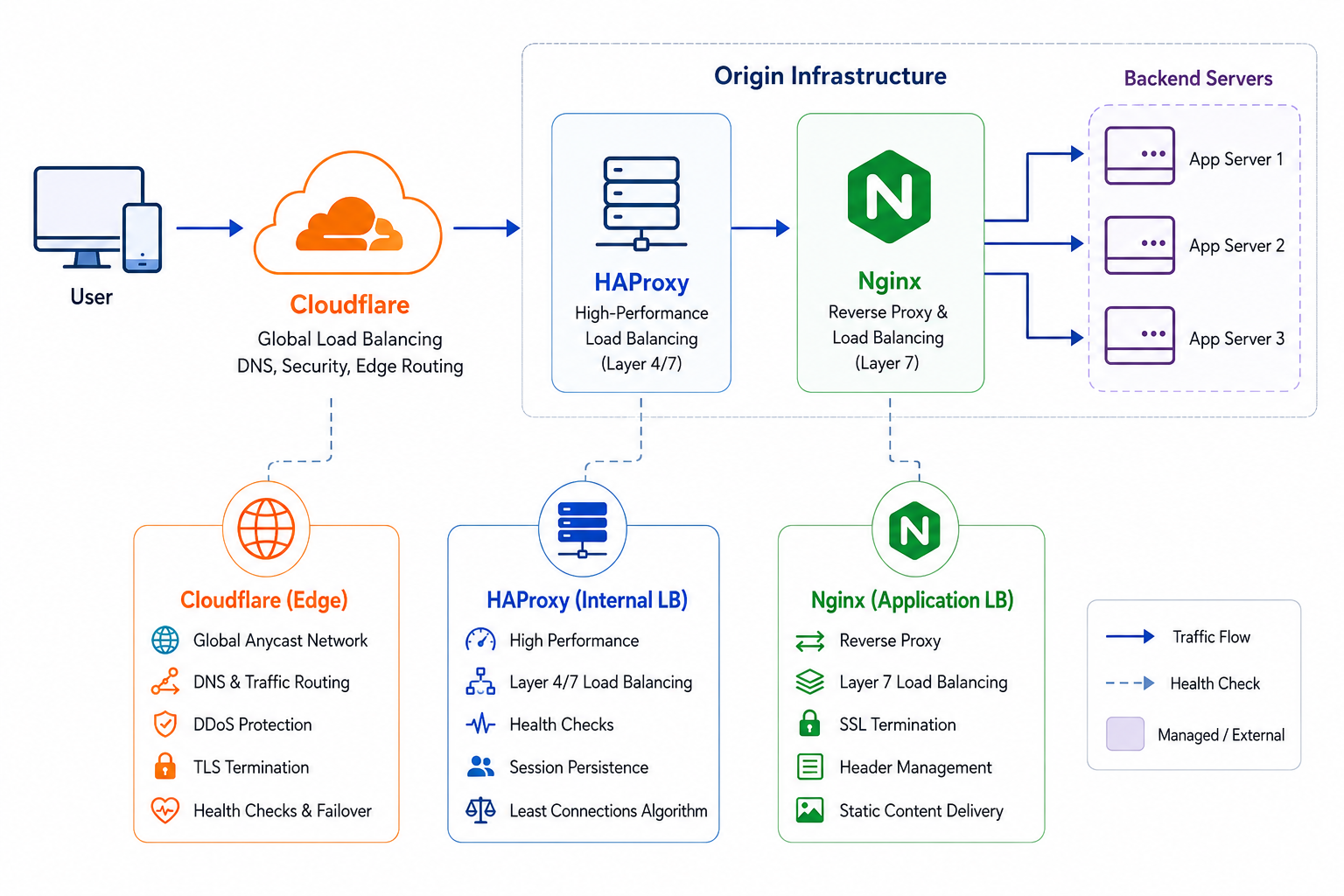
In many production systems, these technologies are combined rather than used in isolation. A common architecture places Cloudflare at the edge for DNS, security, and global routing. Traffic is then forwarded to an internal HAProxy layer for high-performance load balancing, followed by Nginx instances that handle application routing and static content delivery.
This layered approach provides global resilience, strong security, and fine-grained traffic control while keeping operational complexity manageable.
Conclusion
Load balancers are fundamental to building scalable and resilient systems. HAProxy excels in high-performance environments that demand precise traffic control. Nginx offers flexibility and simplicity for web-facing applications, while Cloudflare delivers global scale, security, and managed failover.
By understanding how these load balancers work and how they are configured in real-world environments, engineers can design architectures that handle growth, failures, and performance challenges with confidence.

