


Implement Advanced Error Handling and Dead Letter Channel in Apache Camel for reliability. Our Apache Support team is ready to assist you.
Mastering Advanced Error Handling with Dead Letter Channel in Apache Camel
Error handling is one of the most critical aspects of building robust and reliable integration solutions using Apache Camel. With multiple data sources and complex routing logic, handling errors efficiently ensures smooth message flow, protects data integrity, and prevents system failures. This article explores key techniques and best practices to manage errors in Apache Camel effectively, using Java-based implementations.
Understanding the Importance of Error Handling
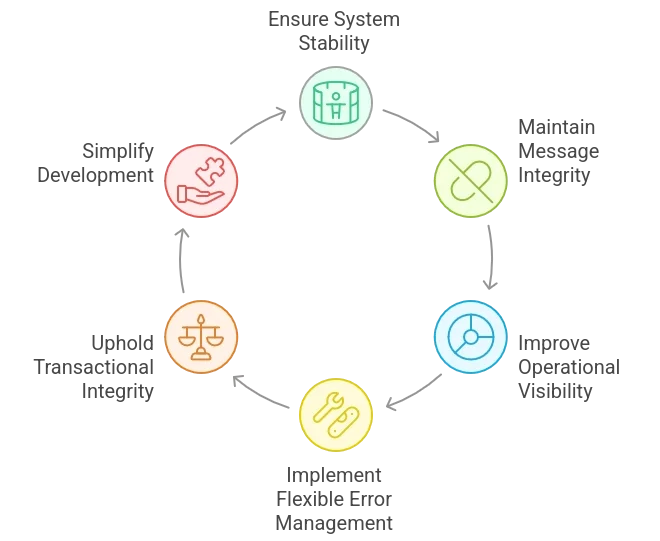
Error handling in integration systems goes beyond fixing bugs. It ensures system stability, maintains message integrity, and improves operational visibility. For environments running on Debian servers, commands like Apache2 graceful restart debian allow administrators to reload Apache configurations safely during error-handling tests or route adjustments, ensuring minimal service disruption.
Effective error handling provides:
- System resilience and stability: External services can fail unexpectedly. Handling these errors prevents disruptions in message processing.
- Recovery and message integrity: Redelivery strategies and dead-letter queues ensure that no message is lost due to temporary failures.
- Operational visibility: Clear logging and notifications give insight into failures, helping teams troubleshoot issues quickly.
- Flexible error management: Camel provides multiple strategies like errorHandler(), onException(), and try-catch blocks, letting you tailor responses to different error types.
- Transactional integrity: In transactional routes, errors trigger rollbacks to keep data consistent.
- Simplified development: Built-in error-handling features reduce complexity and improve maintainability.
Understanding these benefits lays the foundation for implementing robust error-handling strategies in your integration routes.
Dead Letter Channel and Smart Retry Strategies
A Dead Letter Channel (DLC) is a dedicated route that stores messages which fail to process. It isolates problematic messages so that they do not block other operations, allowing developers to inspect and reprocess them later.
Alongside dead-letter queues, smart retry strategies provide intelligent ways to retry failed operations. Unlike fixed retries, these strategies adjust timing and frequency based on system conditions, improving success rates without overloading services.
Dead Letter Channel vs. Smart Retry:
- Retry handles temporary failures, such as a network hiccup or brief service unavailability.
- Dead-lettering manages persistent failures when retries have been exhausted.
Key smart retry techniques include:
- Exponential backoff with jitter: Retry delays increase progressively, preventing system overload and allowing services to recover.
- Circuit breaker pattern: Protects failing services by limiting requests in open or half-open states until recovery.
- AI-driven intelligent retries: Uses historical and contextual data to optimize retry timing for maximum success, such as payment retries based on user behavior or time zones.
Best practices for managing Dead Letter Queues:
- Monitor DLQs with alerts for sudden spikes in failures.
- Enrich messages with metadata like exception type, failure reason, and retry count.
- Establish processes to reprocess or purge messages as appropriate.
- Consider separate DLQs for complex systems to simplify troubleshooting.
- Implement retention and redrive policies for controlled message handling.
Custom Processors and Exception-Specific Handling
Apache Camel allows developers to build custom processors that manage errors in a targeted manner. These processors can intercept messages before or after standard error handling, enriching logs, sending notifications, or transforming exception types.
Example uses of custom processors:
- Handling corrupted data records gracefully without halting the entire route.
- Logging or notifying administrators about failures with enriched context.
Exception-specific handling provides granular control by responding differently to various types of exceptions. For instance, a file-not-found error could trigger a retry using a default file, whereas a database error may reestablish a connection before retrying. Developers can create custom exception classes to include detailed contextual information, improving debugging efficiency.
Benefits of this approach:
- Faster identification and resolution of errors.
- Improved application robustness through targeted handling.
- Cleaner, more maintainable code.
- Domain-specific error handling tailored to business logic.
Global Error Handler Configuration and Delayed Redelivery
Global error handling ensures that unhandled exceptions across the system are caught and managed consistently. For applications hosting multiple websites or services, Apache virtual hosts allow separation of configurations and targeted error handling for each domain, complementing Camel’s global error management strategies.
Delayed redelivery complements global handling by retrying failed messages after a configurable delay, rather than immediately. This approach addresses transient issues, prevents downstream overload, and allows the system to recover before the next attempt.
In practice, global error handlers and delayed redelivery often work together. An unhandled exception triggers the global handler, which may then initiate a delayed retry, increasing the likelihood of successful message processing while maintaining stability.
Logging, Notifications, and Unit Testing for Reliable Integrations
Logging is the backbone of error visibility. Structured logs, enriched with contextual information, allow teams to analyze issues quickly. Logs should be centralized, categorized by severity, and avoid sensitive information.
Notifications transform logs into proactive alerts. Critical failures should trigger messages via email, Slack, or PagerDuty, including details such as correlation IDs, affected services, and links to relevant logs. Effective alerting prevents small issues from escalating into major incidents.
Unit testing ensures that error-handling logic works as intended. Key practices include:
- Isolating dependencies with mocks and stubs.
- Testing both normal and edge cases.
- Automating tests in CI/CD pipelines to catch issues early.
Combining unit tests with integration tests forms a robust strategy. Unit tests verify individual components, while integration tests validate interactions across modules, ensuring overall system reliability. Following this testing pyramid ensures faster feedback, higher coverage, and reduced production risks.
[Need assistance with a different issue? Our team is available 24/7.]
Conclusion
Advanced Error Handling & Dead Letter Channel in Apache Camel ensure reliable message processing, maintain data integrity, and improve system stability, making integrations more resilient and robust.
In brief, our Support Experts demonstrated how to fix the “554 5.7.1 : Relay access denied” error.

