


When the product is launched soon, it might feel like a huge success. Subsequently, the businesses reach customers sooner with greater feedback. However, this won’t last longer. New features take longer to build, releases become stressful, and development costs keep growing. In many cases, the real problem is not the new feature. It is the software architecture that was built in the early stages.
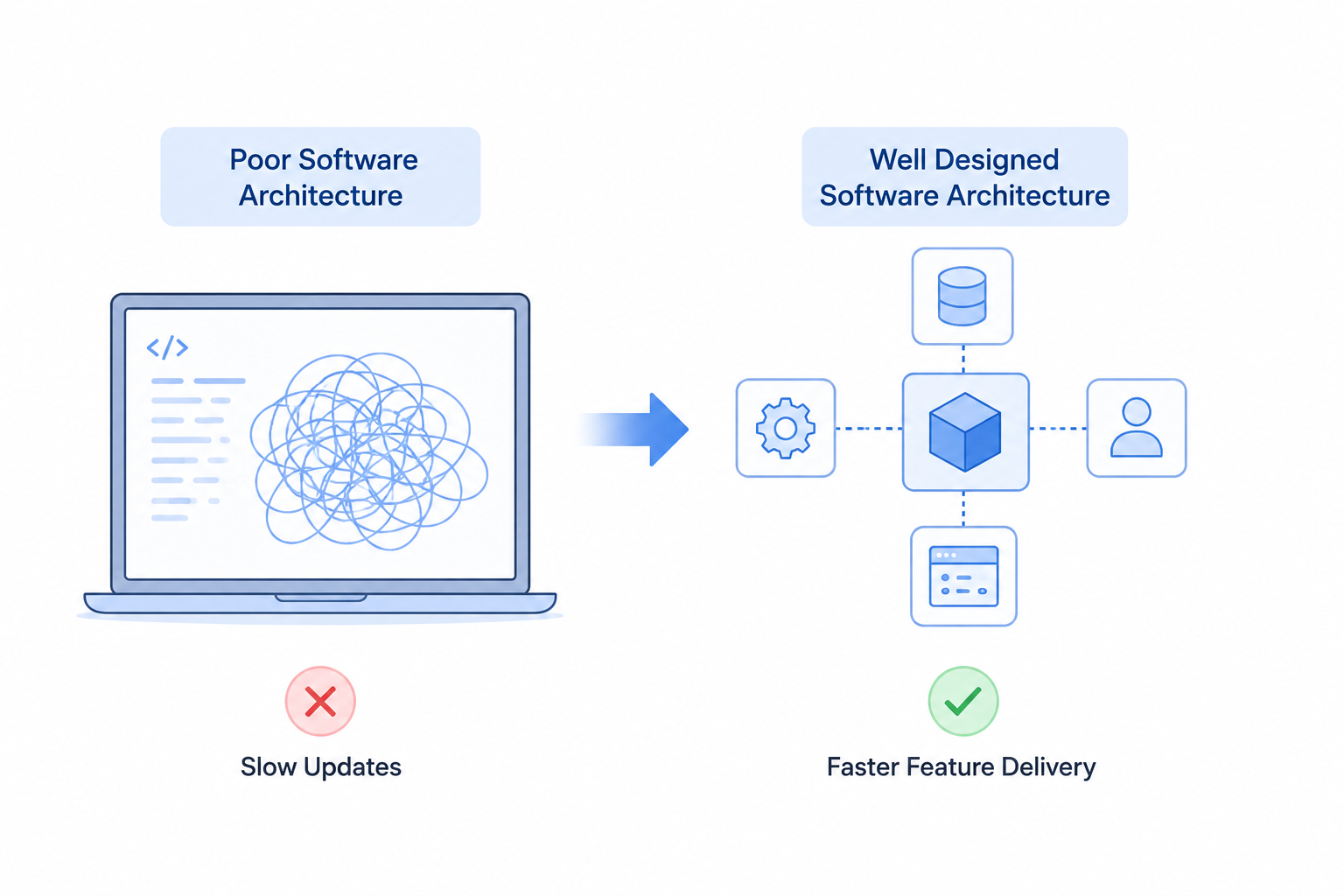
Why Every New Feature Becomes a Challenge
Many products are built under tight deadlines. To launch faster, development teams sometimes take shortcuts. This makes the early steps easier; at the same time, it makes future updates much harder. Therefore, negligible changes take more time, cost more money, and create more risk.
Small Features Take Too Long
Updates, such as a new dashboard filter or a small workflow change seems like a quick task. Nevertheless, the development team finds that the code is closely connected, which means one part results in affecting several others. Therefore, the task which is supposed to take a few days takes a few weeks.
Every Release Feels Risky
Weak software architecture could make every release more difficult. So, even a small change in one area can cause problems somewhere else.
Thus, developing team spend more time on testing and checking the application before every release. This affects development and delays new features.
Quick Fixes Keep Adding Up
Many products include temporary fixes to meet deadlines. This will eventually become part of the main application.
Old code has to be constantly modified as more features are added. The application becomes harder to understand and maintain. This is called technical debt. It increases development time and raises maintenance costs.
Your Business Slows Down
Customer needs change quickly. Your business needs to add new features just as fast. However, poor software architecture makes every update more difficult.
Developers start spending more time fixing old problems instead of building new features. Alternatively, competitors continue improving their products and moving faster.
Build software that grows with your business.

Build for the Future, Not Only for Today
Even though launching fast is important, building software that can grow with your business is even more important. Implementing a strong software architecture facilitates your team to add features faster and minimize future problems.
A good architecture should support three things:
Modularity
Break the application into smaller parts to help developers to update one area without affecting the rest of the system.
Scalability
Building the application allows it to handle more users and more work as your business grows. This eliminates the need for major changes later.
Maintainability
The code should be clean and well organized to make it easier for developers to understand the application, fix issues, and add new features.
Conclusion
If every new feature takes longer than expected, your software may need more than another quick fix. The real issue could be the way the application was built.
A software architecture review helps developers identify technical debt, improve your application’s structure, and remove unnecessary complexity. Therefore, your team will be able to build new features faster, spend less time fixing old problems, and minimze development risks.

