


Understand cloud cost optimization for Kubernetes deployments and regain control over cluster spending as workloads scale. See how our Cost Optimization Services help maintain cost visibility.
Kubernetes lets you scale applications quickly, but that freedom can increase cloud spending if you don’t manage resources carefully. The goal isn’t to cut spending blindly, but to understand where money goes and make better decisions.
This includes improving pod scheduling, tuning autoscaling behavior, managing storage allocation, and controlling network usage.
Although Kubernetes is open source, running it still costs money. Oversized nodes, idle workloads, and unused storage often push costs higher without improving performance. A clear optimization approach helps teams use Kubernetes effectively without paying for resources they don’t need.
Overview
Why Kubernetes Cost Reduction Matters
Kubernetes spending directly affects business health. When resource usage grows out of control, margins shrink and planning gets harder.
CFOs need clear visibility and predictable cloud spend.
DevOps teams need to move fast without unexpected cost spikes.
Cost management has become a core part of operating Kubernetes.
Signs Your Kubernetes Costs Are Out of Control
Several warning signs point to the need for optimization:
- Cloud bills increase faster than user or traffic growth.
- Average cluster usage stays below 50 percent.
- CPU and memory requests are based on guesses or defaults.
- Autoscaling behaves unpredictably.
- Cost tracking relies on delayed reports or spreadsheets.
- Budget concerns slow down product decisions.
If it is difficult to explain why your Kubernetes bill changed this month, it is time to act. For a deeper look at reducing Kubernetes expenses, our guide on mastering Kubernetes cost optimization for cloud savings outlines practical strategies to improve resource efficiency and control cloud spending.
Explore Our Cost Optimization Services

What Drives Kubernetes Costs
Although Kubernetes itself is free, every component around it costs money. Over-provisioned clusters and idle nodes keep unused capacity running, while underutilized or misconfigured pods reserve CPU and memory they never consume.
Cluster sprawl adds duplicated infrastructure across projects and environments, and inefficient scheduling leaves nodes partially idle even as you add new ones. On top of that, using instance types that do not match workload needs further drives up spending without improving results.
Common Reasons for Kubernetes Overspending
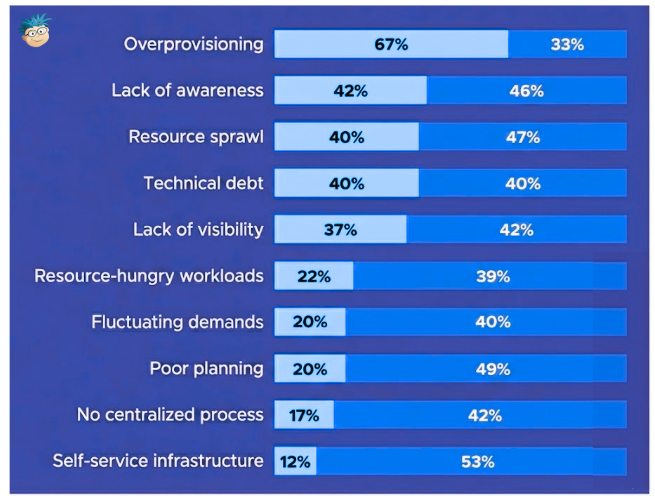
Industry surveys consistently point to three recurring causes of rising Kubernetes costs: over-provisioning that leaves large portions of resources unused, unclear ownership of cloud spending, and unused resources combined with growing technical debt. Addressing these issues requires better cost visibility, clear accountability, and regular cleanup to prevent waste from building up over time.
Improve Kubernetes Cost Visibility
Understanding total cluster spending is only the starting point. Businesses also need to know which workloads, namespaces, applications, or environments drive that spending.
Start by allocating infrastructure costs to the resources that consume them. Labels and tags can help associate workloads with applications, environments, projects, or cost centers. This makes it easier to identify which workloads are consuming the most resources and where unusual spending is coming from.
Cost visibility should also include CPU, memory, storage, and network usage. Comparing these costs against actual resource consumption can reveal workloads that are consistently overprovisioned or generating unnecessary infrastructure expenses.
Regular cost reports can then give application owners a clearer view of their resource usage. This makes cost management part of ongoing Kubernetes operations rather than something reviewed only after the cloud bill increases.
Managing Kubernetes Costs in Reality
Kubernetes cost issues rarely appear out of nowhere. They usually grow from everyday decisions such as requesting more resources than applications actually use, scaling clusters too aggressively, or leaving unused components running. Because Kubernetes environments change constantly, with pods appearing and disappearing and nodes scaling throughout the day, tracking spending becomes difficult without looking at cost and performance together.
The most effective way to stay in control is to base decisions on real usage, not assumptions. Clusters should expand and contract with actual demand. Pod resource requests should reflect how applications behave in production, not worst-case estimates. Autoscaling needs careful tuning so it responds to true workload pressure instead of inflated requests. Regularly cleaning up unused namespaces, volumes, and services helps prevent forgotten resources from quietly adding to the bill. For workloads that can handle interruptions, using lower-cost capacity options can further reduce spend without affecting reliability.
When resource ownership is unclear, unused storage and abandoned services tend to linger. Over time, these small inefficiencies add up. Clear visibility, regular review, and shared responsibility are what keep Kubernetes costs predictable as environments evolve. Organizations operating across multiple environments can also benefit from adopting smart cost optimization in hybrid cloud, which helps maintain performance while keeping infrastructure costs predictable.
Conclusion
This transformation proves that when data, AI, and teamwork come together, customer retention becomes proactive and predictable. The company now understands its customers earlier, acts faster, and builds stronger relationships. At Bobcares, we help businesses turn insights into action through intelligent systems.

