


An Overview
- What Is an AI Agent?
- How is an AI Agent Different from a Chatbot?
- What Are Collaborative AI Agents?
- Practical Example: David’s Restaurant
- How to Build Collaborative AI Agents
- Future Applications of Collaborative AI Agents
AI is used in business to automate, enhance decision-making, and minimize manual workload. For complex workflows, multiple AI systems may be needed to collaborate. For more complex workflows, multiple AI systems might need to collaborate. It is here that collaborative AI agents come into play.
Collaborative AI agents are groups of specialized AI agents that can communicate, share information, and coordinate their actions to accomplish a shared objective. You will understand how they operate, how they are better than individual AI agents, and how businesses can create them with a practical, real-world example.
What Is an AI Agent
An AI agent is a self-contained software program that can carry out a particular task with little human involvement. AI agents can comprehend information, make decisions, plan multiple actions, and execute tasks to reach a specific goal, whereas traditional AI chatbots can only react to the user’s prompts.
How is an AI Agent Different from a Chatbot?
The main function of a chatbot is to answer questions or respond to requests. An AI agent can independently perform various actions.
For instance, an AI agent can select the optimal route, navigate around traffic, plan for stops when necessary, and make the trip without much user input.
A Real World Example
Imagine that David is the owner of a very busy restaurant. He is managing reservations on various booking platforms via an AI agent. The agent verifies table availability, confirms reservations, sends confirmation emails, and sets up reminders automatically. It also gets to know customers over time, for example, by assigning quieter tables for anniversary bookings.
Build Smarter AI Workflows.

This eliminates a few hours of manual work daily and eliminates booking errors. The agent can only deal with reservation management, however. Other tasks like inventory planning, staff scheduling, profitability analysis still need to be addressed separately. This constraint is one of the reasons why businesses tend to transition from a single AI agent to collaborative AI agents.
What Are Collaborative AI Agents
Collaborative AI agents are a set of AI agents that can communicate, coordinate, and collaborate to solve complex problems. Each agent is assigned a particular role and set of responsibilities, rather than a single agent being responsible for an entire workflow. They can share information, make decisions and accomplish tasks more efficiently than a single agent working alone.
This has several benefits:
- Specialization: Each agent is specialized in a certain task or area of expertise.
- Parallel processing: Several agents process concurrently, thus shortening the time needed to complete workflows.
- Scalability: The system can be expanded or contracted based on business needs without the need to redesign the entire system.
Unlike a single AI agent, collaborative AI agents continuously exchange information. This shared intelligence allows the entire system to adapt, improve, and respond more effectively to changing business needs.
Practical Example Davids Restaurant
David’s reservation agent is able to book reservations successfully but has some challenges in his operations. Some of his problems are frequent absenteeism, inventory loss, staff scheduling, lack of menu profitability and customer complaints about the wait time. These challenges are interrelated, so one AI agent can’t handle them all.
David introduces a team of specialized AI agents that are each responsible for a specific business function.
| AI Agent | Primary Responsibility |
|---|---|
| Reservation Intelligence Agent | Manages reservations and analyzes booking patterns. |
| No Show Predictor Agent | Identifies high-risk reservations, sends reminders, and manages the waitlist. |
| Inventory Optimizer Agent | Forecasts ingredient demand and improves inventory planning. |
| Staff Scheduler Agent | Predicts staffing needs and manages shift scheduling. |
| Menu Profitability Analyst Agent | Evaluates menu performance and identifies pricing opportunities. |
| Customer Experience Monitor Agent | Tracks service quality, identifies bottlenecks, and measures improvements. |
| Operations Coordinator Agent | Connects all agents, shares information, and coordinates decisions. |
These agents share information with each other as they work together. The trends in reservations help to forecast inventory, which affects staffing decisions; the expected demand affects operational planning, which in turn affects profitability insights. The agents are not only working alone but also helping each other to enhance the restaurant’s performance.
How to Build Collaborative AI Agents
The first step in creating collaborative AI agents is to comprehend your business processes and break them down into specific tasks. Every agent must have a clear goal, the appropriate tools and the power to communicate with other agents.
1. Define your use case
Identify the business goal, break it into smaller tasks, determine the expertise required, and list the systems or data sources each agent needs.
2. Choose a development framework
Choose a framework based on your project’s goals and technical requirements. CrewAI, LangGraph, AutoGen, and fully tailored solutions are common options for building collaborative AI systems.
3. Design specialized agents
Define each agent’s role, goal and tools. Having clear responsibilities allows agents to complete their work efficiently and assists with the workflow.
4. Create workflows
Specify the interaction and communication of agents with each other. Each task should support the next in the process, and the whole system should be a coordinated team.
5. Enable communication
Share a workspace, database, or messaging system to allow agents to share information, keep context and make decisions based on the most current information.
6. Add human oversight
Add sign-off points for decisions that have a significant impact on the business, such as price changes or unusual stock orders.
7. Test and optimize
The system is tested across different scenarios, optimize agent behavior, improve communication, and monitor business results after deployment to continually enhance performance.
Future Applications of Collaborative AI Agents
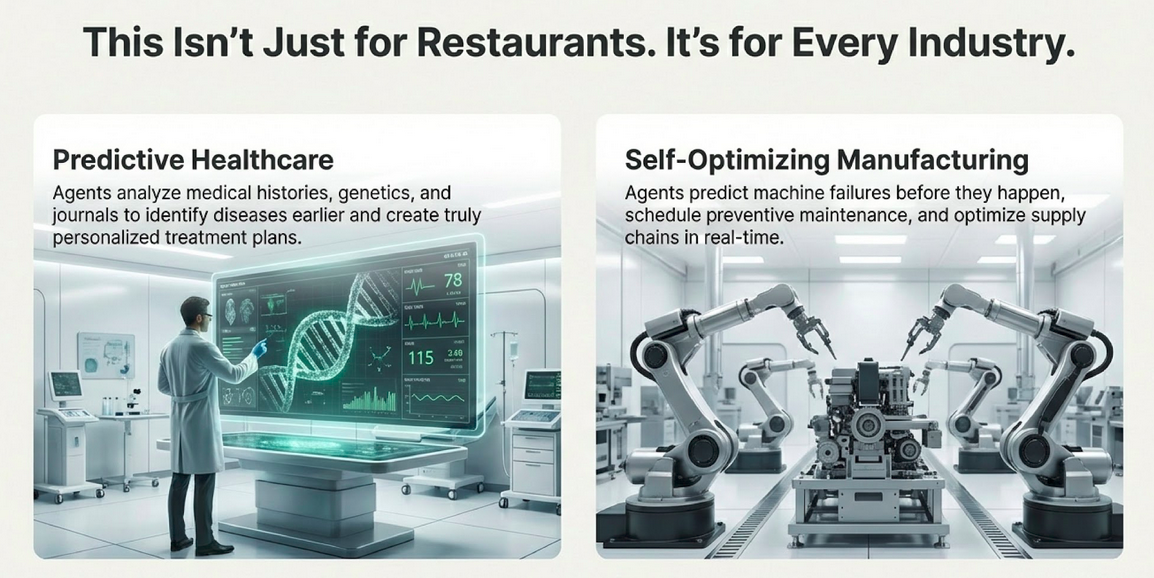
Collaborative AI agents have applications beyond a single business function. As organizations manage larger volumes of data and more connected workflows, teams of specialized AI agents can help improve decision-making and operational efficiency across different industries.
Healthcare
In the healthcare sector, AI agents can work collaboratively to analyze patient records, research, and other relevant data. Using the information from several specialized agents, healthcare professionals can make more informed decisions about possible diagnoses, suggested testing, and treatment options.
Manufacturing
Collaborative AI agents can be employed in manufacturing to keep track of equipment, forecast maintenance requirements, manage inventory, and aid production planning. AI agents can provide cross-functional information, helping to detect potential problems early and minimize disruptions in operations.
Research, Education, and Climate Science
Collaborative AI agents can also support scientific research, personalized learning, and climate studies. They can process large volumes of information, identify patterns, assist with research, adapt learning experiences, and combine insights from multiple disciplines to help solve complex problems.
Helping Businesses of Every Size
One of the biggest advantages of collaborative AI agents is that they make specialized capabilities more accessible. Instead of relying on large teams, businesses can use AI agents to support functions such as data analysis, operations, and planning. As these systems continue to learn from shared information, they become more effective over time and help businesses respond more quickly to changing requirements.
Conclusion
Collaborative AI agents enable businesses to tackle complex problems by enabling multiple specialized AI agents to collaborate. They can share information, coordinate tasks, and enhance efficiency, decision-making, and scalability of business processes.

