


An Overview
Software projects rarely fall behind because of technical challenges alone. In many cases, the project requirements keep changing in development, which makes delivery slower. Every new request, even a small one, can affect coding, testing, documentation, and release timelines. If your team is asking, “Why are features shipping late because the requirements change weekly?” The good news is that it can be managed. This article explores why changing requirements so often slow down software delivery, and offers practical suggestions for getting releases stabilized without sacrificing quality.
The Hidden Cost of “Just One More Change”
Does your product development team struggle to meet release deadlines? Do feature launch dates keep moving because requirements change every week? If so, your project is likely dealing with requirements churn, one of the biggest causes of delayed software delivery.
Many teams experience the same pattern. A feature may reach the final stage when a new request suddenly emerges. This change might seem insignificant, but capable of causing more testing, revisions, code updates, and deployment delays. This ends up in customer and development team dissatisfaction as the project took six months instead of three months.
Frequent requirement changes may create real business challenges.
- Uncertainty and lost opportunities: A delay in release can make things difficult, including product planning, marketing campaigns, and customer onboarding integration. Subsequently, lost time and income opportunities for businesses may occur.
- Reduced software quality: Teams dealing with frequent deadline pressure will struggle to have time for testing and validation. This creates the possibility that flaws will find their way into production.
- Higher project costs: Every unplanned requirement introduces additional development, testing, and project management effort. These changes cost more over time and don’t add proportional business value.
The root cause is that when requirements change without notice, it is quite difficult to deliver predictable software.
How to Stabilize Software Delivery
The good news is that requirements churn can be managed through clear governance and disciplined planning. Development teams can protect delivery timelines, while accommodating important business needs.
The following exercises keep projects on time.
1. Freeze Requirements Before Development Begins
The challenge
Open requirements throughout development encourage continuous revisions and scope expansion.
The solution
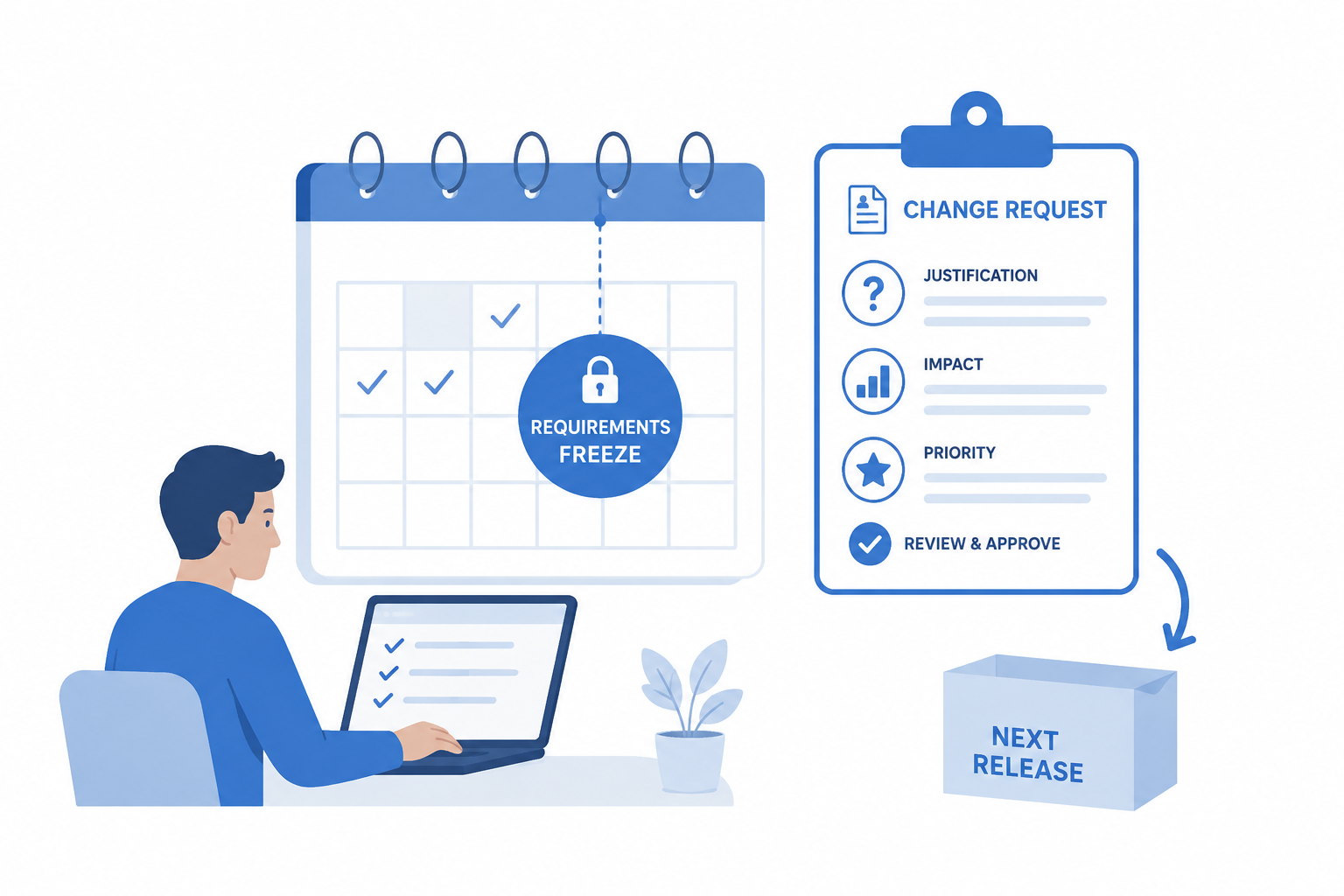
Before development begins, establish a strict requirements freeze date. If a feature is in sprint planning or in active development, place new requests, large and small, on hold until the next planned release. This can keep the current sprint on track and maintain the delivery timeline and project budget.
2. Use a Formal Change Request Process
Keep your software projects on schedule.

The challenge
Change requests often come to teams via email, chat messages or informal conversations. Requests soon interfere with planned work without adequate documentation.
The solution
All new requests must be routed via a formal Change Request (CR) process. Each request shall be clearly recorded:
- Business justification: Why is the change needed now?
- Project impact: How will it affect timelines, effort, costs, and existing commitments?
- Priority: Does it exceed other planned work?
Business critical requests should be the only requests for the current release. When a change is approved, eliminate an equivalent amount of planned work to keep the release schedule realistic.
3. Deliver Smaller Minimum Viable Products (MVPs)
The challenge
Large features naturally result in continuous additions, as stakeholders want every possible capability to be included before release.
The solution
Large initiatives break down into small and independently deployable MVPs. Smaller releases possibly minimize the effect of requirement changes and deploy users with new functionality sooner. Rather than expanding the current version, this process enables teams to acquire actual customer feedback and utilize it to design future improvements.
Build Predictable Delivery with Better Change Management
Instead of entirely avoiding changes, stable software delivery depends on controlled requirement management. This helps in keeping the project on track without compromising the quality when teams are tied to defined boundaries, release functionality in smaller increments, and access changes using a methodical procedure.
Bobcares helps organizations in implementing delivery procedures that reduce scope creep, maintain software projects in line with corporate objectives, and enhance release predictability. As a result, every release is more confident, and the development process is more dependable.
Conclusion
Requirements evolve in every software project, but they do not need to control your delivery timeline. Setting up a clear requirement freeze after a basic change request process and MVP creation can keep the project on track. This strategy effectively minimizes rework, makes stakeholders confident in the release schedule, and keeps delivery dates more predictable. This enables teams to handle new business needs without delaying every release.

