


DevSecOps for financial services are a security must-have. Learn how to embed security in development to reduce risk and meet compliance demands. Partner with our DevOps Support Service to embed security into development and reduce risk at every stage.
Financial institutions today are expected to deliver secure digital experiences while releasing new features faster than ever. Mobile banking, fintech platforms, open APIs, and AI-driven services have reshaped customer expectations, but they have also expanded the threat landscape. Security is no longer just an IT priority. It directly affects trust, revenue, and long-term business stability.
DevSecOps brings development, security, and operations together under a shared model where protection is built into every stage of the software development lifecycle (SDLC). Instead of slowing innovation, this approach allows organizations to move quickly while maintaining control over risk, compliance, and sensitive data.
What Is DevSecOps?
DevSecOps is the practice of embedding security into the entire software development process through close collaboration between development, security, and operations teams. Security checks begin early rather than appearing at the end of development. Teams can identify vulnerabilities sooner, resolve issues before they grow, and release software with greater confidence. Automated testing supports consistency and reduces the likelihood of last-minute delays.
A well-defined DevSecOps strategy helps financial institutions protect critical assets, maintain uptime, and support continuous digital progress without exposing the organization to avoidable threats.
An Overview
Why DevSecOps Matters Now for Financial Services
Financial organizations have invested heavily in digital transformation to improve efficiency and stay competitive. DevOps accelerated delivery timelines, yet rapid innovation without integrated security has increased exposure to cyber risk.
Security incidents continue to rise. Imperva reports that the number of data breaches recorded in January 2021 alone exceeded the total for all of 2017. Applications now define competitive advantage, but unsecured applications can quickly become gateways for attackers.
Financial data remains especially valuable. Stolen cards, ransomware, and phishing attacks continue to target the sector. Research shows that 77% of financial institutions experienced a cybersecurity incident in 2023, and global cybercrime costs are expected to reach $10.5 trillion in 2025. JPMorgan Chase invests $15 billion to defend against cyber threats, highlighting the scale of the challenge. To strengthen your financial security posture, understanding the right DevSecOps tools and stages is critical, as explained in detail here.
Security has clearly moved beyond technical necessity. It is now a business requirement that influences customer confidence, regulatory standing, and organizational reputation.
Strengthen your financial applications with DevSecOps

Unique Security Challenges in Financial Services
Financial systems operate in an environment where the cost of failure is exceptionally high. DevSecOps helps institutions address several persistent challenges.
- Financial transactions and customer records attract sophisticated attackers who actively search for vulnerabilities.
- Standards such as PCI DSS, GDPR, SOC 2, FFIEC, and ISO 27001 require careful control over data handling, access, and reporting.
- Personally identifiable information and payment details must remain secure at all times.
- Many institutions continue to rely on traditional core banking platforms while expanding into cloud-native services. Maintaining consistent security across these hybrid environments is complex but necessary.
How DevSecOps Balances Security and Speed
Financial institutions cannot afford to choose between protection and progress. DevSecOps helps create a development culture where both move forward together.
- Testing during development allows teams to detect and correct issues before they affect production.
- Automated controls reduce manual effort, limit downtime, and help maintain steady delivery.
- Standard processes bring structure while still allowing flexibility for different environments.
- Ongoing detection and remediation strengthen system resilience and reduce disruption.
- Security becomes part of everyday work rather than the sole responsibility of a specialized team.
- AI and machine learning assist teams in identifying anomalies early and improving code quality.
- Testing and delivery occur together, allowing teams to respond to feedback quickly and introduce updates without extended delays.
Key Capabilities for a Financial Services DevSecOps Platform
- Automated security testing through SAST and DAST within CI/CD pipelines
- AI-driven monitoring that helps detect fraud in real time
- Strong API protections that guard against unauthorized access and data leaks
- Zero-trust architecture supported by identity and access management
- Encryption that protects data both at rest and in transit
- Integrated threat intelligence that keeps teams aware of emerging risks
Common Adoption Challenges and Mistakes
Moving to DevSecOps involves more than introducing new tools. It often requires a shift in mindset and operating practices.
Siloed teams can limit collaboration between development and security. Regulatory complexity may slow adoption if compliance is not built into workflows. Legacy infrastructure frequently complicates integration with modern platforms.
Threat actors continue to evolve, using techniques such as credential stuffing, insider misuse, and API exploitation. Constant vigilance remains essential.
A frequent mistake involves treating security as a final checkpoint rather than embedding it throughout development. Another involves focusing heavily on tools while overlooking the processes needed to support them.
How to Get Started with DevSecOps
Successful adoption usually begins with a clear understanding of current capabilities and risks. A structured rollout allows organizations to strengthen security without interrupting ongoing operations.
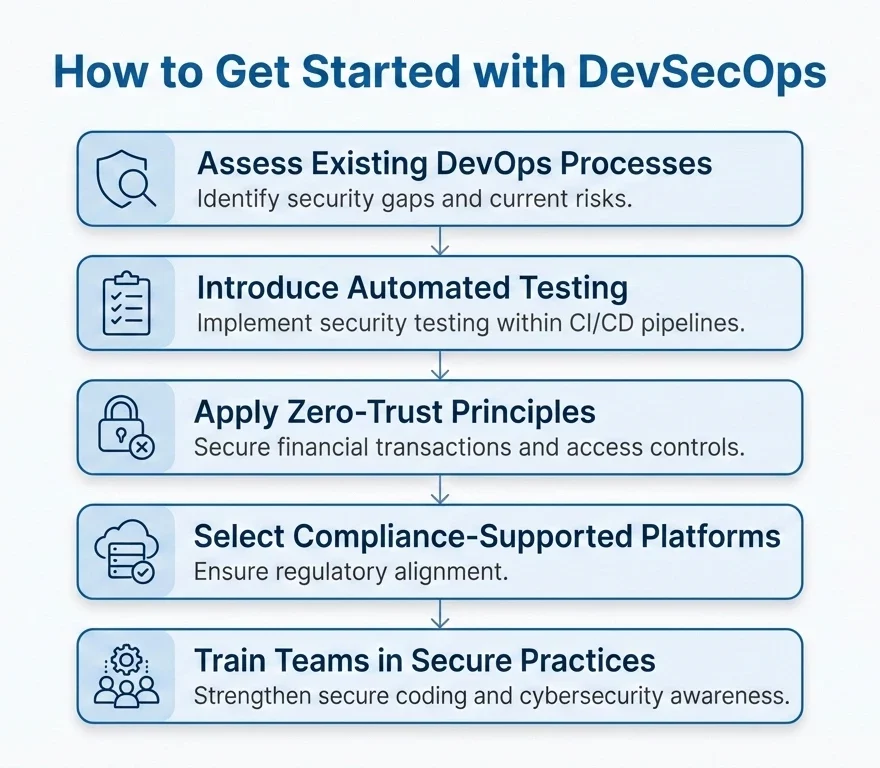
Gradual implementation helps teams adapt while building confidence in the new model.
Key Takeaways
- Integrating security into development is essential for modern financial institutions.
- Early and proactive controls help reduce breaches, fraud, and compliance issues.
- Platforms should support automated testing, monitoring, and API protection.
- Cultural alignment and thoughtful implementation are just as important as technology.
Conclusion
In short, financial services organizations operate in a landscape shaped by persistent threats, demanding regulations, and rising customer expectations. DevSecOps offers a practical path forward by embedding security into development while allowing innovation to continue at pace.

