


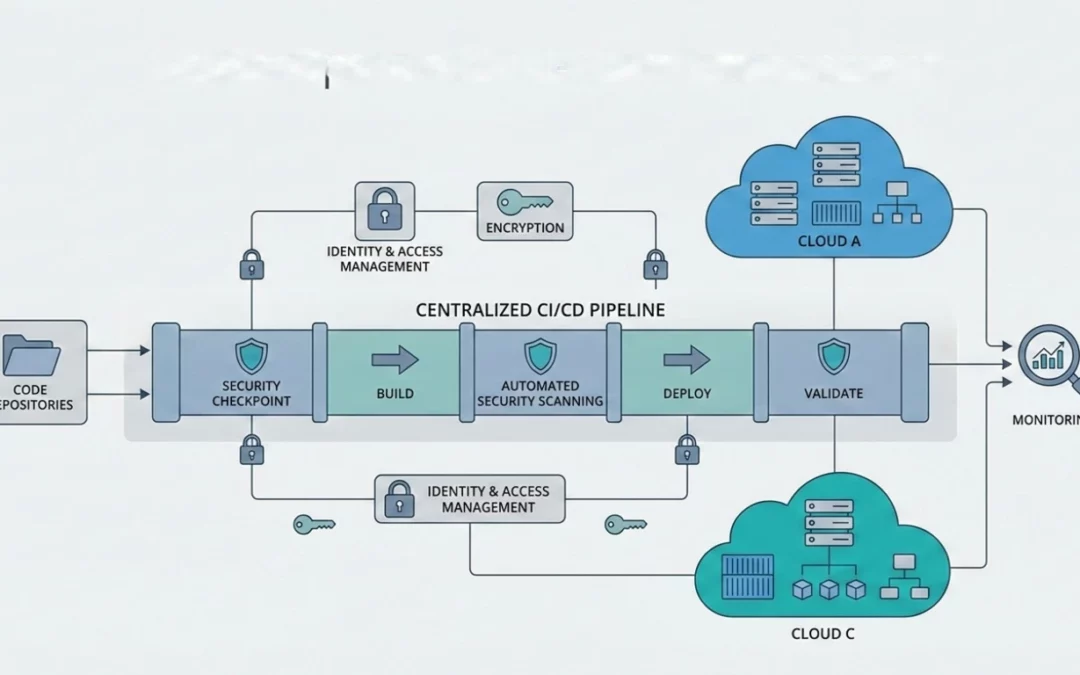
Learn how DevSecOps for multi-cloud environments focuses on securing workloads, data, and pipelines across cloud platforms. Talk to Bobcares about DevSecOps Support for securing and managing multi-cloud environments.
Multi-cloud refers to the use of two or more cloud platforms at the same time. Instead of relying on a single provider, organizations distribute workloads across multiple clouds to reduce vendor dependency, manage costs, improve fault tolerance, and access services from different providers.
A common setup involves running databases on AWS, AI workloads on Google Cloud, and front-end servers on Azure.
An Overview
What is DevSecOps in a Multi-Cloud Environment?
DevSecOps integrates security into development and operations from the beginning rather than treating it as a final step. In a multi-cloud setup, this approach focuses on maintaining consistent security policies and practices across all cloud platforms.
Multi-cloud environments rely on providers such as AWS, Azure, and Google Cloud to distribute workloads for flexibility, performance, and reliability. Security management becomes more complex since each platform offers its own tools and controls. DevSecOps addresses this complexity by providing a framework that integrates and automates security checks across environments.
Embedding Security at Every Stage of the DevSecOps Lifecycle
DevSecOps introduces security into every phase of the software delivery pipeline to reduce the risk of issues affecting applications or business operations. Core practices include the following:
- Automated security scans integrated into CI/CD pipelines detect vulnerabilities early and prevent insecure code from reaching production. Tools such as SonarQube, OWASP ZAP, and Snyk help identify code weaknesses and system misconfigurations.
- Security-focused coding reduces exposure to vulnerabilities. Organizations support this through regular training on secure coding standards and the use of SAST tools during code reviews and compliance checks.
- Threat modeling during the design phase helps identify risks and vulnerabilities early. This process focuses on assessing potential threats, understanding exposure areas, and prioritizing protection for components most likely to be targeted.
Security Strategies for Multi-Cloud Data and Business Workloads
Managing data protection and workloads across multiple clouds introduces challenges such as inconsistent security policies and expanded attack surfaces.
Here are some strategies to address these concerns:
- Encryption protects data from unauthorized access. Data should be encrypted at rest and in transit, and encryption keys should be secured using hardware security modules and key management services.
- IAM policies control access to cloud resources across platforms. Role-based access control limits permissions based on responsibilities, and multi-factor authentication strengthens protection for critical accounts.
- Real-time threat intelligence supports early detection of security incidents. Centralized monitoring through SIEM solutions enables visibility across environments, while anomaly detection helps identify unusual activity.
- Automating security policies across cloud platforms reduces manual errors. Infrastructure as Code tools such as Terraform and AWS CloudFormation allow security requirements to be defined and enforced during provisioning.
Get Bobcares DevSecOps Support

Security Challenges in Multi-Cloud Environments
Hybrid and multi-cloud environments combine on-premises infrastructure with multiple cloud providers, increasing complexity and the attack surface. DevSecOps helps address these challenges by integrating and consistently applying security practices.
Security testing runs throughout the development pipeline to maintain protection across platforms. Standardized security controls reduce fragmentation between cloud providers, while automated compliance checks support regulatory requirements across distributed environments.
Real-time monitoring and automated incident response improve the speed and effectiveness of threat detection and containment. Security configurations managed as code allow visibility into changes and support consistent enforcement as environments evolve. Collaboration between development, security, and operations teams further strengthens security across complex setups.
Best Practices for DevSecOps in Multi-Cloud Environments
Organizations operating across hybrid and multi-cloud environments require clear security practices to protect applications and data.
- Least privilege access limits permissions to required levels. Multi-factor authentication strengthens protection across access points. Centralized identity management simplifies access control across cloud platforms.
- End-to-end encryption protects data in transit and at rest. Centralized key management improves control of encryption keys. Data classification ensures sensitive information receives appropriate safeguards.
- Code repositories should enforce access controls and vulnerability scanning. CI/CD pipelines must include security checks to identify issues early. Container environments require image scanning, secure orchestration, and restricted permissions.
- Automated testing identifies vulnerabilities in code and configurations. Penetration testing simulates attacks to expose weaknesses. Continuous monitoring tracks logs, traffic, and system behavior to detect incidents quickly.
- Incident response plans should define roles, communication steps, and recovery actions for multi-cloud environments. Tabletop exercises test readiness, while backup and recovery strategies support data availability during incidents.
Conclusion
Multi-cloud adoption continues to grow as organizations look for flexibility and resilience. DevSecOps brings development, operations, and security teams together while integrating security across the delivery process. Bobcares helps organizations apply these practices to reduce risk, protect assets, and maintain consistent security across complex multi-cloud environments.

