


Discover how digital transformation in retail is reshaping customer experiences in 2025. Read up on expert insights, real-world examples, and future trends driving growth.
Take a minute to think back to the way people shopped in the mid-1990s. A family heading to the local mall on a weekend, browsing aisles with paper shopping lists, relying on sales staff to suggest options, and paying at long queues before heading home. Fast forward to today, and the picture is completely different. A customer can scroll through products on their phone at midnight, compare prices instantly, try out virtual fitting rooms, and receive their order the very next day without stepping into a store. In short, online shopping has changed the way the entire world shops.
Retail has always evolved, but the pace of change over the last decade has been extraordinary. What once felt futuristic, like buying groceries through an app, trying furniture virtually in your living room, paying without pulling out a wallet, and trying on makeup virtually, is now part of daily life for millions of people across the globe. Technology is not simply an add-on anymore. It has become the backbone of how modern retail functions.
This shift has created both opportunities and pressures for retailers. On one hand, there has never been a bigger chance to reach customers, experiment with new models, and grow rapidly. On the other hand, businesses that fail to adapt risk losing relevance in a market where convenience, speed, and personalization are no longer luxuries but expectations.

The term “digital transformation” gets thrown around a lot, but behind the buzz lies a very real movement reshaping the way retailers operate. It is about far more than adding a mobile app or launching a website. It is about rethinking the entire journey a shopper takes, the systems that power it, and the way employees support it.
Today, we will explore what digital transformation in retail actually means, why it has become unavoidable, and how some of the world’s most recognizable brands, as well as smaller players, are making it work. We will look at the forces driving this change, the obstacles that stand in the way, the benefits waiting to be unlocked, and the practical lessons that leaders can apply.
At its core, this is a story about survival and growth. Retailers that embrace change are not only staying afloat but are thriving. Those who hesitate often find themselves left behind, overshadowed by competitors who moved quickly and connected better with customers.
So the question is not if retail should transform, but how. And more importantly, what really works?
An Overview
- Making Sense of Digital Transformation in Retail
- Key Drivers Behind Digital Transformation in Retail
- Core Elements of Digital Transformation in Retail
- Challenges on the Road to Digital Transformation in Retail
- Benefits of Digital Transformation
- Real-World Examples of Digital Transformation in Retail
- Lessons Learned from Retail Leaders
- Why Retailers Must Act Now
Making Sense of Digital Transformation in Retail
When many people hear the phrase “digital transformation in retail,” they immediately think of building a new app or setting up an online store. At its heart, digital transformation in retail is about reimagining how a business connects with its customers, how it manages its operations, and how it adapts to a rapidly changing world.
Think of it this way. In the past, retail was built on physical presence. Stores were the center of everything, customers walked in, explored shelves, spoke with staff, and made their purchases. Today, the customer journey begins long before someone steps into a store, and in many cases, it may not involve a store visit at all.

A shopper may scroll through Instagram, discover a product, read reviews on an e-commerce site, check prices on another platform, and finally place an order through voice command or a chatbot. For retailers, keeping up with this journey means more than just having a digital presence. It requires creating an experience that feels connected across every touchpoint.
Digital transformation in retail is also about how decisions are made inside the company. Data now plays the role of a compass. Every click, purchase, and search produces information. When used correctly, this information helps retailers understand what customers want, when they want it, and how they prefer to shop. It guides inventory planning, pricing, and marketing campaigns, replacing guesswork with real evidence.
Another dimension is the employee experience. Associates on the shop floor now use tablets to check product availability, managers rely on dashboards to predict sales trends, and supply chain teams depend on automation to ensure shelves stay stocked. Transformation is not just something customers see, it also reshapes how employees work every day.
Importantly, digital transformation in retail is not a one-time project with a start and finish line. It is an ongoing process of learning, testing, and adapting. The technologies may change. Today it is AI and AR, tomorrow it could be something new. However, the underlying goal remains constant: building a retail model that is more responsive, more customer-focused, and more resilient against disruption.
In simple terms, digital transformation in retail is the shift from being product-centered to being experience-centered. So, retailers who understand this distinction are the ones setting the pace in today’s market.
To explore how automation is transforming business operations and driving digital transformation, read our comprehensive guide on the role of automation in driving digital transformation.
Key Drivers Behind Digital Transformation in Retail
The rise of digital transformation in retail is not happening by chance. A mix of global, technological, and consumer-driven forces is pushing businesses to rethink the way they operate. Understanding these drivers helps explain why retailers across the world are investing heavily in digital tools and strategies.
One of the biggest factors is the growth of online shopping. In just the past decade, billions of people have started buying products through digital channels. For many, shopping on a phone or laptop is now the default choice. This surge has created pressure on retailers that relied solely on physical stores. They can no longer assume customers will walk through their doors. In fact, shoppers expect to find them online, anytime and anywhere.

Another driver is changing customer expectations. Today’s shoppers want convenience, personalization, and speed. They expect a retailer to know their preferences, suggest relevant products, and deliver orders quickly. If those expectations are not met, switching to a competitor is only a click away. This shift has forced businesses to look beyond traditional methods and embrace technologies that allow them to better understand and serve their audience.
The competitive landscape is also fueling transformation. Large players such as Amazon, Walmart, and Alibaba have raised the bar by offering vast selections, efficient logistics, and engaging digital experiences. Smaller and mid-sized retailers are now under pressure to keep pace. Falling behind no longer just means losing some sales, it can mean fading into irrelevance.
Technological advancement itself plays a role. Tools like artificial intelligence, machine learning, augmented reality, and cloud computing have become more accessible and affordable. What was once possible only for massive corporations is now within reach for regional chains and even independent retailers. These technologies are not just shiny add-ons. They solve real problems like inventory planning, fraud detection, and customer engagement.
Finally, global events have accelerated change. The pandemic highlighted the vulnerabilities of retailers that lacked strong digital strategies. Businesses that were slow to adopt digital channels struggled, while those with flexible online systems adapted faster. This experience was a wake-up call, reinforcing the need for transformation as a way to remain resilient during disruptions.
In short, digital transformation in retail is being driven by a powerful combination of consumer behavior, competitive pressure, and technological innovation. Retailers who recognize these forces and act quickly position themselves not only to survive but to thrive in an unpredictable market.
Core Elements of Digital Transformation in Retail
Digital transformation in retail is not one single action. it is a collection of changes that come together to reshape the entire shopping experience. These elements work hand in hand, creating a retail environment that feels more connected, smarter, and better aligned with customer needs.
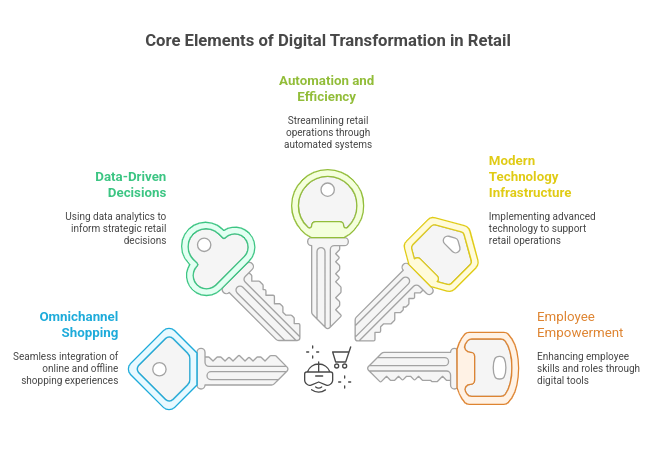
Omnichannel Shopping
One of the most visible elements is the blending of physical and digital shopping experiences. Customers want the freedom to move smoothly between channels like browsing online, checking availability in-store, ordering through an app, and picking up at a nearby location. A strong omnichannel strategy ensures that no matter where a shopper begins, the journey feels consistent. For example, a customer looking at shoes online might later visit the store to try them on and then complete the purchase through the retailer’s mobile app. The key is that the experience feels continuous rather than fragmented.
Data-Driven Decisions
Data is at the heart of modern retail. Every interaction, from clicks on a website to purchases at the register, creates valuable insights. Retailers are now using this data to understand customer preferences, predict demand, and personalize offerings. Instead of stocking shelves based on assumptions, businesses rely on patterns that reveal what shoppers actually want. This shift not only reduces waste but also creates a shopping experience that feels tailor-made.
Automation and Efficiency
Behind the scenes, automation is transforming operations. Chatbots handle routine customer questions, freeing staff to focus on more complex interactions. Warehouses rely on automated systems to speed up order processing and reduce errors. Even supply chains are becoming more efficient as technology tracks goods in real time, ensuring that products reach customers faster. These changes may not always be visible to shoppers, but they directly impact satisfaction by improving speed and reliability.
Modern Technology Infrastructure
A strong digital backbone is another critical element. Cloud systems allow retailers to scale quickly and adapt during busy seasons. Artificial intelligence helps forecast demand, personalize marketing campaigns, and even detect fraud. Augmented and virtual reality bring products to life, letting customers visualize how furniture looks in their homes or how an outfit fits without stepping into a dressing room. Each of these technologies plays a role in making retail more flexible and future-ready.
Employee Empowerment
Transformation is not just about customers. It also changes how employees work. Associates equipped with tablets can check stock instantly, suggest alternatives, and place orders for customers on the spot. Managers use dashboards to monitor performance in real time. These tools make staff more confident and capable, which in turn improves customer satisfaction.
Together, these elements show that digital transformation in retail is not a surface-level change. It is a deep shift touching every aspect of the business, from storefronts to supply chains to staff experiences.
Challenges on the Road to Digital Transformation in Retail
While the promise of digital transformation in retail is exciting, the journey is not simple. Retailers face several obstacles that can slow down progress or even derail projects. Understanding these challenges is the first step to overcoming them.
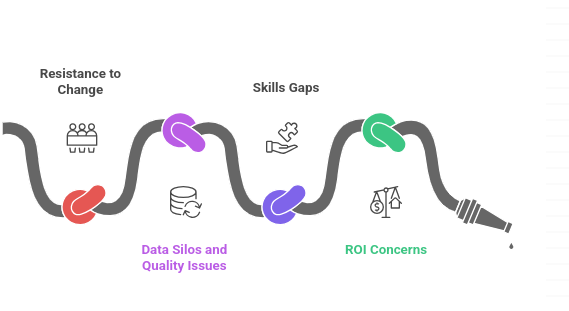
Integration of Old and New Systems
Many retailers still run on legacy systems that were never designed to interact with modern tools. Adding new technology on top of outdated platforms often leads to inefficiencies and data gaps. For example, an e-commerce site may not sync properly with in-store inventory systems, leaving customers frustrated when products shown as available online are missing on shelves. Solving this integration requires careful planning and investment, which can feel overwhelming for businesses with limited resources. This is where partnering with Bobcares comes in handy.
Resistance to Change
Digital transformation is not just about technology. It is also about people. Employees who have worked in the same way for years may feel uncertain about learning new systems. Some worry that automation might replace their roles, while others find the learning curve intimidating. If staff are not properly trained or included in the process, resistance can stall adoption. Retailers that succeed usually focus on building confidence by showing how new tools make jobs easier rather than harder.
Data Silos and Quality Issues
Retailers collect massive amounts of data, but not all of it is accessible or useful. Information often sits in separate systems, customer data in one place, sales in another, supply chain records somewhere else. Without a way to unify and clean this data, insights remain incomplete. Worse, inaccurate data can lead to poor decisions, such as stocking items that customers no longer want or missing trends that competitors are already addressing.
Skills Gaps
Advanced technologies such as artificial intelligence, augmented reality, and machine learning require specialized knowledge. Many retailers struggle to hire or train staff with these skills. Without the right expertise, businesses risk investing in tools that are underused or poorly managed. This creates a cycle where technology adoption lags behind ambition.
Proving Return on Investment
Every transformation effort comes with costs, and stakeholders naturally want proof that the investment is worthwhile. However, benefits such as improved customer satisfaction or long-term loyalty can be hard to measure immediately. Leaders may find themselves under pressure to deliver quick results, even though true transformation takes time.
Despite these hurdles, countless retailers have shown that the journey is possible. The key is acknowledging challenges early, involving people at every stage, and building strategies that combine technology with human insight.
Benefits of Digital Transformation
When done thoughtfully, digital transformation in retail creates advantages for both companies and their customers. It is not just about adopting flashy technology. It is about reshaping the shopping journey and unlocking long-term business growth.
Better Customer Experiences
At its core, transformation allows retailers to understand customers on a deeper level. With data insights, stores can recommend products that match past purchases, suggest alternatives, or offer timely promotions. Imagine walking into a store where staff already know your preferences, or opening an app that highlights products you are most likely to need. This kind of personalization makes shopping more enjoyable and builds lasting loyalty.
Faster and Smarter Operations
Retailers benefit by making operations quicker and more reliable. Automated stock tracking, for example, reduces the chances of empty shelves and overstocking. Cloud-based platforms provide real-time visibility, so managers can react immediately to shifts in demand. This is particularly useful in industries like fashion, where trends change almost overnight.
Data as a Strategic Advantage
Data has become one of the most valuable assets in retail. By consolidating customer behavior, sales patterns, and supply chain information into a single system, businesses gain the ability to predict trends and make smarter choices. For instance, analytics can reveal which products are selling fastest in one region, allowing retailers to redirect inventory before shortages occur.
Improved Employee Productivity
Transformation also benefits employees. Digital tools can simplify daily tasks, from mobile checkout systems that reduce lines to AI-driven dashboards that guide decision-making. When staff are freed from repetitive work, they can focus on helping customers and providing better service, which in turn boosts satisfaction on both sides.
Stronger Competitive Position
In an industry where consumer expectations rise every year, standing still means falling behind. Businesses that adopt digital strategies effectively set themselves apart by offering faster service, greater convenience, and memorable shopping experiences. Competitors who delay transformation often struggle to catch up, as customer habits shift toward retailers who deliver value in smarter ways.
Long-Term Growth
Perhaps the most important benefit is resilience. Retailers that embrace digital tools are better prepared to adapt to unexpected changes, such as supply chain disruptions or sudden shifts in consumer demand. Alos, they can pivot quickly, maintaining customer trust and protecting revenue even during challenging times.
For both shoppers and businesses, digital transformation is a win-win. Customers receive experiences tailored to their needs, while retailers gain efficiency, insights, and sustainable growth.
Real-World Examples of Digital Transformation in Retail
Stories often explain transformation better than theories. Around the world, retailers are experimenting with new technologies, testing bold strategies, and reshaping how customers interact with their brands. Here are some of the most inspiring examples that highlight what works in practice.
Target: Personalization through Smarter POS Systems
 Target has shown how a retailer can turn its checkout counters into customer engagement hubs. By redesigning its point-of-sale (POS) infrastructure, the company linked in-store transactions with online behavior. The new system integrates data across loyalty programs, mobile apps, and purchase history.
For shoppers, this means faster checkout, personalized offers, and better inventory visibility. For Target, it unlocks valuable insights that guide promotions and stocking decisions. The brand also introduced AI-powered tools for staff, helping them answer customer questions instantly and improving service during busy hours.
This led to more efficient stores, happier customers, and stronger loyalty.
IKEA: Bridging Online and Offline with Augmented Reality
 Buying furniture online often comes with a big risk. The main concern is what if it does not fit your space? IKEA tackled this by launching its IKEA Place app, which allows shoppers to use their phone cameras to project furniture into their homes.
With accurate 3D scaling, customers can see how a sofa looks in their living room or how a table fits in their dining area before committing to purchase. This innovation reduced return rates and boosted buyer confidence. More importantly, it positioned IKEA as a leader in combining digital creativity with practical customer needs.
Meijer: In-Store Engagement with Location-Based Offers
 Regional supermarket chain Meijer has taken a clever approach to enhancing the in-store experience. Using geofencing technology, the brand’s mobile app detects where a customer is inside the store. Based on location and shopping history, the app suggests relevant deals and reorders the shopper’s list in real time.
This makes the shopping journey smoother and more engaging. Customers save time, find promotions that matter to them, and enjoy a sense of personalization even in a large store. For Meijer, the strategy translates to higher coupon redemptions, stronger loyalty, and more frequent visits.
Warby Parker: Virtual Try-Ons for Eyewear
 Buying glasses is deeply personal. The fit and style matter just as much as price. Warby Parker used augmented reality (AR) and machine learning to let customers try on glasses virtually through their smartphones.
The app maps the user’s face and overlays realistic images of different frames. Customers can instantly see which styles suit them, reducing the hesitation of buying online. According to company reports, the feature led to higher conversion rates and fewer returns. It also sparked more downloads of the app, showing how useful innovations can drive adoption.
ASOS: Tackling Fashion’s Return Problem
 One of the biggest challenges in online clothing retail is size uncertainty. Customers often order multiple sizes and return those that do not fit, leading to high costs for retailers. ASOS addressed this problem with two tools:
- See My Fit: an AR feature that shows clothing on models of different body types.
- Fit Assistant: an AI-powered system that recommends sizes based on past purchases, return history, and body data.
At the end of the day, these tools reduced return rates and improved shopper confidence. Customers now make decisions with more certainty, saving time while reducing waste for the company.
Walmart: Reinventing Checkout with AI
 Walmart’s transformation is driven by a broader vision it calls “Adaptive Retail.” At the heart of this is AI-powered self-checkout. These systems combine computer vision, sensors, and customer-friendly design to reduce wait times and free staff for more complex tasks.
Walmart has rolled out these smart checkouts across hundreds of stores, reporting faster service and improved customer satisfaction. Beyond checkout, the company is also experimenting with augmented reality shopping, generative AI for product recommendations, and immersive digital catalogs.
This approach cements Walmart’s reputation as one of the most innovative players in global retail.
Zara: A Data-Driven Supply Chain
 Fast fashion relies on speed. Zara has built its reputation by quickly turning runway trends into affordable clothes. But behind the scenes, this requires a highly efficient supply chain.
Zara introduced predictive analytics and real-time data sharing to improve forecasting and inventory allocation. Items are tagged with RFID, allowing managers to track them from the warehouse to the store shelves. Furthermore, automated logistics tools cut down delivery times and costs.
This helps Zara refresh collections in weeks instead of months, keeping its fast-fashion promise while managing costs effectively.
Sephora: Omnichannel at Its Best
 Sephora has become a benchmark in omnichannel retail by blending digital and physical experiences into one journey. Its loyalty program, Beauty Insider, is integrated across mobile apps, in-store kiosks, and online shopping. Customers can try products virtually with AR tools, check stock in real time, and receive personalized recommendations on any platform.
The result is higher engagement and stronger loyalty. Research shows that Sephora’s omnichannel shoppers spend significantly more than single-channel customers. By uniting its systems around customer profiles, the brand delivers continuity, personalization, and convenience at every step.
These examples highlight that digital transformation is not limited to one strategy or tool. Some retailers focus on personalization, others on supply chain efficiency, and some on immersive shopping. But the common thread is clear: success comes when technology solves real problems and improves the experience for both shoppers and staff.
Lessons Learned from Retail Leaders
Looking at the success stories of brands like Target, IKEA, and Sephora, it becomes clear that digital transformation in retail is not just about adopting the newest technologies. It is about aligning technology with purpose, people, and long-term goals. Here are some of the most important lessons other retailers can take away.
1. Start with the Customer, Not the Tool
The most successful initiatives begin by solving a real customer problem. IKEA did not invest in augmented reality just for novelty. It addressed the uncertainty customers feel when buying large furniture online. Warby Parker focused on making eyewear shopping easier and more personal. Retailers that first identify pain points and then choose the right tools end up with stronger adoption and impact.
2. Break Down Silos Early
Many of the challenges retailers face come from data and system silos. Leaders like Sephora invested in central platforms that unify information across online, mobile, and in-store touchpoints. This integration is what enables smooth customer journeys. Without tackling silos, personalization and efficiency are nearly impossible.
3. Invest in People as Much as Technology
Technology alone cannot transform a business. Staff need training, encouragement, and clear communication. Walmart, for example, introduced “checkout hosts” to help customers transition to AI-powered self-checkouts. By supporting both employees and customers, the company made adoption less intimidating and more successful.
4. Small Wins Build Momentum
Digital transformation does not have to happen all at once. Many brands started with targeted projects like ASOS, focusing on size prediction, or Meijer experimenting with geofencing. These smaller initiatives generated visible results, built confidence, and paved the way for larger investments.
5. Make Data Your Guide
Data-driven decisions separate leaders from laggards. Target’s use of POS data and Zara’s predictive analytics show how powerful insights can be when applied strategically. Retailers should focus on cleaning, centralizing, and analyzing data so it becomes a reliable foundation for growth.
6. Think Long-Term
Some benefits, like higher loyalty or improved brand reputation, do not show immediate ROI. Retailers that take a patient approach and measure both short-term wins and long-term value are better positioned to thrive.
Why Retailers Must Act Now
Retail has always been about staying close to the customer. But in today’s world, where technology is reshaping expectations at lightning speed, waiting on the sidelines is no longer an option.
The stories of brands like Target, IKEA, Sephora, and Walmart show us that transformation is not limited to global giants. Each of these companies started with a clear focus on customer needs and built digital strategies around them. They proved that innovation does not have to be flashy. It just has to solve real problems.
For retailers yet to begin their journey, the risk of inaction is scary. Shoppers are increasingly drawn to experiences that are faster, smarter, and more personal. Competitors who adapt first will gain loyalty, leaving others struggling to catch up.
The good news is that transformation does not have to happen overnight. It can start with small, targeted initiatives like using data to improve promotions, testing an AR tool for a single product line, or upgrading a point-of-sale system. Each step builds momentum and prepares the business for larger changes.
What matters most is a mindset shift. Leaders must see digital transformation not as an expense, but as an investment in growth, resilience, and customer trust. Hence, retailers who act today will be better positioned to handle tomorrow’s uncertainties and capture new opportunities.
The future of retail belongs to those who embrace change with confidence. In 2025 and beyond, digital transformation will separate the brands that thrive from those that merely survive. The time to act is now.
[Need assistance with a different issue? Our team is available 24/7.]
Conclusion
Migrating from legacy systems to modern architecture is not just a technical task, it’s a business transformation journey. If done right, it reduces risks, increases efficiency, and prepares organizations for future challenges. On the other hand, if it is poorly done, it can disrupt operations and waste resources.
The earlier organizations embrace legacy migration as a stepping stone to digital transformation, the better. This way, they can unlock the benefits of modern technology and stay ahead in an increasingly competitive marketplace. Talk to our team today!

