


Learn how managed cloud improves IT security and compliance by enhancing visibility, automating controls, and ensuring regulatory adherence across environments. Schedule a consultation to learn how proactive cloud management can protect your business and reduce operational risks.
Cloud computing has become a cornerstone for managing applications, storing data, and delivering services efficiently. As organizations increasingly rely on cloud infrastructure, managing these environments effectively is critical to protect sensitive information, maintain regulatory compliance, and sustain operational efficiency. Cloud management provides the framework for controlling resources, monitoring performance, and safeguarding assets across cloud platforms.
Overview
- What is Cloud Management
- Core Elements of Cloud Management
- Key Features of Cloud Management
- What Makes Cloud Management So Important Today
- Business Value of Cloud Management Tools
- Challenges in Cloud Management
- Best Practices for Cloud Management
- Boost Security and Compliance Via Managed Cloud Services
- Smart Ways to Keep Your Cloud Secure & Compliant
What is Cloud Management
Cloud management refers to the processes and tools used to oversee cloud computing resources, applications, and services. This includes provisioning resources, monitoring usage, automating operations, and implementing security measures. Organizations that adopt structured cloud management practices can improve operational efficiency, reduce costs, and maintain high levels of security and compliance.
Core Elements of Cloud Management
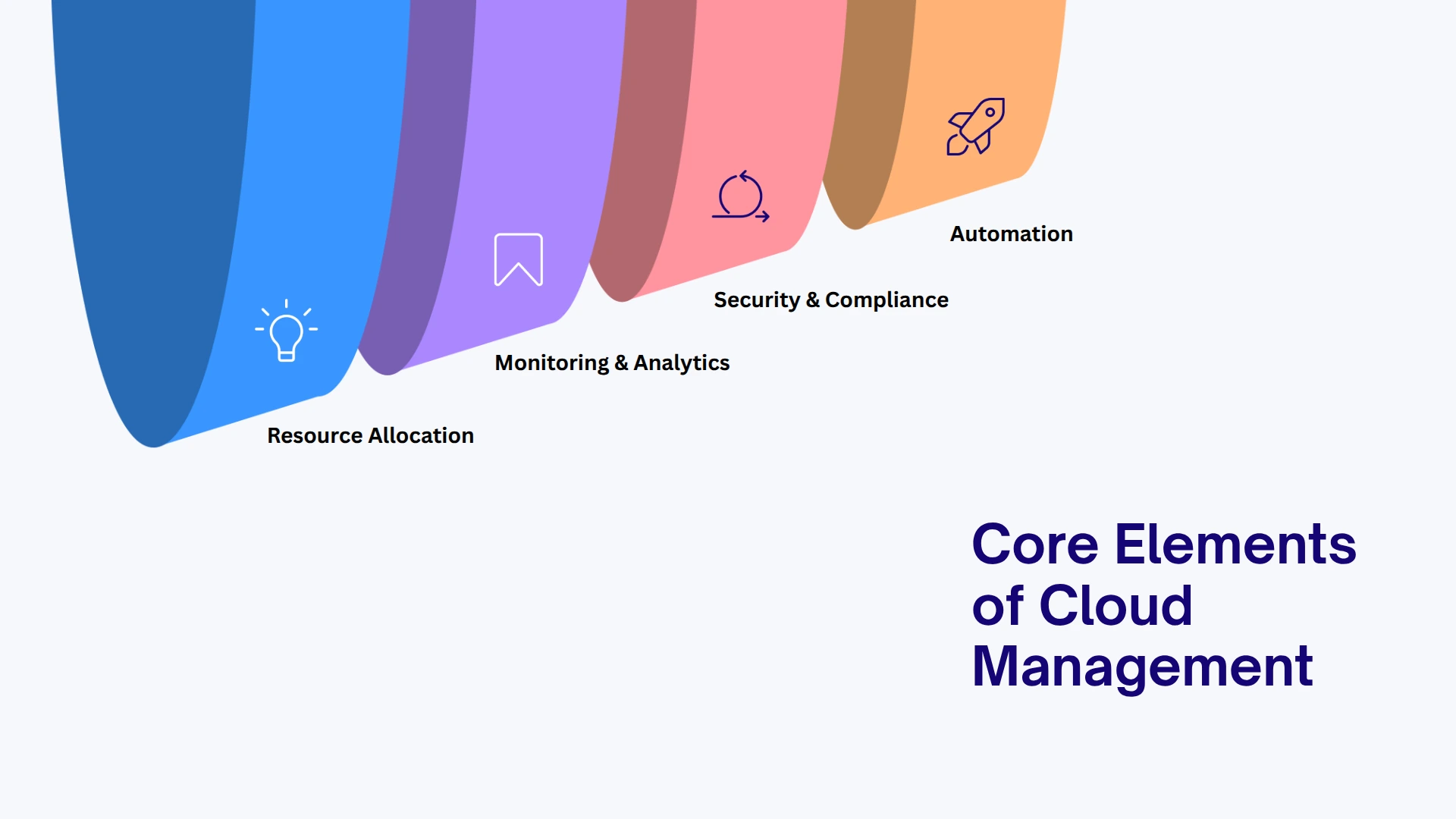
Resource Allocation
Resources such as computing power, storage, and network bandwidth are distributed according to demand to prevent both overuse and waste. Dynamically adjusting resources in response to fluctuating workloads maintains efficiency and cost-effectiveness.
Monitoring & Analytics
Tracking system performance, uptime, latency, and error rates allows teams to identify potential bottlenecks and respond proactively. Analytics tools transform raw data into actionable insights, enabling better decision-making and operational optimization.
Security & Compliance
Strong security measures, including identity management, access controls, and encryption, safeguard cloud environments against threats. Compliance involves meeting industry standards such as GDPR, HIPAA, and SOC 2, ensuring data is handled correctly and audit requirements are met.
Automation
Automating routine tasks like provisioning, patching, backups, and scaling reduces human error and accelerates processes. Infrastructure as Code (IaC) and workflow automation tools allow repeatable, scalable management practices.
Key Features of Cloud Management
Effective cloud management combines several capabilities that streamline operations and improve performance:
Multi-Cloud and Hybrid Cloud Management
Businesses often operate across multiple cloud platforms and on-premises infrastructure. A unified management interface enables seamless integration and workload control, minimizing operational disruptions.
Automated Provisioning and Scaling
Automated deployment, configuration, and scaling of cloud resources improve speed and accuracy while reducing manual effort. This ensures applications perform optimally even as demand changes.
Cost Management
Real-time monitoring and resource optimization help organizations avoid overspending. Cloud cost management tools provide insights into usage patterns, enabling teams to eliminate underutilized resources and allocate budgets efficiently.
Security and Compliance Enforcement
Cloud management solutions implement strong security policies and compliance protocols, including encryption, access controls, and audit trails, to protect data and maintain adherence to legal requirements.
Performance Monitoring
Continuous tracking of system health and resource performance allows teams to identify potential issues, predict demand, and ensure smooth operations.
Load Balancing and Auto-Scaling
Adjusting computing capacity automatically in response to traffic fluctuations prevents downtime and maintains cost efficiency. Load balancing distributes workloads evenly, ensuring optimal performance.
What Makes Cloud Management So Important Today
The importance of structured cloud management extends across several critical areas:
- Automating routine processes reduces manual intervention and human error.
- Right-sizing resources and tracking usage minimizes waste and unnecessary expenses.
- Centralized policies, encryption, and access controls strengthen protection against threats.
- Furthermore, resources adjust dynamically to meet changing workloads without compromising performance.
- Proactive monitoring and automated backups help prevent disruptions.
- Additionally, enforces industry standards and audit trails, ensuring regulatory obligations are met.
- Real-time insights into cloud performance enable informed decision-making.
For example, a global healthcare company migrated to a managed cloud environment to meet HIPAA compliance requirements. By implementing automated access controls and continuous monitoring, they reduced security incidents by 40% and achieved full audit readiness within three months. Understanding how modern observability differs from legacy approaches can help you choose the right tools. Our comparison of AIOps vs traditional IT monitoring explains how AI-driven systems enhance detection, reduce noise, and accelerate incident response compared to conventional monitoring solutions.
Business Value of Cloud Management Tools
Cloud management platforms provide a suite of tools to simplify operations and enhance security:
- Dashboards and usage reports offer granular insights into cloud resource allocation, enabling teams to identify inefficiencies and optimize deployments.
- Routine operations such as provisioning, scaling, patching, and backups are automated, reducing error rates and speeding up incident response.
- FinOps practices integrate financial accountability with engineering processes, helping teams make cost-conscious decisions while maintaining performance. Multi-cloud strategies require vigilant cost tracking, which cloud management software facilitates.
- Centralized control over access permissions, encryption, and compliance monitoring reduces misconfigurations and strengthens overall security posture.
Challenges in Cloud Management
Despite its benefits, cloud management presents specific challenges. For instance, managing multi-cloud environments offers greater flexibility and redundancy but also introduces operational complexity due to varying APIs, billing structures, and security frameworks across providers.
When organizations rely on multiple, disconnected tools, they often face tool sprawl and visibility gaps that lead to inefficiencies and slower incident responses. Centralized cloud management helps overcome these issues by ensuring unified monitoring and consistent operations. However, dependence on proprietary services from a single vendor can limit future scalability and make migration more difficult. Balancing flexibility with platform-specific capabilities is essential to maintain adaptability.
Additionally, while automation enhances efficiency and speed, it must be governed carefully. Without proper oversight, automated processes can result in misconfigurations or compliance gaps. Establishing guardrails, audit mechanisms, and governance policies ensures that automation remains controlled, secure, and aligned with the organization’s objectives.
Best Practices for Cloud Management
1. Comprehensive Monitoring
Monitoring tools provide detailed performance metrics and early warning signals for potential issues. Open-source solutions like Prometheus, Grafana, and Netdata offer fine-grained visibility, while cloud-native tools such as AWS CloudWatch or Azure Monitor provide high-level insights.
2. Automate Routine Operations
Use automation for tasks such as scaling, backups, and provisioning. Tools like AWS Lambda, Azure Automation, and Google Cloud Functions streamline workflows and reduce human error.
3. Optimize Resource Allocation
Regularly assess workloads to prevent underutilization and over-provisioning. Tools such as AWS Trusted Advisor and Azure Cost Management help adjust resources efficiently.
4. Prioritize Security and Compliance
Strong access control, encryption, and compliance enforcement safeguard data. Platforms like AWS IAM, Azure Security Center, and Google Security Command Center help maintain security policies.
5. Centralize Management
A unified cloud management platform simplifies oversight and increases visibility. Consolidated dashboards from providers like AWS, Azure, and Google Cloud enable efficient governance.
Before implementing any large-scale strategy, it’s essential to ensure your systems and policies align with best practices. You can explore this detailed cloud management checklist to evaluate your current setup and identify areas for improvement.
Boost Security and Compliance Via Managed Cloud Services
Managed cloud services provide specialized security solutions for businesses relying on cloud environments. In short, they integrate advanced technologies to strengthen protection and ensure compliance.
Managed Cloud Security Solutions
These services include threat detection, incident response, vulnerability management, and continuous monitoring. Managed cloud providers implement robust measures such as firewalls, intrusion detection, and threat intelligence to safeguard applications and data.
Identity and Access Management (IAM)
IAM controls user access to critical resources, limiting exposure to unauthorized users. Multi-factor authentication and role-based access reduce the risk of breaches and ensure compliance with regulations.
Data Encryption
Encrypting data in transit and at rest protects sensitive information and meets compliance requirements, including GDPR. Managed services enforce stringent encryption protocols to prevent unauthorized access.
Incident Response
Managed services implement predefined response plans and automated alerts, enabling faster identification and resolution of security incidents. This minimizes damage and accelerates recovery.
Routine Vulnerability Assessments
Regular scans identify weaknesses in cloud systems, allowing organizations to address vulnerabilities proactively and strengthen defenses.
Shared Responsibility Model
Understanding the division of security responsibilities between cloud providers and customers ensures that both parties address their respective obligations, reducing gaps in protection.
Business Continuity and Disaster Recovery
Managed services incorporate backup and failover mechanisms, supporting continuous operations even during disruptions. Proactive planning reduces downtime and preserves operational continuity.
Secure Your Cloud Operations with Expert Management.

Smart Ways to Keep Your Cloud Secure and Compliant
- Clarify which security tasks are handled by the provider versus your organization.
- Also, identify vulnerabilities and classify data to determine the appropriate security measures.
- Apply role-based access and multi-factor authentication to safeguard resources.
- Protect sensitive information using provider or third-party encryption solutions.
- Additionally, implement SIEM solutions and perform regular audits to detect risks.
- Keep abreast of legal changes and train employees accordingly.
- Prepare structured processes for detecting, responding to, and recovering from security breaches.
- Furthermore, use IAM and the built-in compliance frameworks offered by cloud providers.
- Finally, consult external specialists to navigate complex compliance requirements.
[Simplify Multi-Cloud Management Today]
Conclusion
Cloud management is more than a technical requirement. It is a strategic enabler for security, compliance, and operational excellence. By implementing effective management practices, leveraging managed cloud services, and adopting proactive monitoring, organizations can secure their cloud environments, meet regulatory standards, and maintain smooth operations. The combination of automated tools, centralized oversight, and expert guidance equips businesses to navigate the challenges of cloud computing confidently while maximizing the benefits of a scalable, secure, and compliant infrastructure.

