


Discover how to integrate a Headless CMS with Static Site Generators to separate content management from site presentation. Choose our Digital Transformation Services that help replace legacy CMS setups with faster, future-ready web architectures.
Modern websites often need to be fast, easy to manage, and scalable. We can accomplish this by combining a headless CMS with a static site generator. To understand why this pairing works so well, let’s take a look at how static site generators function.
Overview
What Is a Static Site Generator?
A static site generator, or SSG, is used to create fully static websites. An SSG builds HTML files in advance and deploys them to an HTTP server.
These tools take text-based content, apply templates, and compile everything into static HTML pages. Once built, the site is typically pushed to a content delivery network, often a global one so that visitors can access pages quickly from anywhere.
Static site generators do not rely on databases or server-side rendering during page loads. This makes them well-suited for smaller websites that do not need dynamic content. Traditional CMS platforms still play an important role, especially when handling frequently changing or interactive content, but they can introduce unnecessary complexity for simpler sites.
Why Static Site Generators Work Well with Headless CMS Platforms
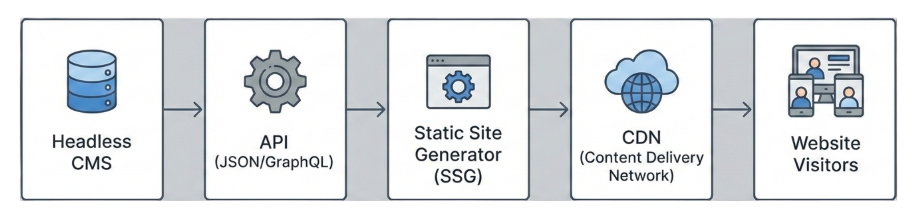
In a traditional CMS setup, content is created, stored, and displayed within the same system. Static site generators work differently. Tools such as Hugo or Eleventy convert content into static HTML files at build time and deliver them through a CDN with very little server memory usage.
The issue pops up when content management is handled through markdown files or local repositories. This setup can become difficult to maintain, especially as content grows or when non-technical users need to contribute.
A headless CMS addresses this gap. It separates content creation from its display. Editors work in a clean, non-coding interface to create and update content. Developers retrieve that content through APIs and use it during the site build process.
This becomes important when content needs to change regularly. Content does not have to live as static files after it is published, which helps avoid issues during updates. This architecture is a practical choice for teams that want fast websites while keeping content management flexible and scalable. To better evaluate whether a decoupled architecture fits your needs, explore our comparison of traditional CMS vs headless CMS, which outlines the key differences in flexibility, scalability, and performance.
How to Integrate a Headless CMS with a Static Site Generator
- The first step is selecting a headless CMS that fits your project’s needs. You need to consider factors like ease of use, API availability, pricing, and how much control you want over your setup.
Some of the common options include Contentful, Sanity, Strapi, and Prismic.
- Once the CMS is selected, the next step is setting up the static site generator. The SSG will use content from the CMS to generate HTML files that are served directly to users.
- The next step is connecting them through APIs. Most headless CMS platforms provide REST or GraphQL APIs to retrieve content.
The static site generator authenticates with the CMS and fetches content during the build process. This content is then used to generate static pages. For example, in a Next.js setup, content can be fetched at build time so the site is generated using the latest available data from the CMS. This ensures the site remains static while still pulling content from a centralized system.
- After fetching content successfully, the site is built using the SSG’s build command. This process generates static HTML files based on the CMS content.
Once built, the site is deployed to a static hosting provider. After deployment, the site becomes publicly accessible. Furthermore, any future content updates in the CMS can trigger new builds to keep the site current.
- One of the major advantages of a headless CMS is the ability to update content without touching the codebase. Webhooks make this possible.
Webhooks notify your hosting platform whenever content changes in the CMS. These notifications can automatically trigger a site rebuild and redeployment. This setup keeps the website aligned with CMS updates without requiring manual deployment steps.
Transform your Web Platform today

Benefits of Using a Headless CMS with a Static Site Generator
This integration offers several advantages:
- Faster load times through pre-built HTML pages.
- Reduced security risks due to minimal server-side processing.
- Ability to handle traffic spikes efficiently.
- Furthermore, freedom to choose preferred tools and programming languages.
- Lower hosting costs, often with free options available.
Headless CMS vs Static Site Generator
A headless CMS and a static site generator serve different roles, even though they are often used together.
A headless CMS focuses only on managing content and delivering it through APIs. It does not control how content is displayed. It acts as the content source.
A static site generator takes content, often from a CMS, and combines it with templates to produce static HTML pages. These pages do not require server-side processing, which results in fast load times and improved security.
| Feature | Headless CMS | Static Site Generator |
|---|---|---|
| Purpose | Manage and deliver content via APIs | Generate static HTML from templates and content |
| Role | Backend only | Builds the frontend |
| Output | JSON, XML, or similar formats | Fully rendered static pages |
| Flexibility | Can serve multiple platforms | Works with many CMS tools |
| Hosting | Hosted separately | Delivered through CDNs |
Conclusion
Using a headless CMS with a static site generator allows teams to combine fast page delivery with structured content management. Editors gain an easy way to manage content, while developers retain control over how that content is presented. This works well for teams that value speed, clarity, and long-term content flexibility without adding unnecessary complexity.

