


Discover key Security Issues in Cloud Management and learn how IT leaders can prevent risks, ensure compliance, and protect business continuity.
Modern enterprises have embraced cloud technologies to drive innovation, agility, and scalability. Yet, this growing reliance introduces unprecedented exposure to cyber threats and compliance risks. In fact, cloud security is no longer a technical afterthought for CIOs and IT leaders. It is a strategic pillar that underpins trust, continuity, and profitability.
Today, we will explore the fundamentals of cloud security, its role in business resilience, and the most pressing risks and challenges enterprises face today.
Overview
Cloud Security 101
Cloud security refers to the collection of tools, policies, and processes that safeguard cloud-based systems, applications, and data against breaches, loss, and misuse. It protects every layer of cloud operations, ranging from infrastructure and applications to users and connected devices.
Its main objectives are to ensure data confidentiality, integrity, and availability. This forms the foundation of information security. Effective cloud security ensures that sensitive data remains protected, systems remain operational, and compliance requirements are continuously met.
A key enabler of this protection is the Cloud Access Security Broker (CASB). It acts as a gatekeeper between users and cloud applications, a CASB monitors activities, enforces security policies, and prevents unauthorized access. This helps enterprises maintain control even when data moves beyond their traditional network boundaries.
Why Cloud Security Matters for Modern Enterprises
The business value of the cloud is undeniable. It accelerates time to market, supports innovation, and reduces infrastructure costs. However, without strong security controls, these same advantages can turn into liabilities.
Data breaches, compliance violations, and service outages can inflict lasting damage to a company’s finances and reputation. For example, the 2018 Uber data breach exposed sensitive customer data due to misconfigured storage settings, resulting in regulatory fines and public backlash. Such incidents illustrate how a single oversight in cloud configuration can ripple across an organization’s operations and brand trust.
Investing in cloud security, therefore, is not just about compliance. It’s about maintaining business continuity and customer confidence in an increasingly threat-heavy environment.
Protecting your cloud environment is critical, but managing costs is equally important. Discover how security-conscious approaches can also minimize expenses in these cloud TCO reduction strategies
Core Components of Cloud Security
CIOs must approach cloud security as an integrated ecosystem that spans technology, policy, and culture. The most effective programs include:
| Cloud Security Component | Description |
|---|---|
| Identity and Access Management (IAM) | Ensures that users and systems have the right level of access to the right resources. Misconfigured permissions remain a leading cause of data breaches. |
| Data Encryption | Protects information in storage and during transmission, ensuring unauthorized users cannot interpret sensitive content. |
| Threat Detection and Response | Uses machine learning and behavioral analytics to detect unusual activity and respond swiftly to attacks. |
| Compliance Management | Aligns cloud operations with regulations such as GDPR, HIPAA, and PCI DSS. |
| Security Monitoring | Provides real-time visibility into the health and posture of all cloud resources. |
Each of these components reinforces the others. When implemented together, they create a layered defense that minimizes exposure and enhances organizational agility.
Building a Resilient Cloud Security Strategy
CIOs need to transition from reactive defenses to proactive resilience. Here is a sample forward-looking strategy:
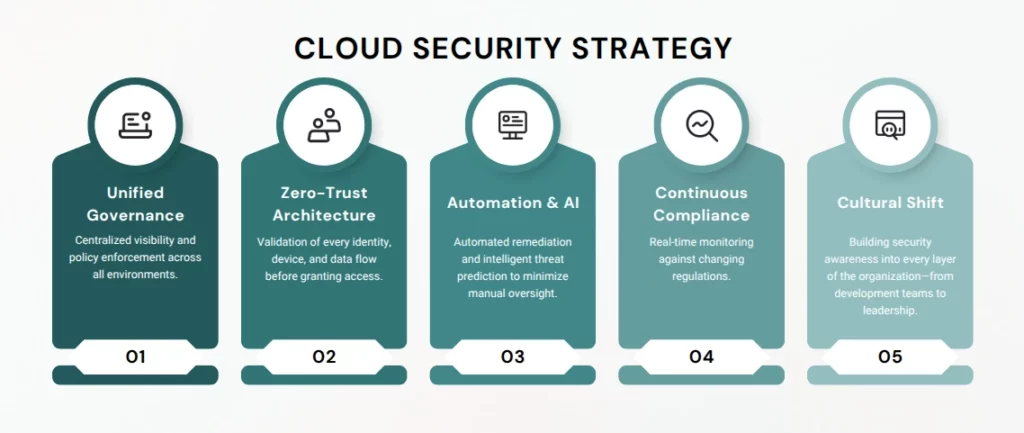
Implementing robust cloud governance strategies is essential for organizations aiming to maintain security and compliance in increasingly complex cloud environments.
Major Security Risks in Cloud Environments
Although cloud technologies simplify operations, they also introduce new vectors of vulnerability. The following risks are the most common and consequential for enterprises:
1. Data Breaches
Sensitive business information stored in the cloud is an attractive target for attackers. Breaches often occur due to weak authentication, misconfigured access controls, or insider negligence. The Uber and Capital One breaches serve as reminders that a single configuration error can expose millions of customer records.
Adopt encryption for all data, enforce multi-factor authentication, and conduct regular audits of permissions. Invest in Data Loss Prevention (DLP) tools to monitor data flow across environments and prevent unauthorized transfers.
2. Inadequate Identity Access Management
Improperly managed access controls allow attackers—or even internal users—to exploit excessive privileges. The 2017 Equifax breach highlighted this issue, where inconsistencies in IAM controls enabled hackers to operate undetected for months.
Implement role-based access control (RBAC) and enforce the principle of least privilege. Centralize identity management and integrate with single sign-on (SSO) systems for greater oversight.
3. Insecure APIs
APIs facilitate communication between cloud applications but can become backdoors if poorly secured. The Cambridge Analytica scandal revealed how inadequate API restrictions can lead to mass data misuse.
Use secure authentication protocols like OAuth, conduct regular vulnerability scans, and encrypt all API traffic. Restrict API access based on need and continuously monitor activity.
4. Misconfigurations
Cloud misconfigurations are one of the leading causes of enterprise data exposure. A simple firewall or policy error can open access to critical systems, as seen in the Capital One incident.
Adopt configuration management automation using Infrastructure as Code (IaC). Enforce consistent policies, conduct periodic audits, and utilize cloud security posture management (CSPM) tools.
5. Shared Infrastructure Vulnerabilities
Public clouds rely on multi-tenant architectures, which means multiple users share the same physical hardware. Without proper isolation, vulnerabilities in one tenant’s environment can impact others.
Isolate workloads using virtual private clouds (VPCs) and encrypt all data stored in shared environments. Implement intrusion prevention systems to detect cross-tenant risks early.
6. Shadow IT
When departments adopt cloud tools without IT approval, they inadvertently create blind spots and compliance risks. Shadow IT reduces visibility and control over where data resides.
Deploy CASBs to monitor and manage all cloud usage across the organization. Encourage transparency by establishing clear cloud adoption policies and regular audits.
7. Human Error
Many breaches stem not from sophisticated hackers but from missteps by employees—like leaving storage buckets public or reusing passwords. The Verizon incident in 2017 exemplified this problem.
Conduct regular employee training, establish clear security protocols, and deploy automated guardrails to detect risky actions before they escalate.
Evolving Threats in Cloud Security
Account Hijacking
Attackers often exploit weak passwords or phishing campaigns to seize cloud accounts. Once inside, they can manipulate systems, steal data, or disrupt services.
Multi-factor authentication and anomaly detection are must-have defenses for enterprises relying heavily on SaaS and IaaS platforms.
Denial of Service (DoS) Attacks
Excessive traffic floods can disrupt access to services and degrade performance. Even top providers like AWS have faced such large-scale disruptions.
Use DDoS mitigation services and implement rate limiting. Load balancers and redundancy mechanisms can help sustain uptime during high-traffic incidents.
Insider Threats
Not all threats originate externally. Employees or contractors with access to sensitive systems can misuse privileges for personal or competitive gain—as seen in the Tesla data leak of 2023.
Apply continuous behavior analytics, review permissions frequently, and enforce strict data access logging.
Cloud Malware Injection
Malicious code can infiltrate cloud applications, often disguised as legitimate updates or scripts. Such attacks can compromise thousands of users simultaneously.
Maintain integrity checks across your software supply chain and implement endpoint protection across hybrid infrastructures.
Strategic Challenges for CIOs
Regulatory Compliance
Different regions and industries impose distinct data protection mandates. British Airways’ GDPR fine illustrates the cost of neglecting compliance alignment.
Implement automated compliance monitoring and ensure your provider meets all regional data handling regulations.
Lack of Visibility
As organizations expand across hybrid and multi-cloud setups, tracking all assets becomes increasingly difficult. Hidden workloads and unmonitored APIs can mask risks.
Adopt unified dashboards offering full-stack visibility and integrate continuous asset discovery tools.
Talent Shortage
The cybersecurity talent gap remains a global issue. Without skilled staff, cloud environments often rely too heavily on automation or vendor tools.
Upskill existing teams, invest in managed security services, and promote collaboration between security and DevOps teams.
Cloud Data Governance
Ensuring proper data classification and residency is vital for compliance and protection. Poor governance often results in accidental exposures.
Develop data governance frameworks that define ownership, access rights, and audit frequency across cloud environments.
Expanding Attack Surface
Cloud adoption scales faster than many security strategies. Every new service, identity, and connection point expands the attack surface.
Implement zero-trust principles—validate every connection request and segment access wherever possible.
Multi-Cloud Security
Many enterprises now use AWS, Azure, and GCP simultaneously. This creates complexity in managing configurations, identity, and compliance.
Standardize security policies across providers, centralize IAM, and use AI-based analytics to detect anomalies across environments.
[Get a Custom Cloud Management Proposal.]
Conclusion
Cloud security represents a defining challenge of the digital era for CIOs and IT decision-makers. The question is no longer about adopting the cloud. It’s about doing so securely and intelligently.
A strategic approach to cloud security safeguards more than data. It protects trust, reputation, and the very continuity of modern business. With the right mix of governance, visibility, and proactive defense, organizations can turn cloud security into a competitive advantage rather than a constant concern.

