


Discover the 5 most important questions to ask before choosing a cloud cost optimization provider for your business. Bobcares’ Cloud Management Support helps teams understand spending patterns and manage cloud environments more effectively.
At Bobcares, we often hear from clients who struggle to understand why their cloud bills keep rising despite efforts to control spending. Pricing models, unused resources, and limited visibility can make cloud costs feel harder to manage than expected.
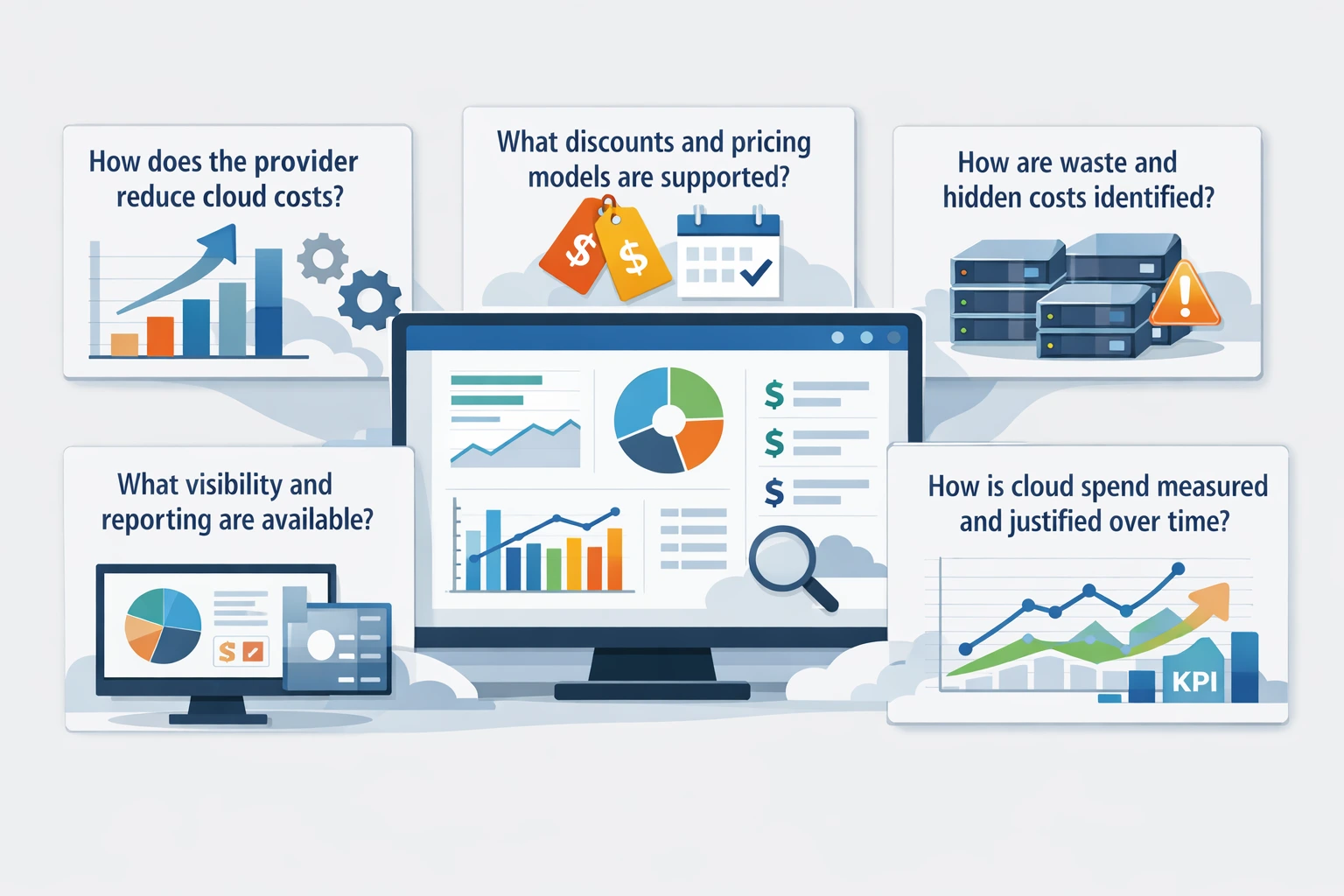
Our experts put together these five questions to help clarify that situation. They focus on how a cloud cost optimization provider manages costs, improves visibility, and helps teams understand the value behind their cloud spend while staying aligned with business goals.
An Overview
1. How Does the Provider Reduce Cloud Costs?
Cloud cost optimization focuses on managing cloud resources and spending to reduce overall costs. This process relies on a combination of proven strategies.
Discount programs play a key role. Long-term commitments, such as Reserved Instances, enable organizations to reduce costs by making upfront payments tied to defined usage periods. Monitoring is equally important. Continuous tracking helps identify waste, including idle and underutilized resources that continue to generate charges.
Scaling decisions also affect costs. Unused resources can be removed, existing ones resized, and additional resources added as performance requirements increase. Effective cost optimization depends on balancing discounts, monitoring, and scaling based on actual usage.
2. What Discounts and Pricing Models Are Supported?
Many cloud providers offer discounts when resources are purchased in advance. Reserved capacity remains one of the most common cost-saving options. This approach involves paying upfront regardless of usage in exchange for discounted pricing based on long-term commitments.
Major public cloud platforms follow this model. AWS offers Reserved Instances, Azure provides Reserved Virtual Machine Instances, and Google Cloud Platform uses Committed Use Discounts. Each allows commitments for 1 or 3 years, based on a defined volume of resources.
Pricing transparency also matters. Some cost management tools charge a percentage of total cloud spend, which can grow expensive over time. Per-device pricing models may deliver stronger return on investment, depending on usage scale.
3. How Does the Solution Identify Waste and Hidden Costs?
Unused cloud resources are a common source of unnecessary spending. Idle or underutilized instances continue to incur charges while providing no value.
The pay-as-you-go model often leads to confusion. Charges apply to what is provisioned, not what is actively used. This makes it easy to accumulate high bills tied to unused resources.
A capable provider helps identify unused, idle, and underutilized instances. Once identified, these resources can be reviewed and addressed by shutting them down, resizing them, or redistributing workloads to make better use of existing capacity.
4. What Level of Visibility and Reporting Does It Provide?
Most organizations operate across multiple cloud providers. Multi-cloud visibility is essential to maintain consistent insight across environments such as AWS, Azure, and Google Cloud Platform. Hybrid visibility also matters, as infrastructure often spans on-premises systems, public cloud, and private cloud environments.
Reporting capabilities should support both high-level oversight and detailed analysis. A cost savings dashboard should present current spending, comparisons with previous periods, idle resources, rightsizing opportunities, and potential savings.
Detailed reports need to be easy to configure and understand. The ability to group and filter billing data by attributes, tags, and time periods supports deeper analysis. Comparing spend across time periods helps track trends and usage shifts.
Multi-dimensional analysis allows costs to be examined from multiple angles. Per-instance visibility supports identifying expensive resources and comparing them by utilization, type, tags, and usage states, such as reserved or on-demand. Custom and exception-based reporting ensures teams focus only on data that requires action.
5. How Is Cloud Spend Justified and Measured Over Time?
Lower spend does not always indicate better outcomes. In some cases, stable or increased cloud spend supports growth and operational goals.
Justification depends on demonstrating return on investment. This requires clear insight into why the cloud is used, what value it delivers, and how it aligns with business strategy. Leadership benefits from visibility into usage patterns and their connection to organizational objectives.
Review your Cloud Costs with Bobcares

Measuring success involves more than revenue. Financial KPIs track spending efficiency, while business-value KPIs assess improvements in productivity, efficiency, and operational outcomes. These benchmarks help evaluate the effectiveness of cloud investments and explain the value of cloud adoption compared to on-premises environments.
Conclusion
At Bobcares, these are the same questions we encourage clients to ask when reviewing their cloud cost management approach. They help set clear expectations around visibility, accountability, and long-term value. When cloud spending is understood and measured properly, teams are better equipped to control costs while keeping their infrastructure aligned with business priorities.

