


Designing zero-trust access models for cloud infrastructure with DevSecOps to secure identities, workloads, credentials, and resource access.
The security model of a traditional corporate network does not work as well once workloads move to the cloud. In dynamic, multi-cloud environments, relying only on IP allowlists, static firewalls, or VPN boundaries creates weak points.
Instead, frameworks such as NIST SP 800-207 move security away from the network edge and closer to individual resources and identities.
The first principle of Zero Trust Architecture (ZTA) is to never trust the network, and never trust a user just because they are located somewhere else. This can enable organizations to develop access models to confirm every request before it is granted.
An Overview
How Cloud-Native Zero Trust Works
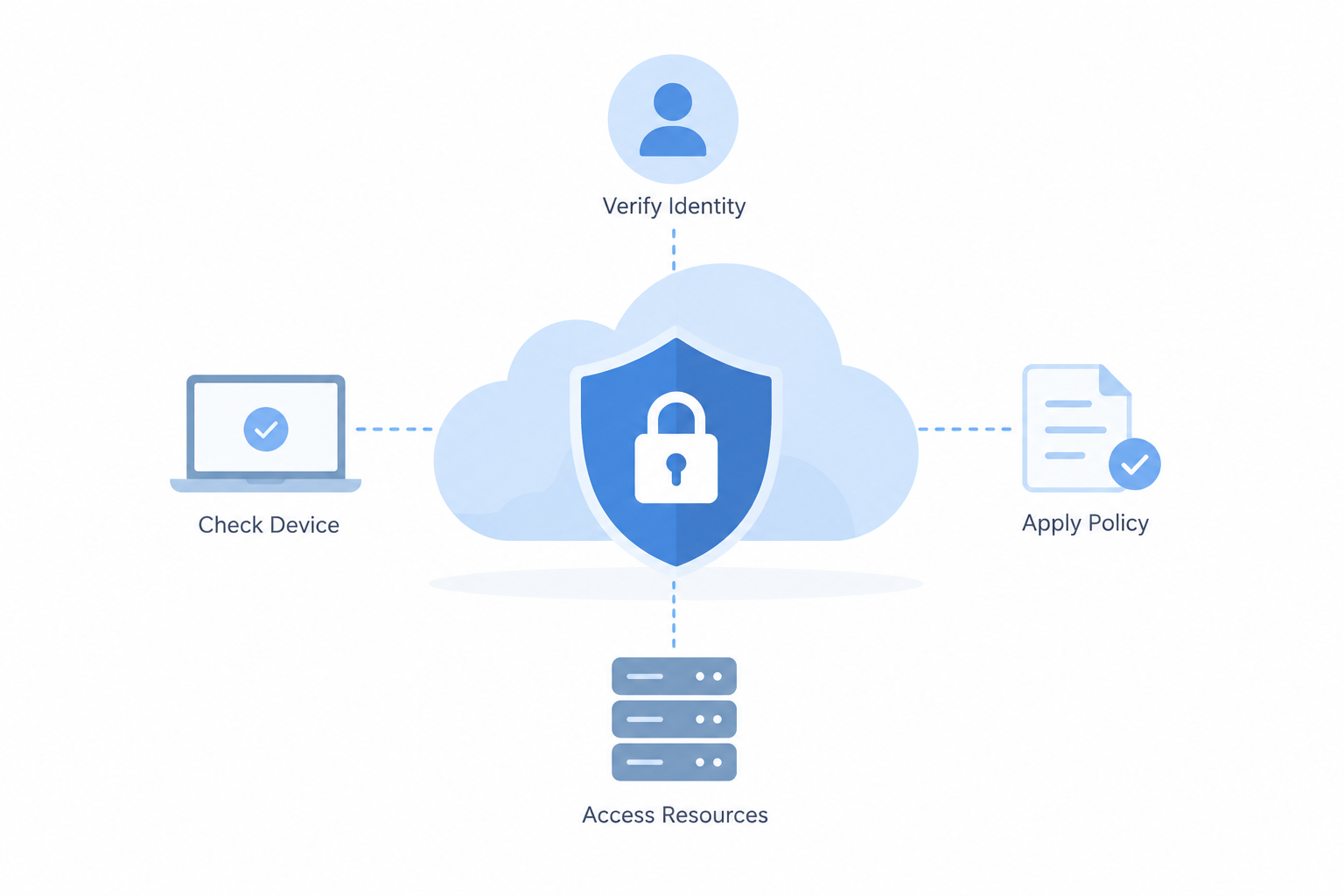
A cloud-native Zero Trust approach is a way of decoupling access decisions from access enforcement. The NIST approach is based on two elements:
| Component | Role |
|---|---|
| Policy Decision Point (PDP) | Assesses each request and decides whether to grant access based on identity assurance, device posture, and environmental signals. |
| Policy Enforcement Point (PEP) | Applies the PDP decision at the resource boundary by allowing, restricting, or ending the session. |
For instance, an API Gateway, sidecar proxy or an identity-aware proxy can be used as a PEP.
The separation enables consistent security policies to be maintained whilst the system enforces them near the resource.
Replace Static Credentials with Temporary Access
The use of static API keys, long-lived access tokens, and permanent service accounts can make cloud breaches more likely. So, Zero Trust is least privilege per session.
Alternatively, cloud architectures can use Just-In-Time (JIT) access and temporary credentials, rather than permanent keys.
Strengthen Your Cloud Security.

An engineer or deployment pipeline requests a temporary token for a specific task when it wants to access a secure resource. The permission is granted for as long as necessary. After the expiration of the token, the access is automatically terminated.
This means, therefore, that even if a credential is stolen, there is only a limited amount of time for it to be used.
Secure Machine-to-Machine Communication
Human identity is only one part of Zero Trust. In distributed microservices, workloads can scale across different clusters. As a result, IP-based security policies become less effective.
This is where SPIFFE (Secure Production Identity Framework for Everyone) and SPIRE become important. SPIFFE assigns cryptographically verifiable identities directly to workloads instead of depending on network location.
A workload identity can use a URI such as:
spiffe://trust-domain.internal/ns/production/sa/payment-serviceSPIRE agents can perform local attestation by checking workload details in the host environment. For example, they can check Kubernetes pod labels or AWS instance metadata.
After successful verification, SPIRE provides a short-lived X.509 certificate or JWT. Microservices can then use these credentials to establish mutual TLS (mTLS).
With mTLS, both sides of a network call authenticate each other before they exchange data.
A Practical Zero Trust Blueprint
Moving from a perimeter-based model to Zero Trust should happen in clear stages.
1. Map Assets and Identities
Begin with giving names to human users, identities for non-human users, and data flows. This helps to show areas where there is still implicit trust in the current environment.
2. Strengthen Identity Controls
Next, require strong authentication and enforce multi-factor authentication (MFA). Also, verify device compliance prior to granting access to protected resources.
3. Protect the Application Layer
On the application level, break up large flat subnets. Intercept, authenticate and encrypt internal traffic with software-defined perimeters and service meshes.
4. Use Continuous Telemetry
Zero Trust doesn’t end at login. Access should be continually reevaluated with real-time behavior and risk signals.
Feed these signals into the policy decision process so the system can revoke sessions when it detects abnormal activity.
Building a Resource-Focused Security Model
Zero Trust is not a single software product. Instead, it is an architectural approach that removes unnecessary trust from the environment.
Using temporary access controls and cryptographic authentication for workloads helps organizations lessen their reliance on perimeter defenses and to better secure individual resources.
Conclusion
Cloud environments require an access model that is not based on network location or permanent credentials. Zero Trust meets this requirement by verifying identity, device posture and other signals available before granting access.
With the mix of policy, resource-level enforcement, temporary credentials, workload identities and ongoing telemetry, an organization can create a more resilient security model for dynamic cloud infrastructures.

