


Explore the world of DevSecOps Automation and elevate your development processes with integrated security measures.
Software development moves fast. Developers may update code several times a day, so waiting for a separate security review can slow down the entire process.
A DevSecOps Automation Platform brings security checks into the development process. As a result, teams can find security issues earlier and fix them before they affect a release.
An Overview
The Problem With Traditional Software Security
Early software development relied heavily on task exchange across developer, operations, and security teams to build and ship secure software.
A developer would write code, pass it to an operations team to deploy the software, and ultimately, a security review team that would test if the software was safe prior to a release. As you would expect, a security review that turned up a vulnerability would halt the project in its tracks until the developers addressed the security concerns.
However, this process does not suit teams that release code daily or even hourly. They need security checks to happen quickly without stopping development.
That need led to the idea behind DevSecOps: Development, Security, and Operations working together through the development process.
Secure Your Development Pipeline.

What Is a DevSecOps Automation Platform
DevSecOps Automation platforms integrate automated security checks into the software development process.
Traditional software developers build and review code as a linear process. However, a DevSecOps platform checks for security risks as a developer writes code or expands a component.
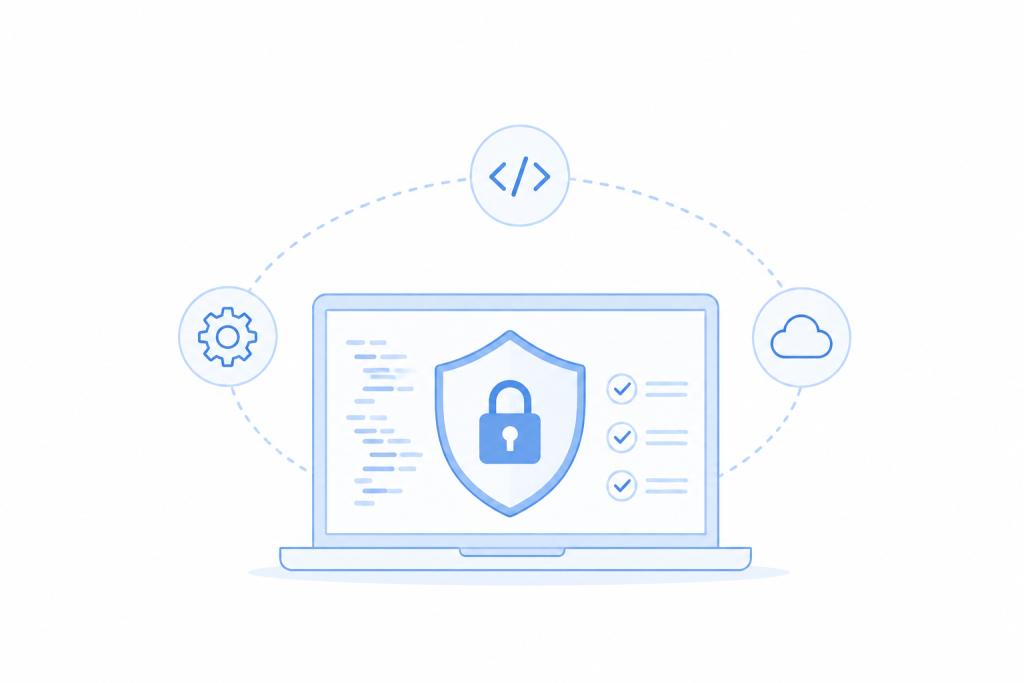
If the code passes the checks, then the developer can build and deploy more code. However, if a security concern is found, the code is blocked from proceeding.
Therefore, security becomes part of development rather than a final step.
How Does the Platform Check for Security Risks
The platform integrates a collection of automated security testing methods.
Static Application Security Testing (SAST)
SAST analyzes source code for security risks. These types of security concerns can take the form of an injection attack, where code can intentionally be used to exploit web application functionality through SQL.
Dynamic Application Security Testing (DAST)
DAST checks the software by emulating a variety of attacks against a functioning application. DAST security testing checks web application functionality and web forms and can test the security of APIs.
Software Composition Analysis (SCA)
Instead of developers building everything, developers can use open source components. SCA performs analysis on those components for known vulnerabilities.
Secret Scanning
A file storing secrets, like API keys or database passwords, may be added by the developer. Secret scanning finds these secrets and prevents them from being deployed to production environments.
DevSecOps Automation in Action
Let’s assume a fintech team is building a mobile application to provide mobile payments.
A developer enables a feature in the application and uses an open-source library to help format the data. Unfortunately, the library has a vulnerability. The developer also uses a configuration file to store the password to an AWS database.
Without Automation
The code moves to the staging environment and a week later is reviewed by a security analyst. Both issues are found at this time.
An analyst block the release.
With Automation
The developer submits the code. As a result, the security checks performed by the CI pipeline begin.
The secret scanning tool finds the exposed AWS database password while the SCA scan finds the vulnerable library.
The build automatically fails and a notification is sent to the developer.
The AWS database password and vulnerable library are fixed.
As a result, the issues are fixed quickly.
Why Use a DevSecOps Automation Platform
DevSecOps automation enables a team to continue developing the application and avoid security reviews from becoming a criteria that blocks the development of an application.
Automated security checks allow developers to:
- Identify security issues earlier in the development process.
- Receive feedback and resolve security issues quicker.
- Resolve security issues during the development process and avoid delays leading to the release of the product.
- Continuously develop new features that integrate security checks.
Automated security checks are integrated into development workflows which is the most significant feature of the security checks platform.
Conclusion
Traditional security reviews may end up prolonging the release of software. The DevSecOps Automation Platform fixes this problematic situation by moving security checks to the development phase.
The platform is capable of performing SAST, DAST, SCA, and secret scanning to check various components of the application. Due to this, developers can identify issues earlier, solve them sooner, and avoid delays during the development process to wait for a final security check.

