


DevSecOps helps cloud teams automate incident response, preserve evidence, improve visibility, and contain security threats with faster action.
Cloud incident response needs more than a fast human response. In a cloud environment, workloads can start and stop within minutes. By the time an engineer logs in and connects to a cluster, an auto-scaler may have already removed the affected container and started new ones.
That can leave security teams with little evidence to investigate.
Thus, the key points of effective cloud incident response are automated evidence collection, deep system visibility, rapid containment and continued reliability improvements. Teams can create these steps within their infrastructure rather than relying on manual action.
An Overview
Automate Evidence Collection
Traditional forensics becomes difficult when a workload exists for only a few minutes. In the cloud, teams need to preserve evidence before the affected workload disappears.
If a security tool identifies an unauthorized binary running a pod, for instance, it should not just kill the pod, but also take steps to alert the user to the presence of the binary.
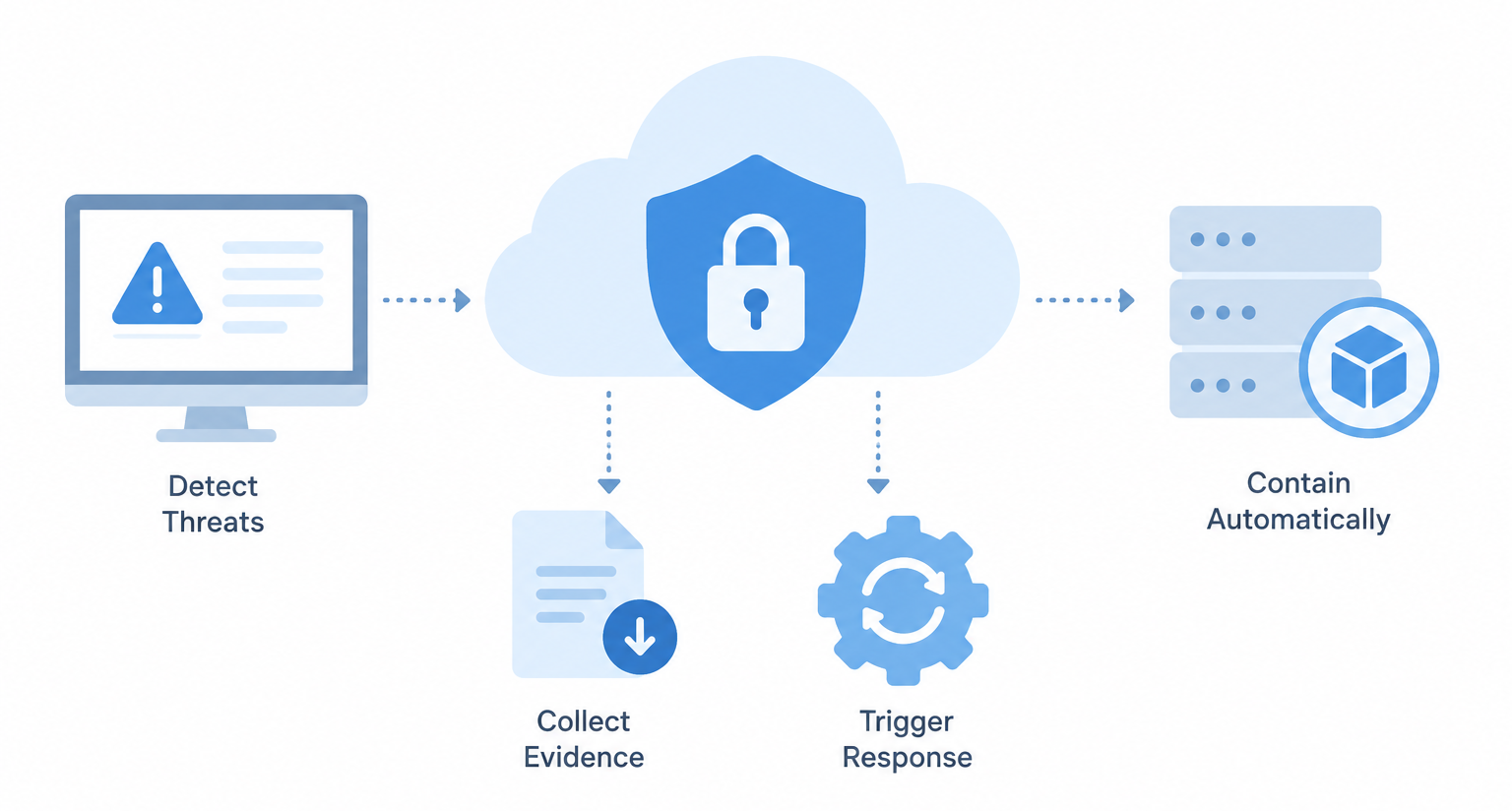
An event-driven response can:
- Trigger a serverless function to start evidence collection.
- Make snapshots of underlying EBS volumes.
- Capture container memory.
- Change the security groups of the affected node to isolate it.
- Place evidence in a very restricted S3 bucket.
- Terminate the instance only after the required evidence is safe.
This will enable teams to maintain valuable forensic data and ensure a rapid response.
Use eBPF for Deeper Visibility
User-space monitoring may not provide enough visibility during a serious attack. An attacker with root access inside a container may also try to disable security agents.
That’s where Extended Berkeley Packet Filter (eBPF) can come in handy. The team can attach eBPF programs to Linux kernel hooks and see:
- System calls
- Network packets
- File execution
- Activity across containers on a node
However, eBPF can also create security risks. Attackers with the required privileges, such as CAP_BPF, can use malicious eBPF programs to hide their activity.
Strengthen Cloud Incident Response.

Therefore, incident response plans should also control and audit who and what can load eBPF bytecode.
Build Containment into Code
During a security incident, manual decisions can take too long. Automated containment can reduce that delay.
Consider a developer who accidentally publishes an AWS access key in a public repository. An attacker can find and test exposed credentials within seconds. The risk can be heightened if you wait for an analyst to confirm the alert and delete the access manually.
A response workflow can respond immediately upon the detection of the leak or suspicious API activity. It can:
- Revoke the current session.
- Rotate the compromised keys.
- Apply a strict deny-all IAM policy to the affected role.
As a result, the team can limit the possible damage while it investigates the incident.
Treat Incident Response as Reliability Debt
A security incident can also become a reliability problem. If an incident causes downtime or forces teams to isolate services, it can affect the service level objectives (SLOs) and consume part of the error budget.
For this reason, security and reliability teams should review incidents together.
After a breach, near-miss, or automated containment action, teams can conduct a blameless post-mortem. The review should turn lessons into engineering work. For instance, the team may discover:
- A missing guardrail
- An overly permissive IAM role
- A gap in kernel telemetry
The results of these findings benefit the teams in enhancing the infrastructure and minimizing the risk of recurrence.
Conclusion
Infrastructure that can respond before humans can respond is best suited for cloud incident response. Preserving short-lived data with automated evidence collection, deeper visibility with eBPF, and faster response times with coded containment.
Most importantly, teams should treat every incident as a chance to improve reliability.
Do not depend on heroic action. Build incident response into the infrastructure and let automation handle the time-sensitive work.

