


Learn how to start a hypothesis and turn product ideas into testable assumptions. Understand how we can use hypotheses to validate ideas, guide MVP development, and reduce early startup risk. Our Product Engineering Support team is here to help you with your questions and concerns.
Many people working on a new product feel confident about their idea in the early stages. The problem appears obvious and the solution looks promising. Conversations with friends or colleagues often reinforce that belief.
However, reality changes once a product reaches real users. This is when assumptions begin to face evidence.
A hypothesis helps you face this uncertainty in a structured way. It turns an idea into something that can be tested.
This is why we believe understanding how to start a hypothesis is an important step in early product development and MVP planning.
Why Product Ideas Need Hypotheses
Every product concept contains assumptions. These assumptions influence how the product is built, who it serves, and why users would adopt it.
Some of the common assumptions include:
- People experience the problem you identified
- Users want the type of solution you imagine
- The product can deliver clear value
Many organizations make the mistake of skipping this step and moving directly to building features. In short, development begins before the core assumptions are validated. This approach creates risk.
Months of work may produce a product that solves the wrong problem or targets the wrong audience. Investors and early users quickly notice this gap.
Fortunately, a hypothesis has the power to reduce that risk. It defines exactly what must be true for the product idea to work.
Idea to Hypothesis: The First Shift in Thinking
Product ideas often begin as broad thoughts. You notice a problem and quickly imagine a solution. Early discussions usually stay at this level. The concept sounds promising, yet the assumptions behind it remain unclear. In order to progress further, there needs to be a shift in thinking. The idea must move from a general belief to a clear statement that can be examined. This shift marks the point where a concept begins to turn into a hypothesis.
Examples appear often in early discussions:
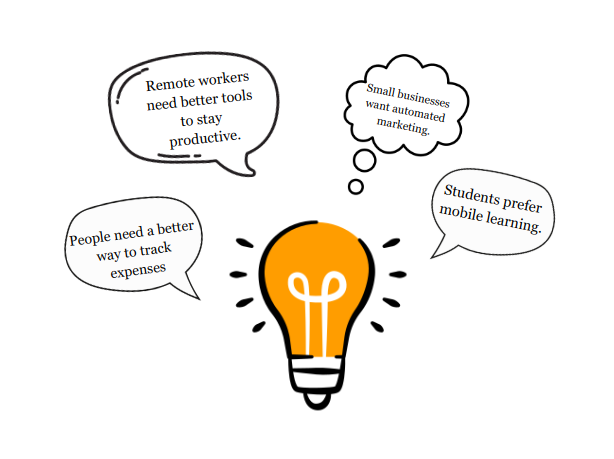
These statements sound convincing. However, they are difficult to test.
A useful hypothesis requires more clarity. It describes a specific belief about a specific group of users.
A simple structure helps: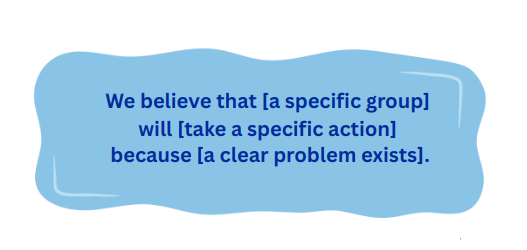
For example:
“We believe that freelance designers will use an automated invoicing tool because manual billing takes too much time.”
This forces clarity and reveals exactly what assumption needs validation.
How to Identify the Assumptions Behind an Idea
Start by asking a simple question: what must be true for this idea to succeed? The answers usually relate to users, problems, or expected behavior. Some assumptions involve how people currently solve the problem. Others relate to why they might try a new solution. Writing these beliefs down helps see what needs validation before product development begins.
Here is a useful question to help get started:
“What must be true for this idea to succeed?”
The answers usually fall into several areas:
- Customer behavior
Users must care about the problem.
- Value perception
Users must see the solution as useful.
- Adoption willingness
Users must be willing to try the product.
- Technical feasibility
The product must deliver the promised experience.
Now, we can turn each assumption into a hypothesis.
Example:
Idea: A platform that helps riders find compatible bike parts.
Possible hypotheses:
- Riders struggle to identify compatible components.
- Riders want a faster way to check compatibility.
- Compatibility recommendations increase purchase confidence.
Each statement can later be tested through user interviews, prototypes, or MVP features.
What Makes a Good Hypothesis
A good hypothesis clarifies an assumption. It explains exactly what you believe and what result would confirm that belief. Clear hypotheses make it easier to design experiments and understand outcomes. Each hypothesis should describe a specific user behavior or observable outcome. This clarity allows us to learn from real evidence rather than rely on guesswork. Not every hypothesis produces useful learning.
Testable Hypothesis
A hypothesis must be capable of being proven right or wrong.
Example of a weak statement:
People prefer digital banking.
This statement lacks clarity.
A stronger hypothesis looks different:
Young professionals between 22 and 30 will check their banking app daily if spending insights appear on the dashboard.
This version can be tested through usage data.
Clear and Specific
Ambiguous statements cause problems during validation.
Example of a vague assumption:
Students care about saving money.
Different people may interpret this in different ways.
A clearer hypothesis removes that ambiguity:
University students living off campus will compare prices between grocery stores if a mobile app shows weekly discounts.
Everyone now understands the behavior being tested.
Focused on One Idea
Some hypotheses mix several assumptions together.
Example:
Our platform will increase conversions and reduce support costs.
Two separate questions exist here.
A clearer approach separates them:
- The platform will increase conversion rates for product purchases.
- The platform will reduce support requests related to product selection.
Each statement can be tested independently.
Ranking Hypotheses Before Testing
As mentioned earlier, not every hypothesis carries the same level of importance. Some assumptions determine whether the product idea works at all. Others influence details that can be adjusted later. We should review their hypotheses and identify which ones involve the highest uncertainty and the biggest impact on the product. These should be tested first. This approach ensures early experiments focus on the assumptions that matter most. Clear prioritization helps avoid wasting time validating minor details while critical risks remain unanswered.
We can rank hypotheses using two factors:
- Importance
Does the assumption affect the core idea? - Uncertainty
Do we have evidence supporting it?
Hypotheses that score high in both areas should be tested first.
For example:
A startup building a compatibility engine for bike parts may identify several assumptions. The most critical one might be:
Riders will trust automated compatibility recommendations when choosing components.
This assumption directly affects the product’s value and testing it early provides clarity.
How to Turn Hypotheses Into Validation Experiments
A hypothesis becomes useful only after it leads to a test. Validation experiments help determine if the assumption holds true in real situations. Each experiment should focus on one clear question linked to the hypothesis. User interviews, simple prototypes, or landing page tests can reveal how people react to the idea. Results from these experiments provide evidence that either supports the belief or challenges it. This process helps us learn quickly before committing to full product development.
Some of the common early validation methods include:
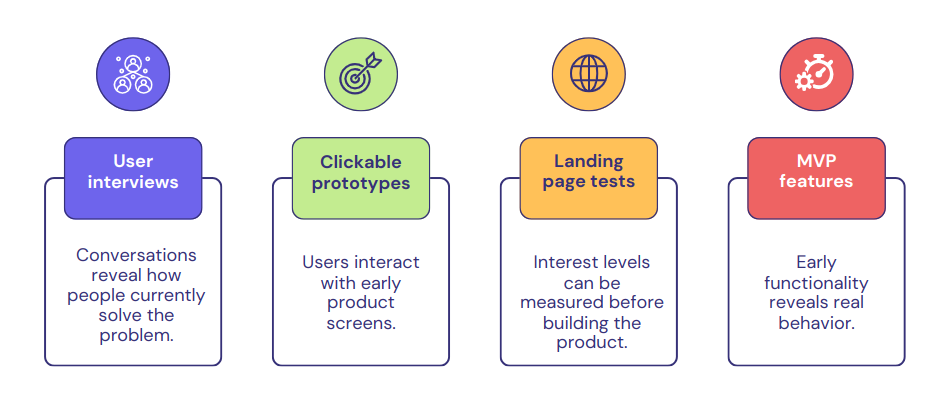
Each experiment attempts to answer one question.
Does the hypothesis hold true?
Clear hypotheses make experiment design easier and results also become easier to interpret.
Why Hypotheses Matter for MVP Development
Hypotheses play a central role in MVP development because they define what the product is trying to learn. An MVP should not exist just to show features. Its purpose is to test the most important assumptions behind the idea. This focus keeps the MVP simple and meaningful. Evidence gathered from early users then helps founders decide the next step with greater confidence.
Many early products fail because they attempt to deliver too many features at once. Learning becomes unclear.
A hypothesis-driven MVP focuses on validating the most critical assumptions first.
For instance:
A startup building an AI data security product may begin with one central hypothesis.
Enterprises want visibility into sensitive data passing through APIs and AI systems.
The MVP then demonstrates this single concept. Early users and investors can understand the value quickly.
Learning happens faster because the product tests a clear idea.
Steps to Start Your First Hypothesis
Turning an idea into a hypothesis becomes easier through a simple process.
- First, write down your product idea.
Example: A marketplace that helps cyclists find compatible parts for their bikes.
- Then, ask what must be true.
Possible answers:
- Riders struggle to verify compatibility.
- Riders want faster product discovery.
- Compatibility recommendations increase purchase confidence.
- Next, convert assumptions into hypotheses
Example: We believe that riders will use compatibility suggestions when searching for replacement bike components.
- Now, define success signals
Example: Users choose recommended compatible parts more often than manual search results.
Each step moves the idea closer to evidence.
Investors rarely expect founders to know everything early. They look for clarity in thinking.
Clear hypotheses demonstrate disciplined product development. They show that founders understand risk and actively test assumptions.
Conversations become stronger when explanations are clear:
- What assumptions exist
- Which hypotheses are being tested
- What evidence has been collected
This approach builds credibility and investors see learning instead of guesswork.
Conclusion
In short, a strong product begins with clear questions. A hypothesis helps founders ask those questions properly. It converts belief into something that can be tested and learned from.
Understanding how to start a hypothesis allows founders to move from concept to evidence. Most important of all, it ensures that every step forward reduces uncertainty instead of increasing it.

