


Managed cloud services help achieve ISO compliance with better risk control, access management, security practices, and cloud governance.
It is important that organisations can demonstrate that their cloud infrastructure aligns with known security standards as more organisations shift critical workloads to the cloud. ISO/IEC 27001 is a framework designed to handle information security risks and shield crucial data and systems.
It’s also useful for cloud hosting providers to meet the responsibility for shared resources, multi-tenancy, access management and evolving infrastructure.
An Overview
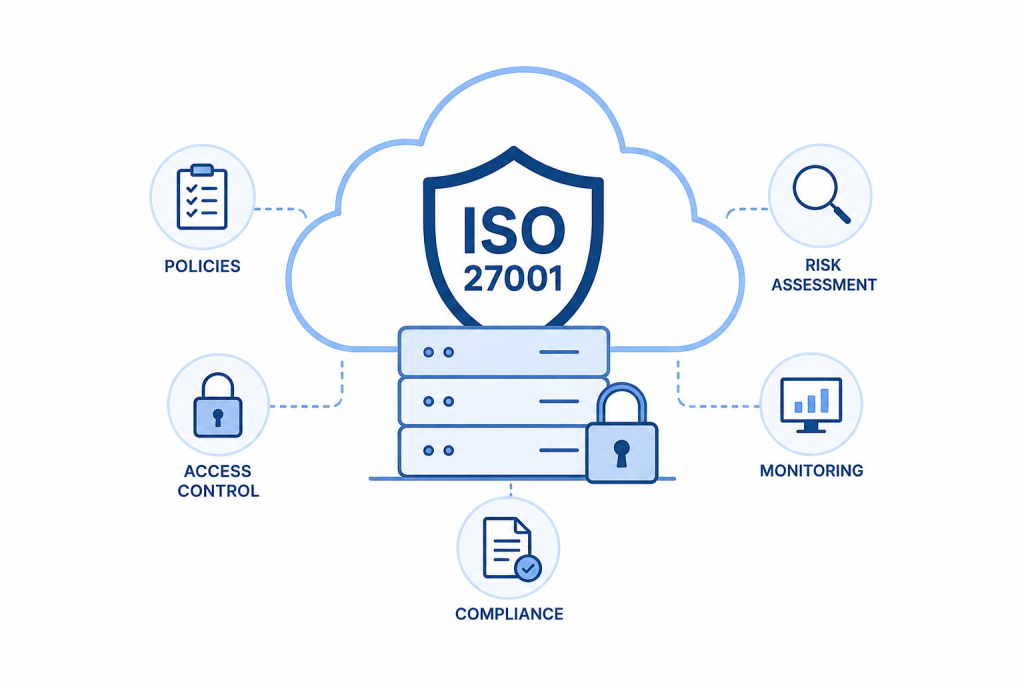
What Is ISO Compliance in Cloud Hosting?
ISO/IEC 27001 is the standard which specifies the requirements for an Information Security Management System (ISMS). It assists organisations to detect risks, implement security measures and enhance information security as time goes on.
It is more than just a checklist of technical details. Clear ownership, security policies, risk assessments and evidence of controls in practice are of course required for organisations as well.
Two related standards are also relevant:
- ISO/IEC 27017: Provides guidance for cloud services and shared responsibilities between providers and customers.
- ISO/IEC 27018: Focuses on protecting personally identifiable information in public cloud environments.
Strengthen Your Cloud Security.

Why Does ISO Compliance Matter?
Cloud environments create security challenges because workloads can span different data centres, regions, and providers. The provider and customer are also responsible for security tasks.
Key areas include:
- Shared responsibility: Providers can secure the physical infrastructure; customers can take care of operating systems, applications and access.
- Multi-tenancy: Good network and storage isolation of customer environments.
- Dynamic infrastructure: It can be more difficult to track assets and keep an accurate change record when resources change frequently.
Steps to Achieve ISO Compliance
1. Define the ISMS Scope
Define the systems, services, infrastructure and processes the ISMS will apply to. This provides transparency to the organisation and auditors of what is included in the compliance scope.
2. Assess Security Risks
Define critical assets, threats and existing controls. Poor patch management, weak network separation, excessive privileged access, and weak controls over hypervisors and management consoles are some of the common risks associated with cloud hosting.
Then, create a risk treatment plan based on likelihood and impact.
3. Apply Security Controls
Key controls include:
| Control | Purpose |
|---|---|
| Access control and MFA | Restrict administrative access |
| Encryption | Encrypt data at rest and in transit |
| Network segmentation | Separate customer environments |
| Logging and monitoring | Detect unusual activity |
| Change management | Track infrastructure changes |
| Vendor management | Manage third-party risks |
4. Maintain Documentation
Ensure policies, risk assessments, access records, change records and logs are kept current and up to date, along with evidence. Also, review and approve policies periodically.
5. Audit and Certify
Do an internal audit to determine the gaps first. Next, management should review the ISMS and existing risks.
An external certification body carries out the certification audit in two stages. In Stage 1, the ISMS documentation and readiness will be reviewed, and in Stage 2, the effectiveness of the controls and processes will be checked.
How to Maintain ISO Compliance
Compliance with ISO needs to be monitored on an ongoing basis. Cloud hosting providers should:
- Use automation to collect evidence when possible.
- Monitor changes to configuration with Infrastructure as Code.
- Conduct regular vulnerability assessments and penetration tests.
- Update the risk register as the environment changes.
- Periodically examine access permissions.
- Practice incident response practices.
What Are the Benefits?
Effective management of an ISO program can enhance asset tracking, access control and incident response. It may also streamline the security evaluation process for customers of cloud hosting services, which can keep records of the processes used and offer evidence of audits.
Conclusion
ISO compliance isn’t an audit that is simply passed. It is a structured approach to the identification of risks, access control, information protection and change management.
Organisations need to regularly review the security, keep records, and apply appropriate controls to reduce risk and strengthen their cloud security approach.

