


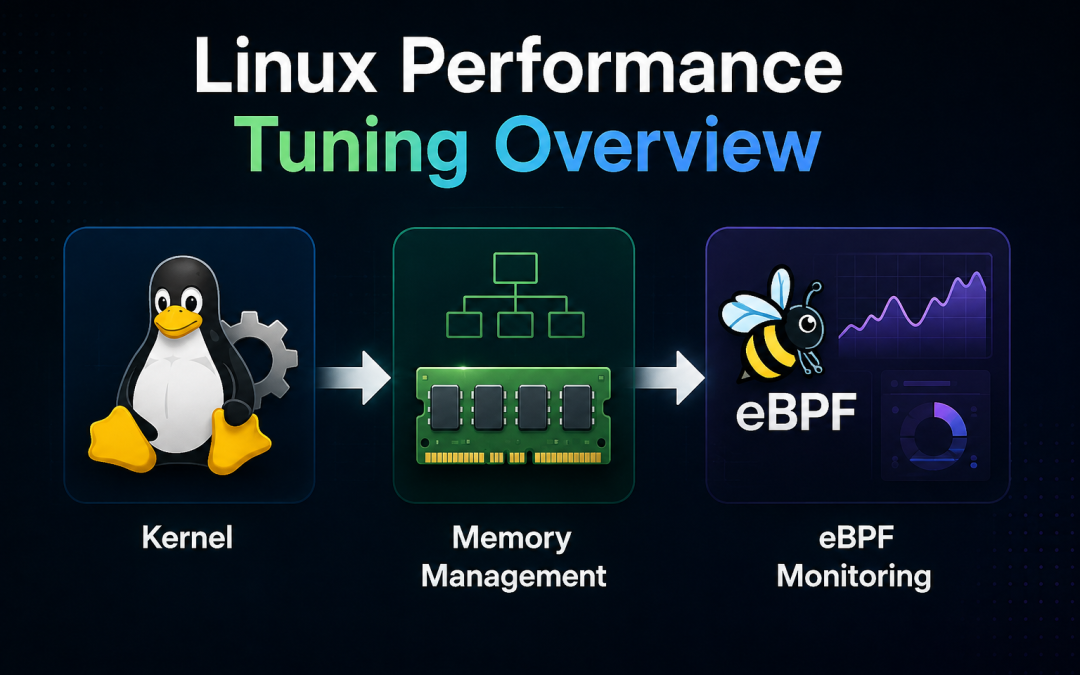
Learn Linux server performance tuning techniques for 2026, including kernel parameters, HugePages, virtual memory management, and eBPF monitoring.
Linux servers are designed to support a wide range of workloads, but default configurations may not deliver the best results under demanding production environments. High-throughput applications require careful tuning of kernel parameters, memory management, and monitoring to improve stability and performance. Bobcares offers Linux Server Management Services to help businesses manage and fine-tune Linux environments for production workloads.
An Overview
Network Stack and Virtual Memory Kernel Tuning
The Linux kernel manages network traffic and temporary page caching through runtime settings exposed by sysctl. Under heavy production workloads, default queue sizes and socket tables can quickly reach their limits. This may result in dropped packets, connection delays, and unnecessary CPU usage. Disk performance can also suffer when dirty data remains in memory for too long before being written to storage.
A production configuration may include increased network backlog limits and adjusted virtual memory settings.
# Elevate the core connection backlog queue limits

net.core.somaxconn = 65535

net.ipv4.tcp_max_syn_backlog = 16384

# Open wide TCP window allocations for high-speed paths

net.ipv4.tcp_rmem = 4096 87380 16777216

net.ipv4.tcp_wmem = 4096 65536 16777216

# Force proactive background storage syncs

vm.dirty_background_ratio = 5

vm.dirty_ratio = 10

vm.swappiness = 10
Improper kernel settings may lead to:
- SYN queue exhaustion during traffic spikes.
- File system stalls caused by delayed disk writes.
- Performance issues from aggressive paging to swap space.
Test configuration changes using sysctl -w before applying them permanently. Verify hardware limits before increasing TCP memory allocations to avoid exhausting available resources.
Advanced Memory Management
Linux uses 4 KB memory pages by default. Resource-intensive workloads such as PostgreSQL and Redis require the CPU to manage a large number of memory pages, increasing Translation Lookaside Buffer (TLB) lookups and reducing performance.
Linux addresses this by supporting HugePages through either Static HugePages or Transparent HugePages (THP). Static HugePages reserve memory in advance, while THP combines pages dynamically.
Transparent HugePages can introduce application delays because of memory defragmentation. Reserving Static HugePages without configuring applications to use them can also leave memory unavailable to the operating system.
Disable Transparent HugePages for high-performance databases and rely on Static HugePages where appropriate.
echo never > /sys/kernel/mm/transparent_hugepage/enabled

echo never > /sys/kernel/mm/transparent_hugepage/defrag
Calculate the required number of 2 MB pages and configure vm.nr_hugepages accordingly.
Real-Time eBPF Monitoring
Traditional monitoring tools collect data at fixed intervals and may miss short-lived performance issues. They also consume system resources during collection.
Extended Berkeley Packet Filter (eBPF) runs lightweight programs inside the kernel, providing detailed performance information with minimal overhead.
Legacy monitoring approaches can consume resources during troubleshooting and miss short-duration latency spikes that occur between collection intervals.
Use native eBPF tools such as Coroot or Tetragon for continuous monitoring. Install bcc-tools for live troubleshooting with utilities including:
- tcptop
- execsnoop
- ext4snoop
These tools provide targeted visibility into network, process, and file system activity.
Conclusion
Effective Linux server tuning requires careful adjustment of kernel networking, memory management, and monitoring rather than isolated configuration changes. Reviewing connection limits, managing memory through HugePages, enabling appropriate congestion control, and adopting eBPF monitoring help create more predictable production environments. Bobcares supports businesses through its Linux Server Management Services, helping maintain Linux infrastructure for demanding production workloads.

