


Compare in-house and outsourced managed IT services for better cost control, lower risk, 24/7 support, and scalable IT infrastructure in 2026.
When it comes to growing companies in the years to come, outsourced and in-house IT infrastructure management solutions both have their positives and their negatives that differentiate them. This assessment looks at these options to help companies determine which solution is the best fit for their business.
An Overview
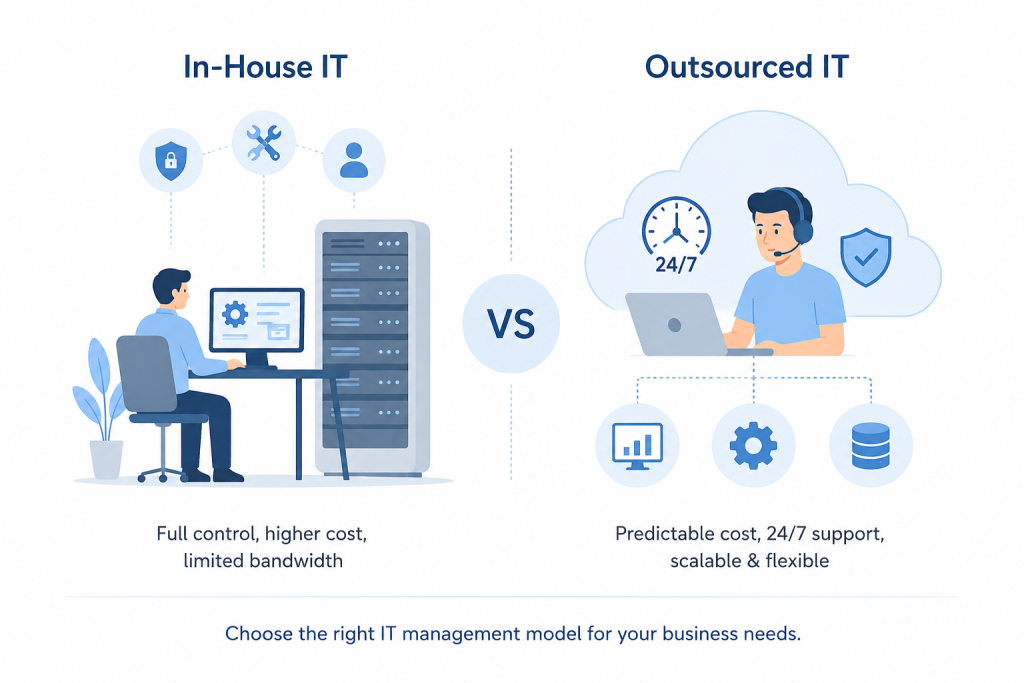
What Is In-House IT Management?
In-house IT management means employing an IT team to manage your servers, cloud resources, security monitoring, backups and support.
This option gives a company a high degree of control over its IT Infrastructure. On the other hand, a company has to manage paying, developing, and supporting the staff, as well as dealing with the rest of the tools and costs.
Simplify Your IT Management.

What Is Outsourced IT Management?
Outsourcing IT management means signing contracts with organizations that provide part or all IT management services.
Some managed services providers may have the capacity to provide 24/7 service support, proactive monitoring, and offer security and scalable services that fit the needs of a firm with a hybrid environment. Some providers may use SLAs to provide predictable pricing.
In-House IT: Pros and Cons
With this model, companies exert complete control and align closely with their internal business processes. Further, a company can ensure complete control and oversight of sensitive data.
This model also carries greater and less predictable costs. It can be challenging for a company to maintain 24/7 coverage or access all necessary skills or specializations. Further, this model can create operational risks through the loss of a key employee, and rapid growth can negatively impact the company’s ability to scale.
Outsourced IT: Pros and Cons
With this model, companies exert complete control and align closely with their internal business processes. Further, a company can ensure complete control and oversight of sensitive data.
This model also carries greater and less predictable costs. It can be challenging for a company to maintain 24/7 coverage or access all necessary skills or specializations. Further, this model can create operational risks through the loss of a key employee, and rapid growth can negatively impact the company’s ability to scale.
Outsourced vs In-House IT: Key Differences
| Factor | In-House IT | Outsourced IT |
|---|---|---|
| Cost | Salaries, training, tools, and other staff-related costs | More consistent monthly costs |
| Control | Full direct control | Less direct control in some areas |
| Support | Difficult to provide 24/7 coverage | 24/7 support |
| Expertise | Depends on the team | More diverse expertise |
| Scalability | Scalability can be slow in times of rapid growth | Flexible scalability |
| Risk | Key-person dependency is a risk | Can minimize risk |
| Monitoring | Managed by the internal team | Can be an add-on and include proactive monitoring |
Which IT Management Model Is Better?
There are several factors.
For companies with a strong need for significant control and customization, large companies are more likely to choose in-house IT. Large companies also tend to have the dedicated budgets necessary to support in-house IT.
Mid- to large companies in the e-commerce, logistics, retail, or supply chain are more likely to choose outsourced IT. Predictable costs, 24/7 reliability, and the capacity to scale rapidly are more important to these industries.
A company must evaluate their IT needs, resources, and future IT outlook to determine the most appropriate IT management model.
Conclusion
By 2026, many growing companies will find that outsourced IT Infrastructure Management will offer lower costs, less risk, and greater ease of scalability. In-house IT will be appropriate for the companies that need more control and customization.
The choice will depend on your business, your goals, and how you want to grow.
At Bobcares, we value the uniqueness of every customer and strive to meet their specific business goals. Contact us today to know how we can serve you better with our hybrid infrastructure and tailored managed services.

