


Explore AI and ML in DevOps with AIOps to detect anomalies, predict failures, improve CI/CD, optimize cloud costs, and strengthen operations.
DevOps helps teams deliver software faster through automation, cloud platforms, monitoring, and CI/CD pipelines. However, modern applications now use many services across virtual machines, containers, databases, and cloud resources.
These systems generate large amounts of operational data. As a result, engineers cannot review everything in real time. AI and ML can help detect unusual patterns, predict failures, improve resource use, and speed up incident analysis.
An Overview
Why Traditional DevOps Monitoring Has Limits
Monitoring systems using rules and thresholds have their limitations. For example, they cannot warn teams about atypical behavior of a server if its usage stays below the threshold.
Large operating environments may generate thousands of alerts. Determining the true root cause of the issue may necessitate engineers to analyze logs, metrics, and data along with the activity on the network, data storage, and deployment.
Improve DevOps With AI.

Role of AI and ML in DevOps
Large operational data sets pose challenges to traditional pattern recognition. AI and ML address these challenges. They help engineers recognize anomalies and patterns that may escape the human eye.
For instance, a specific model can identify performance issues before a service failure occurs. AI helps automate tasks and enhances pattern recognition for engineers.
Key Uses of AI and ML in DevOps
Anomaly Detection
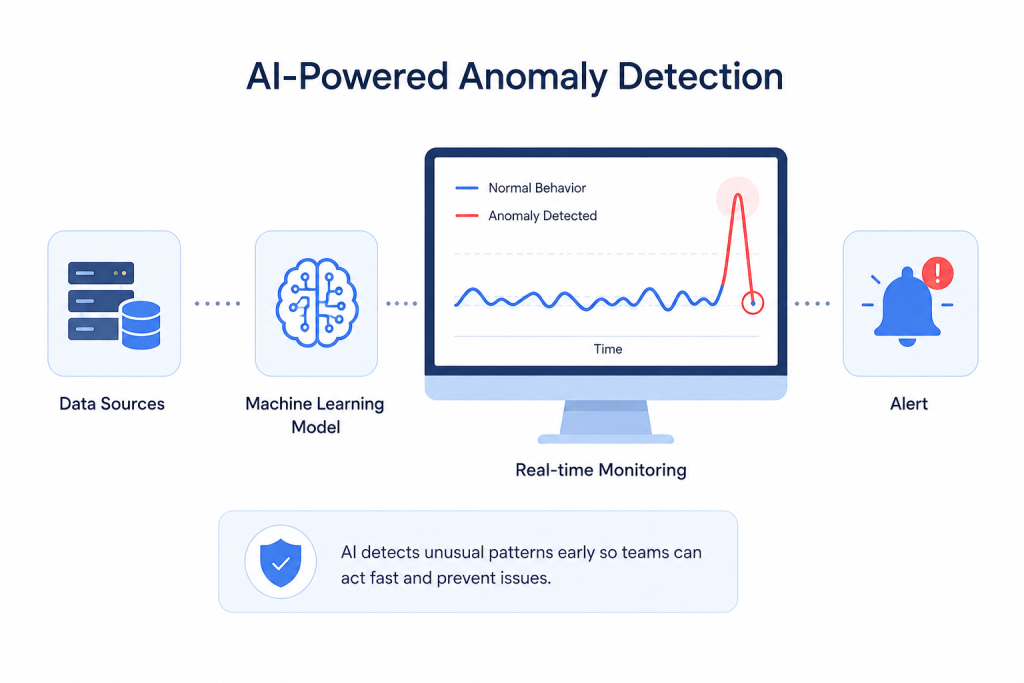
Using a baseline for normal behavior or a system’s expected state is better than using fixed thresholds in most cases. For example, AI can be used to identify if a normally quiet system contains an issue if there is an observed increase in database response time. Anomaly detection systems can also learn to filter out incidents to avoid alert overload for engineers.
Failure Prediction and Maintenance
Systems may show small warning signs before a major failure. These signs can include rising resource usage, unusual latency, or repeated faults.
Machine learning can study past data and identify combinations of events linked to failures. Although predictions are not perfect, earlier detection can help reduce downtime and improve reliability.
AI-Assisted Incident Investigation
When multiple elements and information sources come together to create a production incident, analyzing logs, metrics, deployment, and application traces can become a complex analysis. AI assisted analysis can connect the dots, drawing associations between events and information sources, like a growing number of application failures and recent deployments, which could be a likely root cause of the incident.
AI for CI/CD Pipelines
As the size and complexity of an application increase, the probabilities of encountering build failures, lengthy test execution, and high risk of deployments also grow.
ML and AI technologies can analyze historical deployment data and determine the risks posed by changes at the code and infrastructure levels, as well as the results of past deployments. Furthermore, AI technologies can help select tests that are likely to surface defects in the changed areas.
Cloud Cost Optimization
Resources in a cloud environment may not be fully used by some teams. With time-based analysis of resource usage, AI can determine underutilized resources.
Teams can use AI to:
- Automate scaling up and down of virtual machines
- Optimize storage and autoscaling policies
- Better utilize underused resources
This helps improve the efficiency of resources.
AI for DevOps Security
DevOps integrates security within the development, deployment, and operation sections. AI can help fill the gaps that security rules may leave.
Machine learning can detect characteristics of abnormal logins and unusual network activity within a system and identify internal threats. However, it is critical to know that AI with machine learning is not a complete security solution. AI is a supplement to known threats.
Challenges of AI-Powered DevOps
Currently, the nature of DevOps provides many obstacles when attempting to implement AI. There are difficult to track inputs that result in difficult to track outputs, and generally poorly described systems. In the world of DevOps and ML, bad data input manifests as poorly performing systems.
The Future of AI and ML in DevOps
It can be expected that, in the future, AI will be integrated into DevOps in order to solve more sophisticated problems. DevOps platforms of the future may provide better prediction, automation, and system decision support.
Conclusion
In the realm of security monitoring, machine learning and natural language processing can enhance DevOps with anomaly detection, failure prediction, incident analysis, improvements for CI/CD pipelines, optimization for cost-effectiveness within the cloud, and a host of other security-centered tasks and challenges.
ML and AI cannot be used as a replacement for DevOps best practices. Without these fundamentals, machine learning cannot be utilized to reduce complexity and enhance reliability.

