


Learn how a Content Delivery Network (CDN) works, its benefits, caching methods, and its role in improving server performance, security, and availability.
A Content Delivery Network (CDN) is one of the most important components of modern server infrastructure. It helps businesses deliver content quickly, securely, and reliably to users worldwide.
Instead of relying on a single origin server, a CDN distributes static and dynamic content across strategically located edge servers. Users receive content from the nearest server, reducing latency while improving speed, availability, and security.
Website performance has become essential in today’s digital landscape. Businesses running ecommerce platforms, SaaS applications, enterprise portals, streaming services, or business websites need fast-loading content to meet user expectations. Even small delays can increase bounce rates, reduce customer satisfaction, and impact revenue. Businesses can also leverage our Server Management Services to optimize infrastructure performance, improve availability, and support efficient CDN implementation.
Overview
What is a Content Delivery Network (CDN)?
A Content Delivery Network (CDN) is a globally distributed network of edge servers that caches and delivers website content closer to end users.
Instead of connecting every visitor directly to the origin server, requests are routed to the nearest CDN edge server. Frequently accessed content is served from that location, reducing the distance data travels.
Typical CDN-delivered assets include images, videos, CSS files, PDFs, JavaScript, API responses, fonts and downloadable files.
Why Businesses Need a CDN
As businesses expand globally, a single hosting server can become a performance bottleneck.
Without a CDN:
- Users far from the server experience slower loading times.
- Traffic spikes can overload the server.
- Higher bandwidth costs increase operational expenses.
- Security threats become more difficult to mitigate.
- Website availability suffers during unexpected demand.
A CDN addresses these challenges by acting as an intelligent layer between visitors and the origin server.
How a CDN Works
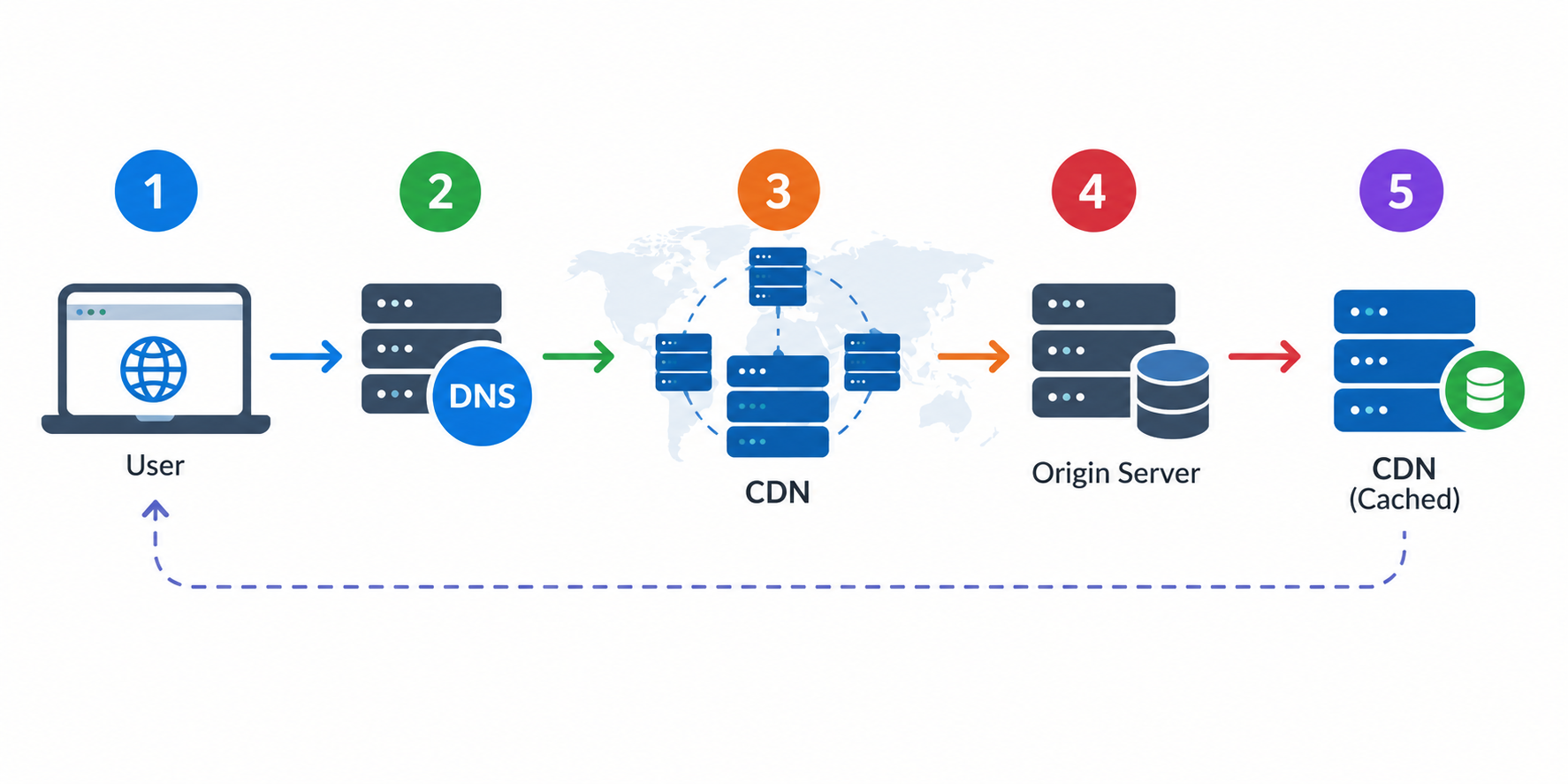
Step 1: User Requests a Website
A visitor enters your website URL.
Step 2: DNS Directs the Request
DNS routes the request to the nearest CDN edge server instead of sending it directly to the origin server.
Step 3: Cached Content Is Delivered
If the requested content is already available on the edge server, it is delivered immediately.
Step 4: Cache Miss
If the content is unavailable at the edge, the CDN securely retrieves it from the origin server.
Step 5: Future Requests Become Faster
The retrieved content is cached on the edge server. As a result, future visitors in the same region receive it almost instantly.
Key Benefits of Using a CDN
- Faster Performance: Delivers content from the nearest server to reduce page load times.
- Lower Server Load: Offloads traffic from the origin server through content caching.
- Global Reach: Provides consistent performance for users worldwide.
- Improved Availability: Helps maintain uptime during traffic spikes and outages.
- Enhanced Security: Supports DDoS protection, SSL/TLS encryption, and Web Application Firewall (WAF).
- Reduced Bandwidth Costs: Lowers data transfer from the origin server and reduces infrastructure costs.
- Better SEO: Faster websites improve user experience and boost search engine rankings.
CDN Caching Explained
A CDN caches static content such as images, videos, stylesheets, and scripts on servers located across different geographic regions. This reduces latency by delivering content from the server closest to the user.
Types of CDN Caching
Static Content Caching stores static files such as images, videos, and scripts to deliver them faster.
Some CDNs also cache dynamic content using techniques such as edge-side includes and smart caching algorithms.
CDN and Server Infrastructure
CDN Use Cases Across Industries
A CDN supports websites and applications across different industries by improving performance, availability, and content delivery.
Need Help Managing Your Hybrid Cloud Environment?

Common Misconceptions About CDNs
-
A CDN is only for large websites.
This is incorrect. Small and medium-sized websites also benefit from faster loading times and improved reliability.
-
A CDN replaces web hosting.
A CDN complements a hosting provider by accelerating content delivery and reducing server load.
-
CDNs only cache images.
Modern CDNs cache and deliver APIs, videos, scripts, fonts, downloadable files, and dynamic content.
-
A CDN is difficult to configure.
Many modern CDN services integrate with hosting platforms and popular content management systems, making deployment straightforward.
The Future of Content Delivery Networks
CDNs continue to evolve beyond content caching. Emerging capabilities include:
- Edge Computing: Running application logic closer to users for lower latency.
- AI-Driven Traffic Optimization: Intelligent routing based on real-time network conditions.
- Serverless Functions at the Edge: Executing lightweight code without relying solely on the origin server.
- Enhanced Security Intelligence: Faster detection and mitigation of evolving cyber threats.
- Integrated Performance Analytics: Better visibility into user experience and infrastructure health.
Meanwhile, as applications become more distributed and user expectations continue to increase, CDNs will play an even greater role in delivering fast, secure, and reliable digital experiences.
Conclusion
A Content Delivery Network has become a foundational part of modern server infrastructure. It brings content closer to users, reduces the load on origin servers, and improves security, availability, and scalability. Additionally, it helps businesses deliver consistent performance across websites, ecommerce platforms, media services, and cloud-native applications.
At Bobcares, our Server Management Services include CDN implementation, infrastructure optimization, and ongoing performance management to help businesses deliver fast, secure, and reliable digital experiences.

