


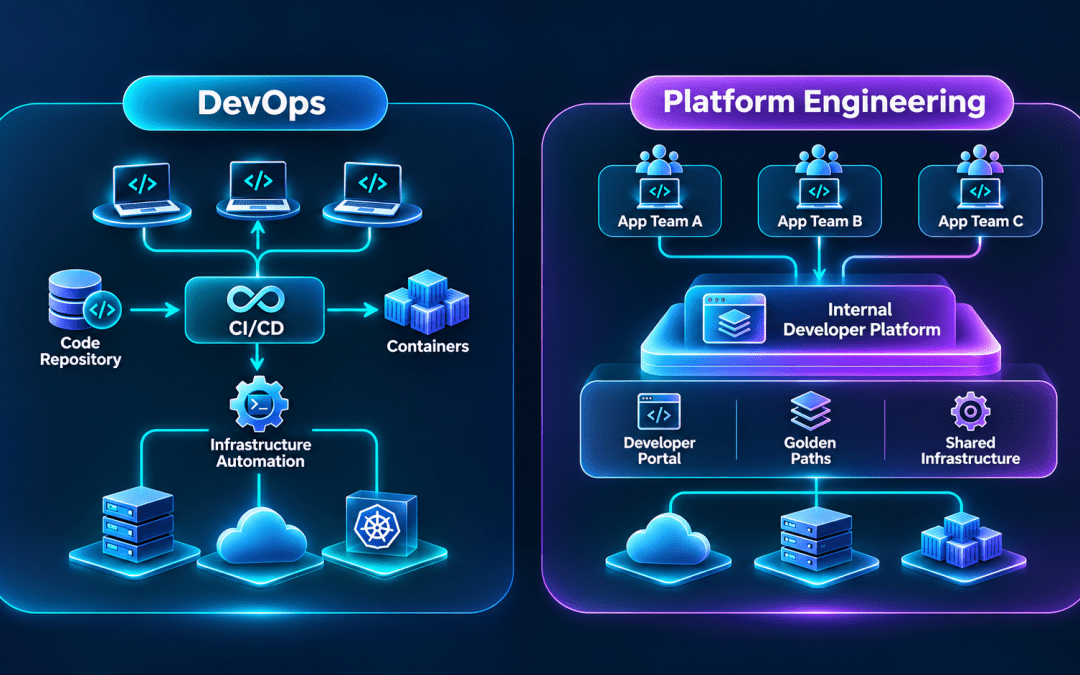
DevOps gave engineering teams more autonomy. As organizations grew, however, that autonomy started creating a new problem.
Every team could build its own CI/CD pipeline, provision infrastructure in its own way, and maintain its own monitoring stack. What worked well for smaller organizations started creating duplicated effort, inconsistent security practices, and more infrastructure work for developers.
Developers were spending more time fighting YAML and managing infrastructure instead of building features.
Platform engineering emerged to address this challenge. It does not reject DevOps principles. Instead, it provides a more structured way to apply them at scale through shared infrastructure, self-service tools, and supported paths for common tasks. Instead, it provides a more structured way to apply them at scale through shared infrastructure, self-service tools, and supported paths for common tasks.
So what’s different between DevOps and platform engineering, and when does each approach make sense?
What Is DevOps?
DevOps is a cultural movement that brings development and operations closer together. Developers want to ship features quickly, while operations focuses on stability. DevOps aims to align these goals by giving the same people, or closely collaborating teams, responsibility for both.
The approach includes practices such as:
- Continuous integration and continuous delivery (CI/CD) to reduce the friction and risk of releasing software
- Infrastructure as code so environments are reproducible and version-controlled
- Shared on-call responsibility, often summarized as “you build it, you run it”
- Fast feedback loops between writing code and seeing its effects in production
- A blameless culture around incidents, where failures are treated as opportunities to learn
DevOps was never intended to be a specific role or tool. Companies did, however, begin hiring “DevOps engineers,” and the term gradually became associated with people who managed CI pipelines, wrote infrastructure code, and responded when systems broke.
What Is Platform Engineering?
Platform engineering takes the automation and infrastructure-as-code principles associated with DevOps and turns them into a product.
Instead of having every application team build its own deployment pipeline, secrets management, and observability setup, a dedicated platform team builds an internal developer platform (IDP).
The platform gives application developers a self-service layer where they can access what they need through a consistent and supported interface.
The platform team’s customers are the engineers writing product code. Its goal is to make the safe, correct, and fast path the easiest path to follow.
Common building blocks include:
-
- Service catalogs or developer portals, such as Backstage, where teams can discover and provision approved resources
- Golden paths, which provide pre-approved templates for common tasks such as creating a microservice or database
- Centralized policy enforcement for security, compliance, and cost controls
- Abstracted infrastructure that lets application teams interact with simple APIs instead of raw cloud primitives
The idea of a dedicated team building tools for other engineering teams predates the term platform engineering. The concept gained momentum around 2022, as Gartner recognized platform engineering as a strategic technology trend and the CNCF’s Backstage project grew in popularity.
Platform Engineering vs DevOps: What’s Different?
DevOps is a set of cultural principles and practices. Platform engineering is a discipline that turns those principles into a reusable, self-service product.
| DevOps | Platform Engineering | |
|---|---|---|
| Primary focus | Shared responsibility between development and operations | Shared infrastructure and developer self-service |
| Ownership | Teams handle their own infrastructure concerns | A specialized platform team builds shared infrastructure |
| Internal customer | No distinct internal customer | Application developers |
| Tooling approach | Greater team-level autonomy | A smaller set of supported golden paths |
| Main friction addressed | Development and operations working separately | Repeated infrastructure work across teams |
The ownership model is one of the biggest differences. DevOps expects teams to handle their own infrastructure concerns, ideally using automation to reduce the workload. Platform engineering puts shared infrastructure responsibilities with a specialized team so application teams don’t have to manage them independently.
The approaches also differ in how they handle choice. DevOps tends to favor team-level autonomy, while platform engineering deliberately narrows the available choices through supported golden paths. The tradeoff is greater consistency, security, and lower cognitive load.
The friction being addressed is different as well. DevOps focuses on the gap between development and operations. Platform engineering addresses problems that can emerge when every application team manages infrastructure independently.
Platform Engineering Doesn’t Replace DevOps
Platform engineering didn’t replace DevOps, and the two aren’t competing philosophies.
Organizations that use platform engineering still rely on DevOps practices such as continuous delivery, infrastructure as code, blameless postmortems, and tight feedback loops.
The platform team also typically uses DevOps practices internally, applying CI/CD and infrastructure as code to the platform’s own codebase.
A useful way to look at the relationship is that DevOps describes what good software delivery looks like, while platform engineering is one way to organize people and tooling to achieve it.
This becomes particularly useful when duplicated effort across teams becomes more expensive than building shared infrastructure.
When Does Each Approach Make Sense?
Platform engineering is not automatically the better choice.
DevOps-style autonomy tends to work well when:
- The organization is small enough for a handful of engineers to reasonably own their infrastructure
- Product requirements and technology stacks vary significantly between teams
- Building internal tooling would require more effort than the benefits it provides
Platform engineering tends to make more sense when:
- Multiple teams are solving the same infrastructure problems independently
- Duplicated infrastructure work is consuming engineering time
- Inconsistent tooling is creating security gaps, compliance challenges, or unpredictable costs
- Developers report that infrastructure complexity is slowing feature delivery
- The organization is large enough to sustain a dedicated platform team without starving product development
The right approach therefore depends on the organization’s size, infrastructure needs, and how much duplicated work its engineering teams handle.
Conclusion
DevOps and platform engineering are not necessarily competing choices.
DevOps brought development and operations closer together through shared responsibility, automation, infrastructure as code, and fast feedback. Platform engineering builds on those principles by creating shared infrastructure and self-service capabilities when organizations grow and repeated infrastructure work becomes a problem.
Smaller organizations may benefit from DevOps-style autonomy, while larger organizations facing duplicated infrastructure work may benefit from a dedicated platform approach.
Platform engineering can ultimately serve as a structured way to apply DevOps principles, giving application teams access to automation and self-service without requiring every team to become an infrastructure expert.


