


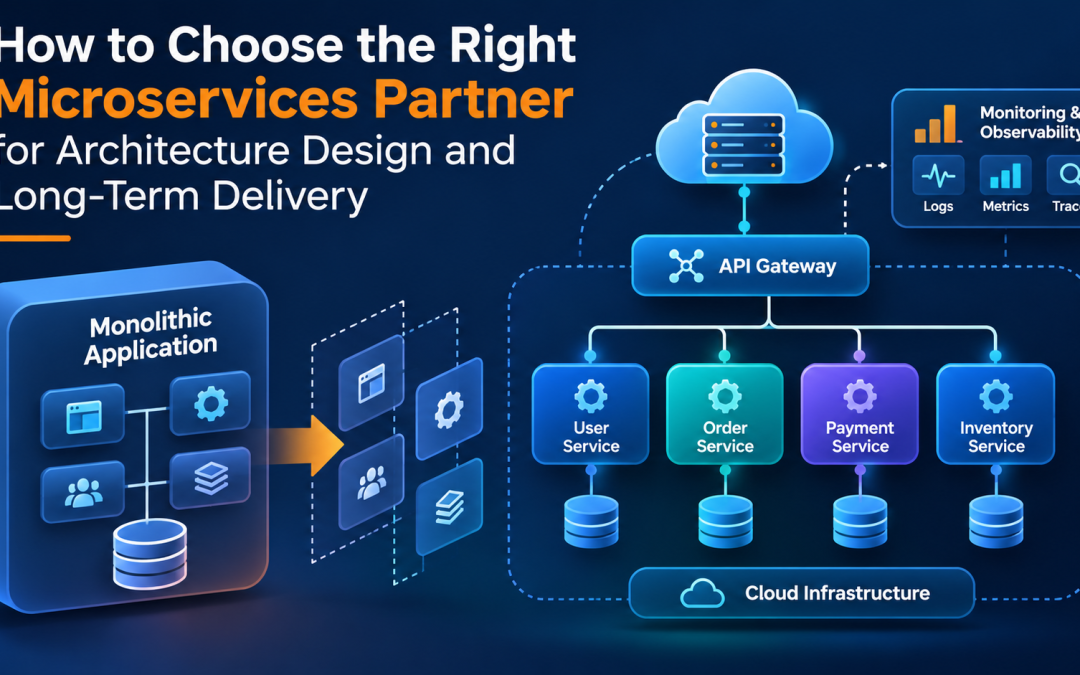
Microservices help businesses build applications that are easier to change, scale, and maintain. The architecture divides an application into smaller services, each responsible for a particular business task. These services interact via defined interfaces. Furthermore, they can be developed and deployed independently.
It can also introduce more technical and operational complexity. Services need to communicate across a network. Data may be distributed across multiple stores. Monitoring becomes more involved. Testing and debugging can also become harder as the number of services increases.
This is why choosing the right microservices partner matters.
A capable partner goes beyond developing individual services. They should understand your existing application, identify suitable service boundaries, design the communication and data architecture, plan the migration, and support the system after deployment. Bobcares helps businesses design, develop, modernize, and support microservices-based applications, combining software development expertise with experience in cloud infrastructure and ongoing application management.
Are Microservices the Right Fit for You?
Microservices also support application modernization when an existing monolith has become difficult to change or scale.
However, microservices introduce their own complexity. Distributed communication, multiple data stores, service discovery, deployment, monitoring, testing, and failure handling all need attention.
So begin with discussing “What specific problem will microservices solve for your business?”
The answer should be based on your application rather than a generic architecture recommendation.
Architecture Design Experience
Microservices architecture is more than dividing a large application into smaller pieces.
Service boundaries have a major effect on the resulting system. Each service should have a clear responsibility and represent a business capability. Services should remain as independent as possible and communicate through defined interfaces rather than relying on internal implementation details.
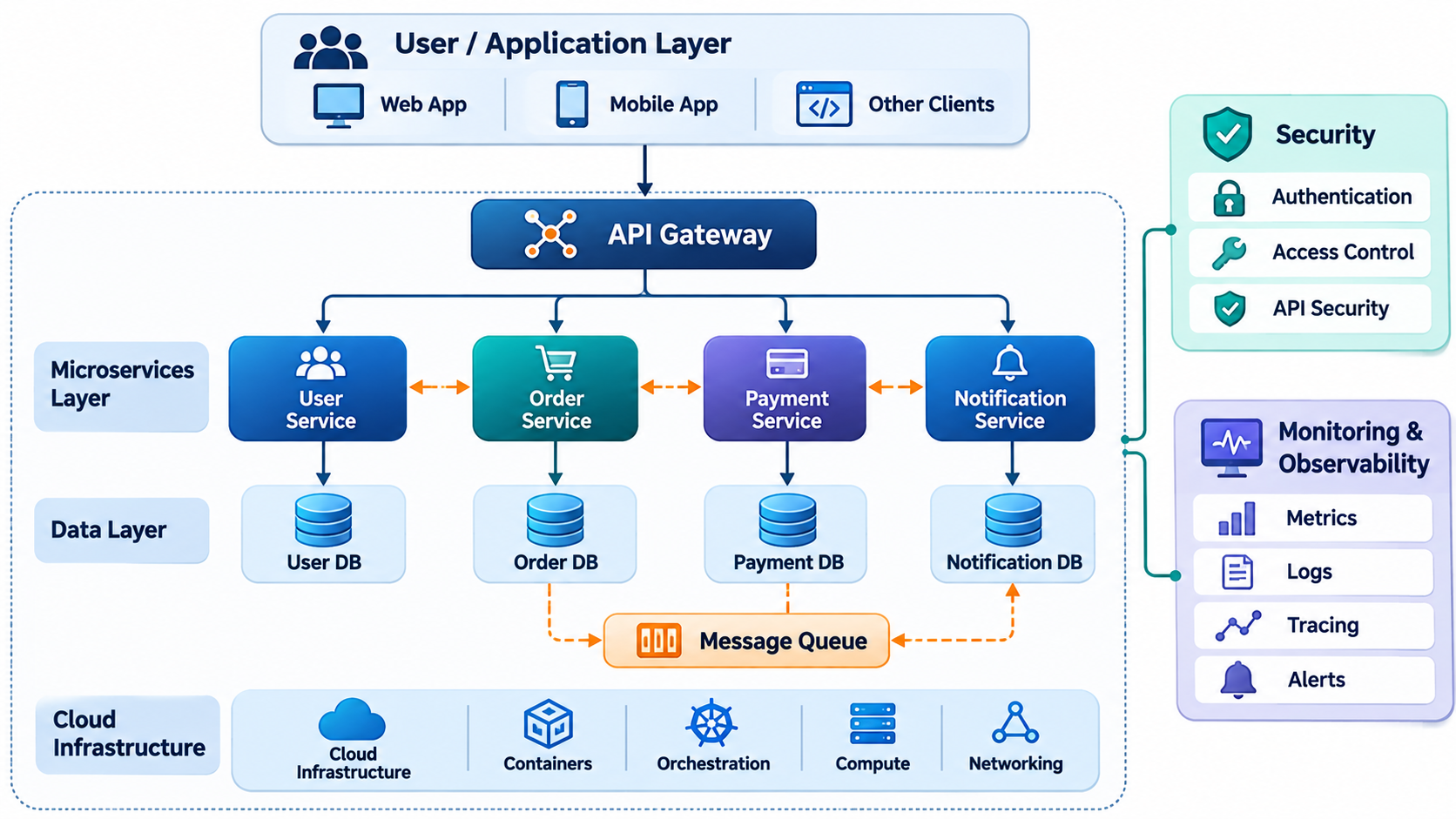
Your prospective partner should be able to explain how they identify these boundaries. Additionally, they should understand the difference between a genuinely independent service and one that still depends heavily on several others. Poor boundaries can create a distributed application that is difficult to maintain because every change requires coordination across multiple services.
Ask them to walk you through an example architecture. Look at how business functions are separated, how services communicate, and how dependencies are controlled.
A microservices environment uses components such as APIs, message queues, containers, service discovery, API gateways, and service meshes. The right partner should know which of these components your application actually needs.
At Bobcares, our microservices development approach starts with the application’s business requirements and existing architecture. We design service boundaries, APIs, and supporting infrastructure around the application’s actual needs rather than applying the same architecture to every project.
Approach to Data Architecture
A monolithic application often has a central database shared across different parts of the application. Microservices usually move toward service-level data ownership. Each service can manage the data needed for its specific business capability.
This can reduce coupling, but it also introduces new challenges.
A business transaction involves more than one service. Reporting may require information from different data stores. Existing tables may contain relationships that are difficult to separate. Data migration can also become complicated when an old application is being gradually replaced.
Do not accept a database strategy based only on a technology preference. The data model has to support the application’s actual business requirements.
Check Their API and Integration Expertise
APIs are a key connection point between microservices.
A service should expose a clear interface instead of requiring other services to understand its internal code. This allows the service to evolve without forcing unnecessary changes across the application.
Your partner should have experience designing and maintaining APIs across both internal and external systems.
Ask how they approach API versioning, authentication, authorization, validation, error handling, documentation, and backward compatibility.
Integration experience is also important. Enterprise applications often need to communicate with payment systems, CRM platforms, identity providers, legacy applications, partner systems, and other external services.
The provider should be able to explain how these connections will be managed without creating excessive dependencies between services.
A well-designed integration layer can also make future changes easier. If an external system changes its API, the impact should be contained rather than spreading across multiple services.
Evaluate Cloud and Infrastructure Knowledge
Microservices often involve cloud infrastructure, containers, orchestration, automated deployment, monitoring, and managed databases.
A partner should understand these technologies, but that does not mean every application needs all of them.
A smaller application may not require Kubernetes. A large platform with many independently deployed services may have different infrastructure requirements.
Ask about containerization, cloud platforms, infrastructure as code, CI/CD, networking, secrets management, backups, and disaster recovery. The discussion should focus on your actual requirements rather than a predetermined technology stack.
Infrastructure decisions should also consider future growth. The architecture should leave room for increased traffic and additional services without forcing major changes every time the application expands.
Monolith Modernization
Many businesses considering microservices already have a working application.
That application may contain years of business logic, integrations, database relationships, and technical debt. Replacing everything at once can create considerable risk.
A good partner should have experience working with existing systems rather than only building new applications from scratch.
Incremental modernization can make the transition more manageable. New capabilities can be introduced alongside the existing application while older components are gradually replaced. This approach allows businesses to modernize specific parts of an application without immediately rebuilding the entire system.
API-based modernization can also help connect existing functionality with newly developed services. The right approach depends on the application’s architecture, dependencies, data model, and business priorities.
Bobcares supports application modernization projects where existing systems need to evolve without disrupting ongoing business operations. Our approach can include assessing the current application, identifying suitable services to extract, and planning a phased transition to a microservices architecture.
Assess Their Approach to Reliability
Microservices can isolate certain failures, but distributed systems also create new failure scenarios.
For instance: a network request can time out, a service can become unavailable, a dependent service may respond slowly, or a deployment can introduce an issue that affects other services.
Your prospective partner should be able to explain how these situations will be handled.
Ask how the architecture will handle service failures, dependency failures, traffic spikes, failed deployments, backup restoration, and disaster recovery.
Techniques such as timeouts, retries, circuit breakers, health checks, and fault isolation can help reduce the impact of service failures. Their use should depend on the application’s actual failure scenarios rather than being added simply because they are common microservices patterns.
Review Monitoring and Observability Practices
Monitoring becomes important when an application is spread across many services.
A problem that looks like an application error may actually originate from a database, another service, a network connection, or an infrastructure component.
Ask how you will identify the source of a failed request or how you will determine which service is causing a performance problem. Ask how the provider will monitor dependencies and track changes after deployment.
Distributed tracing can help follow a request as it moves between services. Centralized logging can make it easier to investigate related events. Metrics can show changes in resource use, response times, error rates, and service health.
The goal is to make the application understandable when something goes wrong.
Consider Security During Architecture Design
Each service may expose APIs, process business information, communicate with other services, or connect to external applications. These interactions need appropriate authentication, authorization, encryption, and access controls.
Data ownership also affects security. Services that handle sensitive information should have clear access boundaries.
Your partner should explain how security will influence API design, network architecture, secrets management, identity, service communication, and data storage.
Industry requirements should also be considered. Applications in areas such as finance, healthcare, and ecommerce may have additional security and compliance requirements that affect architecture decisions.
Beyond Development Skills
Microservices delivery involves more than writing service code.
Architecture decisions affect development, testing, deployment, infrastructure, security, monitoring, and maintenance. A provider that is strong in one area but weak in the others may create gaps that become expensive later.
Look at the provider’s experience across the complete application lifecycle.
The partner should be able to participate in architecture planning, development, testing, deployment, production support, and future architecture changes.
This broader delivery model is part of the value Bobcares brings to microservices projects. Beyond development, our services can cover cloud infrastructure, DevOps, security, monitoring, and ongoing application support, giving businesses a partner for both the initial architecture work and the operational needs that follow.
Architecture diagrams, API specifications, service responsibilities, deployment procedures, data ownership, and important technical decisions should be documented. This helps your internal staff understand the system and reduces dependence on individual people.
Long-term support should also be clearly defined. Ask who handles production issues, how incidents are escalated, how security updates are managed, and how architectural changes are reviewed.
Watch for These Red Flags
Here are warning signs that can help you eliminate unsuitable providers early:
- Microservices are presented as the answer to every problem.
- The proposal focuses on technology names instead of architecture.
- A complete rewrite is recommended immediately.
- The migration plan is vague.
- Production operations are ignored.
- Architectural trade-offs are not discussed.
Questions to Ask Before Choosing a Partner
Use these questions to compare potential providers before signing a long-term agreement:
- How do you decide which application functions should become microservices?
- How do you define service boundaries?
- How do you approach migration from a monolithic application?
- How do you manage data ownership between services?
- How do you design APIs and service communication?
- How do you handle failures between dependent services?
- How do you approach monitoring and distributed tracing?
- How do you address security across APIs and service communication?
- What architecture and API documentation will we receive?
- What support is available after deployment?
- Can you provide case studies involving similar applications?
- How do you handle architecture changes as the application evolves?
Conclusion
In short, choosing a microservices partner is not simply about finding a provider that knows a particular programming language, cloud platform, or container technology. The right partner should understand your application and business requirements before proposing an architecture. They should know where microservices can provide value and where they could introduce unnecessary complexity. That is the approach Bobcares takes to microservices development, combining application engineering, cloud, DevOps, security, and ongoing infrastructure expertise to support businesses from architecture planning through long-term delivery.