


DevOps services help manage CI/CD pipelines, cloud systems, monitoring, scaling, and maintenance, so teams can focus on product development.
Release nights can become stressful when one engineer knows the deployment script, another handles the servers, and everyone waits for the release to finish. Manual commands, old pipelines, and poor documentation can turn a routine deployment into a long night.
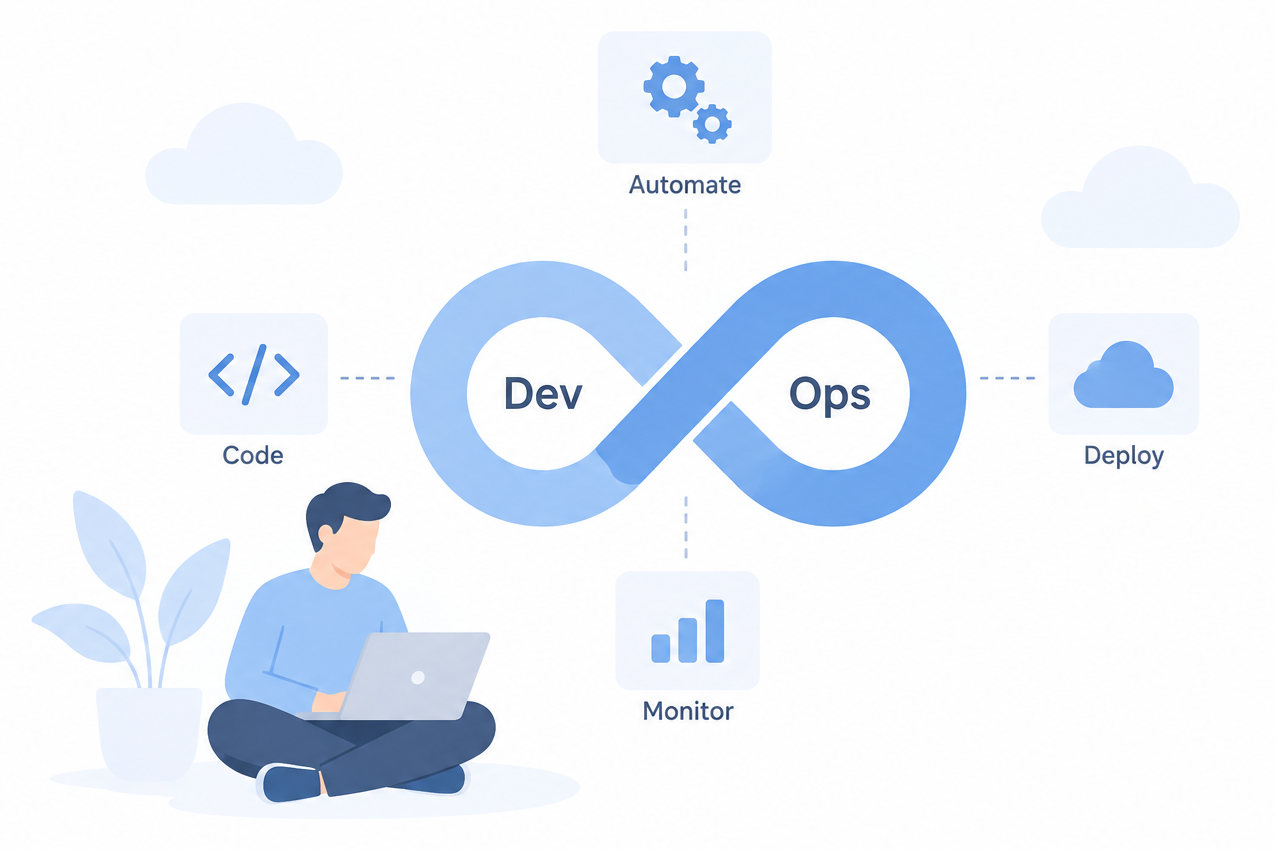
DevOps as a Service gives companies an external team to manage key DevOps work on an ongoing basis. This includes CI/CD pipelines, cloud systems, monitoring, maintenance, and incident response. As a result, developers can spend more time building the product instead of managing production systems.
An Overview
What Is DevOps as a Service?
DevOps as a Service is a continuous service that involves a third party to handle some aspects of software delivery and infrastructure management every month. The provider performs activities like setting up and maintaining CI/CD pipelines, managing cloud solutions and monitoring systems.
Once it is set up, the work does not end. Systems require regular updates, tuning, testing and maintenance. If there’s not enough staff within the team, an external DevOps team can handle this continuous effort.
Talk to us about DevOps.

Why Traditional Deployment Creates Problems
There may be differences between staging and production, which may lead to deployment issues.
- Differences between staging and production can cause deployment problems.
- Manual commands can lead to human errors.
- Rollbacks can take longer when there is no ready script.
- Old Jenkins pipelines can become difficult to change.
- Pipeline knowledge can remain with one engineer.
- Poor documentation can make staff changes harder to manage.
DevOps as a Service addresses these problems through documented, version-controlled, and repeatable pipelines. This reduces reliance on one person’s memory and makes deployment work easier to manage.
Where DevOps as a Service Helps
Faster and More Reliable Deployments
When the deployment process is automated and part of CI/CD pipelines, it becomes a regular process instead of being a big event. Staged deployments can be helpful for teams to identify issues prior to impacting users.
As a result, teams that once spent a month on deployments can move toward several deployments each day.
Easier Scaling
Traffic spikes can create pressure when teams need to add servers manually. Infrastructure as code and auto-scaling can change capacity automatically.
A managed DevOps team can also handle the related troubleshooting when scaling problems occur.
Earlier Problem Detection
Monitoring and clear alert thresholds help teams identify problems before customers report downtime. Rather than having to have a dashboard that no one looks at, teams can use monitoring in their normal workflow.
Routine Security Work
There is a need for regular attention to patching, access management and secrets management. If these tasks aren’t assigned to anyone, then they can get overlooked easily.
With a managed DevOps environment, these tasks become part of the day-to-day workflow.
Lower Operational Overhead
Building an internal platform team requires salaries, tools, and time. DevOps as a Service changes this into a monthly service cost.
Companies can therefore pay for ongoing system management and incident response instead of building a full team only to handle these responsibilities.
What to Ask Before Choosing a DevOps as a Service Provider
The right questions can help you understand what a provider actually offers.
| Area | What to Ask |
|---|---|
| Cloud support | Do they support your cloud ecosystem? |
| Incident response | What are their response times? |
| Infrastructure as code | Can they show examples of their work? |
| Handover | How easily can you take control of your infrastructure? |
| Escalation | Do they have a formal escalation process? |
These questions help you look beyond the service name and understand how the provider handles production work.
Conclusion
DevOps as a Service does not remove every engineering problem. However, it can take regular operations work off of the dev teams.
Rather than having to maintain pipelines, respond to production alerts during night hours, and manage infrastructure internally, companies can have a dedicated team to maintain pipelines, respond to production alerts during night hours, and manage infrastructure.
If the teams are not interested in developing a platform team from scratch, DevOps as a Service is another option to handle the deployment, infrastructure, monitoring and continuous maintenance.

