


Legacy Application Modernization helps reduce technical debt, speed product development, improve code quality, and support long-term growth.
You launched your new product because your business needed it in the market. It was a go/no go situation. Your team had to deliver the features. It was a race against the clock, and the customers were waiting for the release. However, your team was forced to make pragmatic choices and implement temporary solutions, and found that they were forced to delay code cleanup.
Well, that “later” has arrived.
As the number of new features increases, it takes more time to create them. Bugs require more time to be rectified. Releases feel like a risk, and your product roadmap is constantly slipping. Therefore, innovation starts to slow.
If you’ve ever found yourself in this situation, then you may have a technical debt problem.
An Overview
What is Technical Debt? What Causes it to Accumulate?
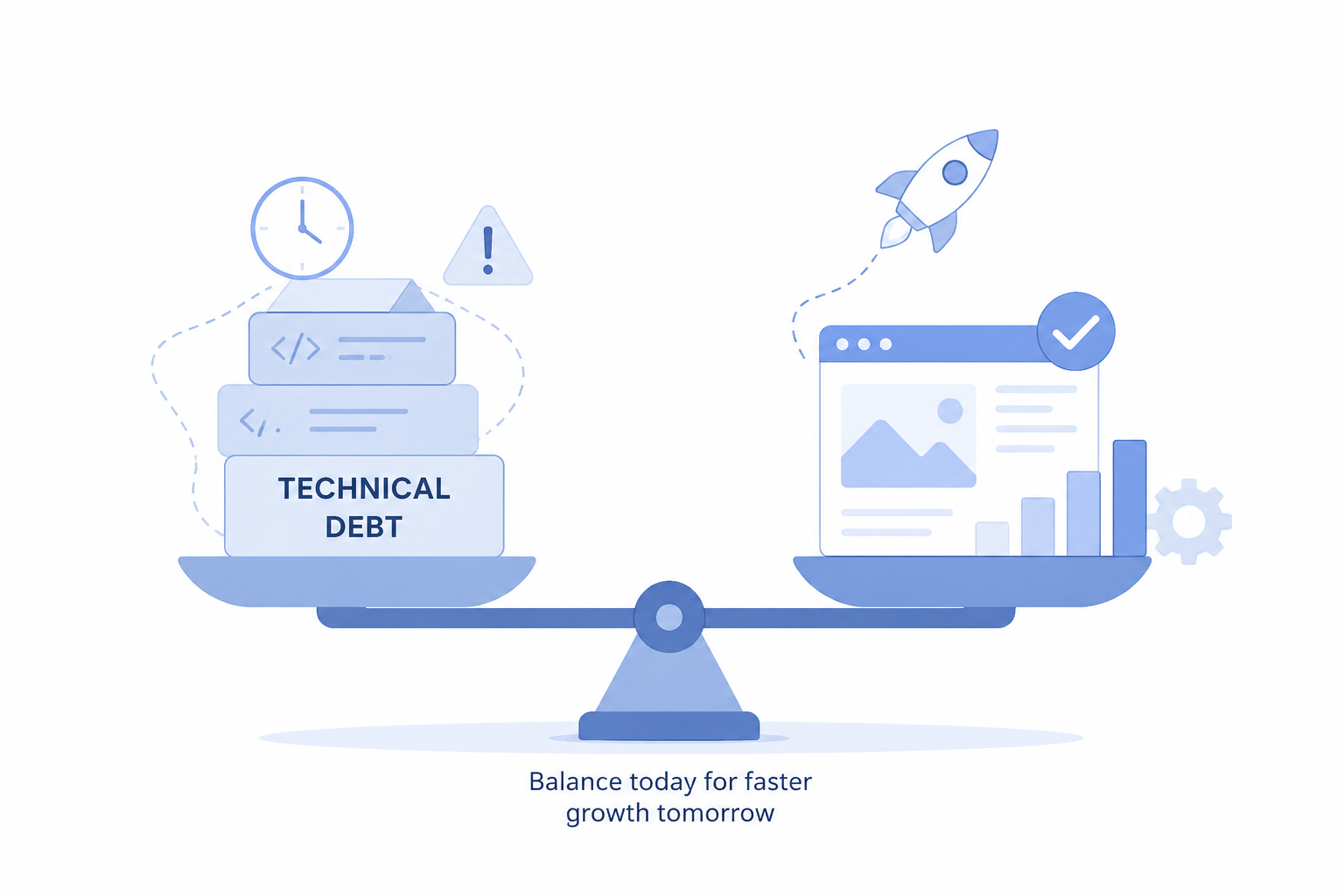
Not all technical debt is caused by poor code. It is typically a result of cutting corners to work towards a deadline or to deliver a feature faster.
Typically occurs due to:
- Tight release schedules
- Changing business requirements
- Limited documentation
- Delayed code cleanup
These decisions, at first, are used to accelerate the team’s speed. But as the code base expands, the shortcuts become more difficult to manage. With time starting to influence product development.
Understand how Technical Debt can impact your business. Know the impact of Technical Debt on your business.
Technical debt impacts more than your engineering team. It delays product delivery, raises costs, and makes business growth difficult.
1. Slower Feature Development
Once every few days, now every few weeks. For example, developers spend more time understanding old code, fixing unexpected issues and dealing with side effects. Because of this, less focus is expended on acquiring new skills.
Keep product development moving.

2. Higher Maintenance Costs
The larger the technical debt, the more costly maintaining the product will be. Teams experience a greater number of bugs, regular hot fixes, and increased support requirements. Meanwhile, maintenance becomes the primary use of engineering time, rather than product improvement.
3. Unpredictable Delivery Timelines
The planning of projects can become complicated. Even if features are well defined, there may be unforeseen problems or dependencies. This leads to less predictability and confidence among stakeholders.
4. Reduce the productivity and morale of teams
Developers work best with a clean and stable codebase. Similarly, the code becomes harder to maintain. This slows productivity and increases frustration. Plus, it also takes more time to get new team members onboard as the system is less intuitive.
5. Innovation Slows Down
The codebase is weak, and any change comes with a risk. Teams lag behind in modernization, refrain from larger enhancements, and are hesitant to try new technologies. Meanwhile, there are new features being released by competitors at an increasing rate.
Technical Debt is an ever-present challenge
Technical debt is a problem known by many organizations, but they have difficulty managing it. Common reasons include:
- New features always take priority over code cleanup.
- Technical debt is rarely tracked like other business metrics.
- Teams address issues only after they become serious.
- Short-term delivery goals often outweigh long-term product quality.
If you begin to see these signs, you might have growing technical debt:
- Each release brings new bugs.
- The accuracy of project estimates decreases.
- Application parts that are not changed by developers.
- Mature & stable software needs little maintenance. Small updates require extensive testing.
- Old code slows down the development of new features.
If you have multiple of these issues happening frequently, technical debt may be impacting your roadmap.
How to keep development going while eliminating technical debt
Eliminating technical debt doesn’t mean you stop developing features. Rather, teams must have a balance.
1. Make the Technical Debt Tangible
Measure tech debt, just as you measure any business metric. Determine areas of high risk, record identified problems and prioritise them by business impact. Making it much easier to plan.
2. Save time to clean up code
Take time in each sprint to refactor. Refinements on a regular basis help to avoid big issues.
3. Target High Impact Areas
Not all problems require immediate action. Prioritize areas of impact to business-critical functions and high-traffic areas and modules that slow down new features.
4. Improve Development Standards
Good coding practices, code reviews and beneficial documentation decrease future technical debt. Having consistent practices also helps to keep the codebase more maintainable.
5. Modernize Gradually
Rewriting is not always the right approach in large systems, adding inappropriate risks. Rather, take out old parts incrementally and enhance design over time. This way, the development process keeps moving forward, but the complexity in the long term is minimized.
How Bobcares Can Help
At Bobcares, we know that engineering teams and business results are impacted by technical debt. We review and identify high-risk areas, enhance critical components, and support teams to work more efficiently without impacting the delivery of products. This can help you to improve the long-term health of your application and help you achieve a gradual development of features.
Conclusion
Technical debt typically accumulates over time without anyone realizing it, until it impacts the product delivery, engineering productivity and growth of the business. Luckily, this doesn’t need to be the case. Technical debt doesn’t have to be a roadmap killer, and with regular code enhancements, planning, and roadmap direction, you can still lower technical debt without impacting your roadmap.

