


See how AIOps improves monitoring and incident response. Learn how our Cloud DevOps Services enables predictive operations and stability.
How AIOps Strengthens Modern DevOps Operations
Modern DevOps environments generate large volumes of operational data. This article covers how AIOps improves monitoring, supports predictive incident response, and integrates into a DevOps pipeline with practical implementation steps.
Read this article to learn how AIOps can strengthen your DevOps operations.
AIOps Strengthens Modern DevOps Operations
If you work in DevOps, you already collect logs, metrics, traces, and alerts. AIOps helps you use that data in a smarter way. Instead of relying only on fixed limits like CPU or memory thresholds, it studies patterns in system behavior. It learns what normal looks like and detects unusual trends before they cause outages.
It also connects related signals across services to identify the actual root cause. This helps your team reduce alert noise, resolve incidents faster, and prevent failures instead of reacting after impact.
Implement AIOps Now

Traditional Monitoring vs Predictive Incident Response with AIOps
| Aspect | Traditional Monitoring | Predictive Incident Response with AIOps |
| Detection Method | Uses logs, metrics, and alerts after a threshold is crossed or a service fails | Uses machine learning to study operational data and understand normal behavior |
| Response Style | Reactive, responds after impact | Proactive, detects anomalies early and predicts incidents |
| Team Effort | High manual effort and increased on call fatigue | Lower manual effort and reduced on call stress |
| Focus | Identifies what is broken | Identifies why it happened and what may fail next |
| Impact on Downtime | Delayed detection may lead to outages and poor user experience | Early detection reduces downtime and protects user experience |
| Alert Quality | High alert noise and duplicate notifications | Correlates related signals and reduces unnecessary alerts |
| Overall Outcome | Teams react to failures | Teams anticipate problems and act before incidents occur |
| Investigation | Requires manual analysis across multiple tools | Automatically connects logs, metrics, and traces |
How AIOps Integrates with a DevOps Pipeline
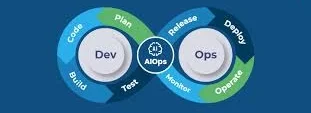
A DevOps pipeline connects build, test, deploy, and operate in a continuous loop. Once code moves to production, systems begin generating large volumes of logs, metrics, traces, and events. This is where AIOps operates.
AIOps sits on top of your observability stack and correlates deployment data with real time system behavior. It links changes in code or configuration with performance anomalies and incidents. These insights feed back into incident response and future releases. As a result, the pipeline becomes data driven, enabling faster root cause analysis, earlier detection, and continuous operational improvement.
Practical Implementation in a Real DevOps Pipeline
Step 1. Assess Your Observability Data
Identify where logs, metrics, traces, and deployment logs are collected. Verify signal availability and quality before applying intelligence.
# Verify all pods across all namespaces are in Running state

kubectl get pods -A

# Check if pods are up and reporting

up{job="kubernetes-pods"}
Step 2. Export Metrics for Analysis
Use existing monitoring data as input for anomaly detection models.
# Pull memory metrics for external ML models

curl http://prometheus:9090/api/v1/query

--data 'query=container_memory_usage_bytes'

Step 3. Validate a Pilot Use Case
Start with a focused anomaly detection scenario before automating actions.
import numpy as np

data = np.array([120, 125, 130, 400, 135])

mean = data.mean()

std = data.std()

anomalies = data[data > mean + 2 * std]

print("Anomalies detected:", anomalies)
Step 4. Integrate with CI and CD
Add predictive checks inside your pipeline to detect risky deployments early.
name: AIOps Deployment Check

on: [push]

jobs:

aiops-gate:

runs-on: ubuntu-latest

steps:

- uses: actions/checkout@v4

- name: Predict Release Risk

run: python aiops_predict.py --input latest_metrics.json
Step 5. Enable Predictive Response
Trigger preventive actions before thresholds are breached.
# Scale deployment before predicted traffic spike

kubectl scale deployment api-service --replicas=6
curl -X POST https://hooks.slack.com/services/TOKEN \
-d '{"text":"Predicted CPU spike detected. Scaling initiated."}'Step 6. Continuously Improve Models
Measure impact and retrain models on a schedule.
# Retrain model every Sunday at 2 AM

0 2 * * 0 python retrain_model.py
[Need assistance with a different issue? Our team is available 24/7.]
Conclusion
AIOps helps DevOps teams move from reacting to predicting. It reduces noise, improves root cause clarity, and strengthens release stability.
Start with a small pilot in your pipeline, measure the results, and expand from there.

