


Businesses collect large amounts of data from sales systems, customer relationship management (CRM) software, financial applications, and operational databases. However, having access to this data does not always make it easier to understand business performance. Companies need a way to consolidate information, identify patterns, and turn raw data into useful insights.
A custom Business Intelligence (BI) platform can help address this challenge. It brings data from different sources into a centralized environment and presents it through dashboards, reports, and analytical tools. Businesses can also tailor its features to their reporting needs and operational requirements.
However, building a custom BI platform requires an investment in data engineering, software development, infrastructure, and ongoing maintenance. The final price depends on the platform’s complexity and the level of customization.
Businesses looking to turn their data into actionable insights can explore our Business Intelligence Services to build BI solutions that support their reporting and analytical requirements.
How Much Does It Cost to Build a Custom BI Platform?
The cost of developing a custom BI platform depends on the capabilities a business needs. A basic dashboard that displays information from a single database requires less development effort than an enterprise platform that processes data from multiple applications and provides advanced analytics.
The following table provides indicative development cost ranges for different BI project sizes.
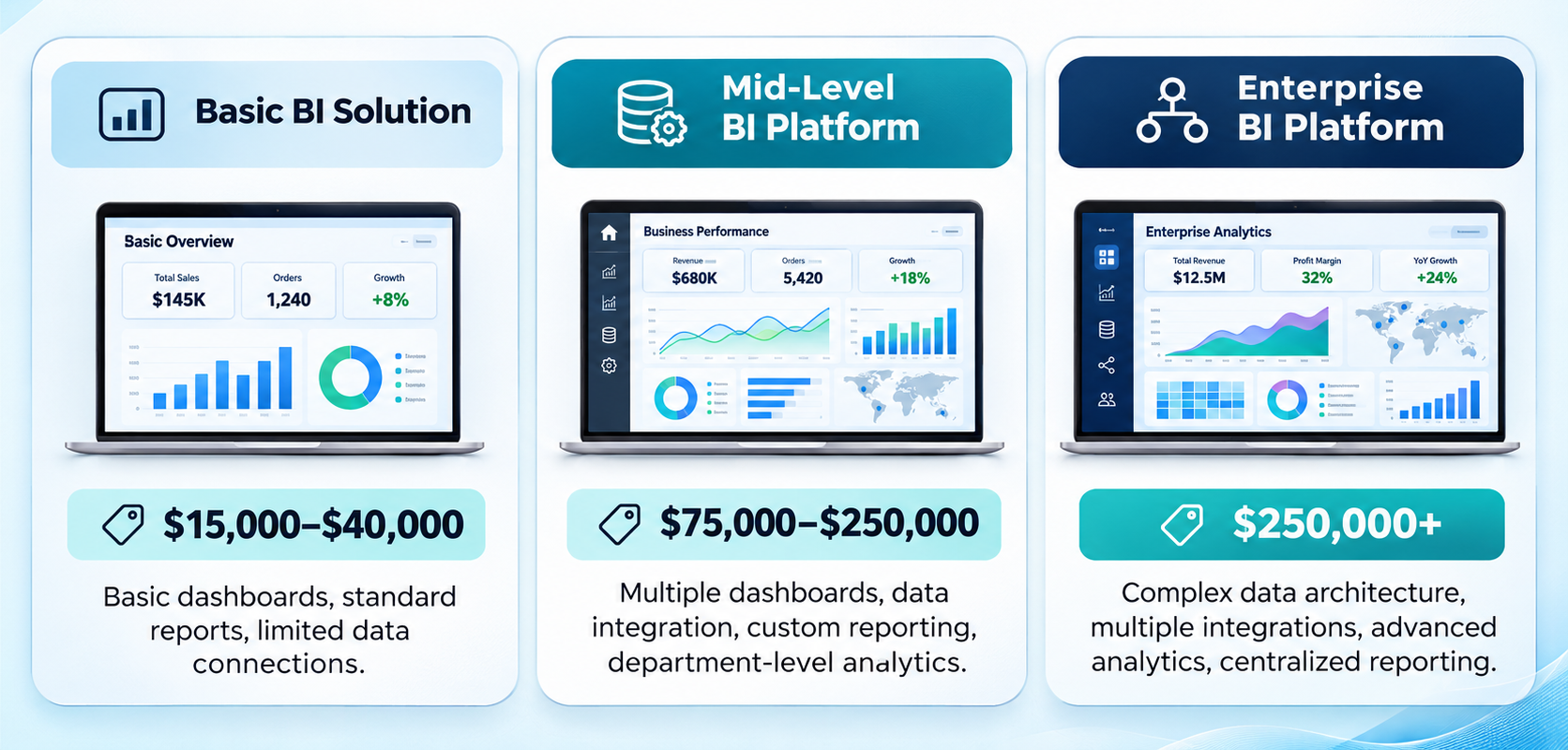
Note: These are broad planning estimates based on indicative BI project pricing. They are not vendor quotations. Actual costs can fall outside these ranges depending on the requirements.
Basic BI Solution
A basic BI solution suits small businesses or departments that need better visibility into specific business activities. It may include a few dashboards, standard visualizations, and connections to existing databases or spreadsheets.
For example, a sales department may need a dashboard that displays monthly revenue, sales performance, and customer acquisition figures. A solution of this scope does not require a complex data architecture or advanced analytical capabilities.
Mid-Level BI Platform
A mid-level BI platform supports reporting across multiple departments. It may connect data from CRM software, accounting applications, ERP systems, and cloud databases.
Such a platform usually includes custom dashboards, automated data updates, role-based access, and more advanced reporting features. It requires additional development effort to integrate data sources and establish consistent reporting rules.
Enterprise BI Platform
An enterprise BI platform supports large organizations with complex data requirements. It may process information from multiple business applications, databases, and cloud environments.
These platforms often include centralized data warehouses, advanced security controls, predictive analytics, and real-time reporting. They also need an architecture that can support increasing data volumes and additional users.
Enterprise projects generally require more planning, development, testing, and infrastructure investment.
What Goes Into the Cost of Custom BI Platform Development?
Custom BI development involves several stages, each contributing to the overall project cost.
Business Requirements Analysis and Planning
This stage involves understanding business objectives, reviewing existing reporting processes, identifying KPIs, and defining data integration requirements. Developers also plan the platform architecture and prepare technical specifications.
UI/UX Design and Dashboard Development
Dashboard development costs depend on the number of dashboards and the level of customization required. Common features include KPI cards, charts, interactive filters, drill-down options, and role-specific views. Advanced visualizations and custom layouts require additional development effort.
Data Integration and Engineering
BI platforms often collect information from multiple applications, databases, and cloud services. Development may involve API integrations, ETL pipelines, data cleaning, and centralized data warehouse setup. Poor data quality, duplicate records, and inconsistent formats can increase these costs.
BI Platform Development
This stage covers frontend and backend development, database design, authentication, and reporting modules. Custom calculations, automated reports, and specialized features can further increase development expenses.
Testing and Deployment
Testing verifies data accuracy, dashboard functionality, access permissions, and application performance. Deployment also involves configuration, documentation, and user training. These activities help ensure the platform works as expected after launch.
Key Factors That Affect Custom BI Platform Development Costs
Custom BI development costs vary based on data complexity, customization requirements, and infrastructure needs. Here are the key factors that influence the budget.
Number and Complexity of Data Sources
Connecting multiple applications, databases, and cloud services increases integration effort. Systems such as Salesforce, SAP, and legacy databases may require custom APIs, authentication, and data transformation.
Data Volume and Quality
Large datasets require more storage and processing capacity. Duplicate records, missing information, and inconsistent data formats also increase the effort needed for data cleaning and validation.
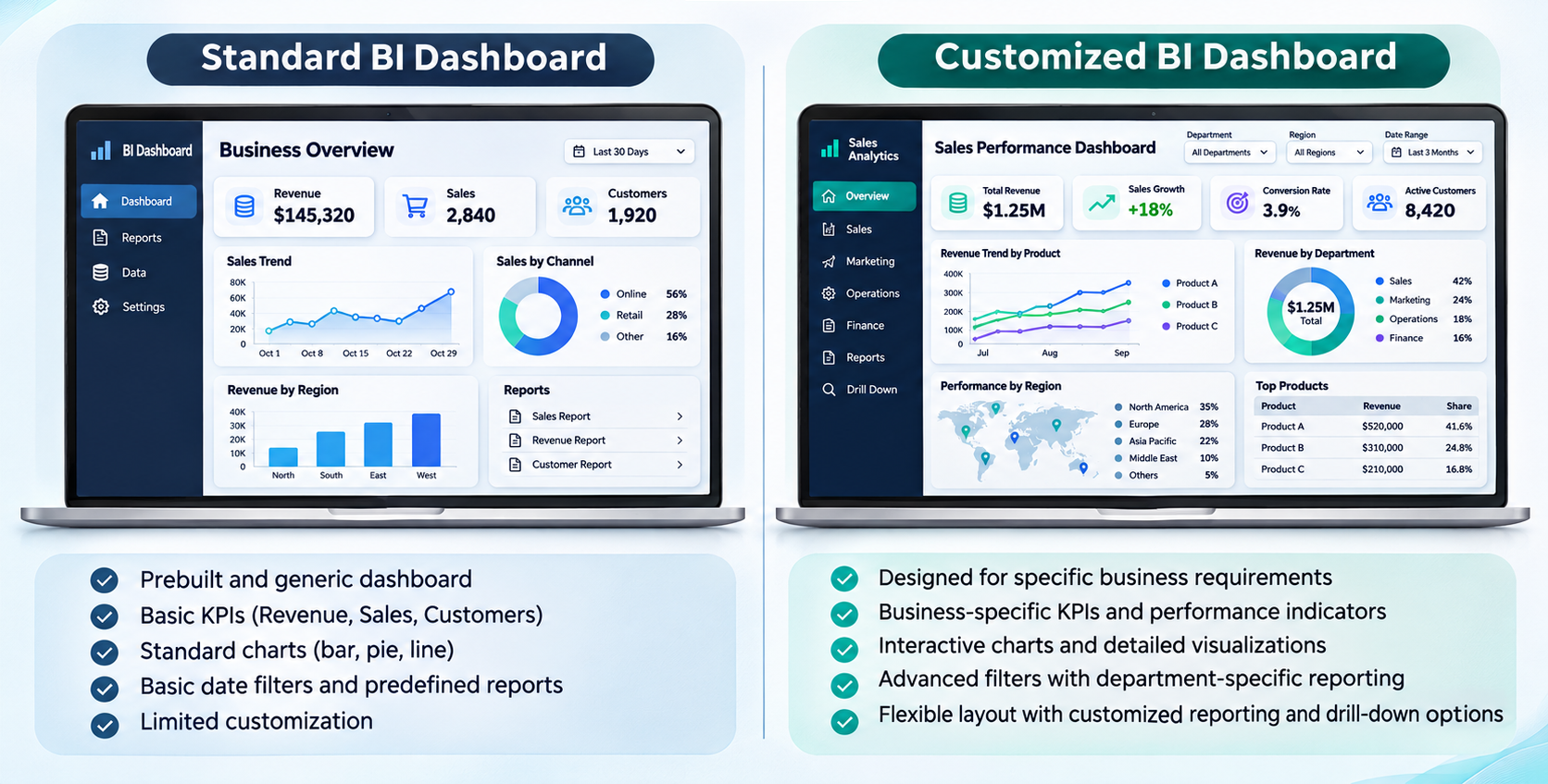
Dashboard Complexity and Customization
Standard dashboards with basic charts cost less to develop than customized interfaces with interactive filters, advanced visualizations, and detailed reports. Different user groups may also require separate dashboards and access permissions.
AI and Advanced Analytics Capabilities
Features such as predictive analytics, machine learning, anomaly detection, and AI-generated reports add to development costs. They require additional data preparation, model development, testing, and infrastructure.
User Roles and Security Requirements
Role-based access control (RBAC), single sign-on (SSO), and data encryption require additional development work. Businesses in regulated industries may also need audit logs and specific compliance controls.
Scalability and Infrastructure Requirements
The choice of cloud infrastructure, database capacity, and computing resources affects the overall budget. Platforms designed to handle growing data volumes and increasing user activity may require more advanced infrastructure.
Additional Costs to Consider After BI Platform Development
The initial development cost is only part of the total investment. Businesses should also consider these ongoing expenses.
- Cloud-based BI platforms require resources for data storage and processing. Costs may include servers, databases, storage, data transfers, and backups. Expenses depend on the cloud provider and resource usage.
- Commercial BI tools, databases, and integration services may require monthly or annual subscriptions. For example, Power BI offers per-user licensing plans, with costs depending on the selected plan and billing region.
- Regular maintenance includes security updates, bug fixes, database maintenance, and troubleshooting. Businesses should also budget for technical support and future platform upgrades.
- Ongoing data quality checks, pipeline monitoring, and data validation help keep reports accurate as business systems and data sources change.
Custom BI Platform vs. Off-the-Shelf BI Tools: Which Is More Cost-Effective?
Businesses do not always need to develop a BI platform from scratch. Ready-made products such as Microsoft Power BI and Tableau offer reporting and data visualization capabilities that may meet standard business requirements.
However, custom BI development may be a better choice when businesses need specialized functionality or greater control over their data architecture.
The following table compares the two approaches.
| Custom BI Platform | Off-the-Shelf BI Tools |
|---|---|
| Initial Investment
Higher initial development cost. |
Initial Investment
Generally lower initial cost. |
| Customization
Built around specific business requirements. |
Customization
Depends on available product features. |
| Data Integration
Custom integrations can be developed. |
Data Integration
Depends on supported connectors and APIs. |
| Licensing
Depends on selected technologies and architecture. |
Licensing
Subscription or capacity-based pricing. |
| User Experience
Interface designed for specific users. |
User Experience
Uses the vendor’s interface and customization options. |
| Maintenance
Requires internal or external technical support. |
Maintenance
Vendor manages product updates. |
| Scalability
Architecture designed around expected growth. |
Scalability
Depends on product plans and infrastructure. |
When Should Businesses Choose Custom BI Development?
Custom BI development makes sense when existing products cannot support important business requirements without expensive workarounds.
Consider a business that collects information from several internal applications. It may need a centralized reporting platform with custom calculations, specialized access permissions, and dashboards designed around its operational processes.
A custom solution can address these requirements in a single application.
It may also be worth considering when a business wants to embed BI capabilities into its own software or provide analytics to customers through a branded portal.
When Are Ready-Made BI Tools a Better Choice?
Off-the-shelf products are suitable when businesses need standard reporting and visualization features.
A company that wants to create sales dashboards from a CRM database may not need a separate custom BI application. A ready-made product can provide the required functionality at a lower initial cost.
These tools are also useful when the business has limited development resources and does not require extensive customization.
The decision should depend on the functionality required, licensing expenses, and long-term ownership costs.
Conclusion
The cost of building a custom BI platform depends on the business requirements, data environment, and technical capabilities involved. A basic reporting solution requires a smaller investment than an enterprise platform with complex integrations and advanced analytics.
Businesses should look beyond the initial development estimate when planning their BI budget. Infrastructure, software licensing, data management, and ongoing maintenance also contribute to the total cost of ownership.
Starting with essential reporting requirements and developing the platform in phases can help control expenses. Choosing the right development partner is equally important for building a solution that supports current reporting needs and future business requirements.
At Bobcares, our Business Intelligence Services help businesses turn their data into meaningful insights through BI solutions tailored to their requirements. Our expertise in data engineering and BI development can help you plan and build a platform that supports informed business decisions.
Frequently Asked Questions
Q. How much does it cost to develop a custom BI platform?
A custom BI platform can cost anywhere from $15,000 to $40,000 for a focused implementation. Department-level projects may cost $75,000 to $250,000, while complex enterprise solutions can exceed $250,000. The final estimate depends on data complexity, integrations, dashboard requirements, and infrastructure.
Q. How long does it take to build a custom BI platform?
Development time depends on the project scope and technical requirements. A basic BI solution may take a few weeks to a few months. A platform with multiple data integrations and advanced reporting features may require several months or longer.
Q. What factors affect BI platform development costs?
The main cost factors include the number of data sources, data quality, dashboard complexity, integration requirements, security controls, and infrastructure. AI-powered analytics and predictive modeling can also increase development expenses.
Q. How much does BI platform maintenance cost?
A general planning estimate is 15% to 20% of the initial development cost annually. This may cover security updates, bug fixes, technical support, and database maintenance. Actual costs depend on the platform’s complexity and support requirements.
Q. Can a small business afford a custom BI platform?
Yes. Small businesses can begin with a focused BI solution that covers essential reporting requirements. They can add more dashboards and integrations as their needs grow. This approach avoids the expense of building a large platform at the beginning.
Q. What technologies are used to develop custom BI platforms?
Custom BI platforms may use Python, Java, JavaScript, SQL, and various frontend frameworks. Data processing may involve Apache Spark or similar technologies. Cloud platforms such as AWS, Azure, and Google Cloud can provide the infrastructure required for data storage and processing.
Q. Can a custom BI platform integrate with existing business applications?
Yes. Custom BI platforms can connect to existing CRM, ERP, accounting, and operational applications through APIs, database connections, or data pipelines. The integration method depends on the source application’s capabilities and data structure.

