


Frugal AI architecture cuts LLM costs without sacrificing accuracy. Learn how a tiered smart router sends each query to the cheapest capable model.
AI costs are draining corporate budgets. Enterprise teams often send everything from simple classification tasks to complex reasoning problems to the same large model. A support ticket that a smaller model could classify ends up costing the same as a query that actually needs a frontier model. Our AI Automation Services help businesses build automated workflows that route each request to an appropriate model instead of sending every task to the largest one.
Frugal AI architecture fixes this mismatch. An intelligent router analyzes each query that arrives and routes it to the most economical model that can respond to it with the correct answer; only if the task requires it uses larger models. What you get is an accurate system that will save you money on cloud infrastructure, as you won’t have to pay frontier-level prices for jobs that can be accomplished by something a lot smaller.
An Overview
- The Rising Cost of Artificial Intelligence
- What the Market Is Telling Us
- Why Oversized Models Waste Capital
- What is Frugal AI Architecture?
- Understanding the Smart Router
- The Tiered Model Pool
- How to Build a Smart Routing Mechanism
- Rules Based Classification
- Embedding Based Classification
- Small LLM Evaluators
- Real World Implementation Benefits
- Concrete Cost Reductions
- Latency Optimization
- Best Practices for Frugal AI
- Continuous Evaluation and Drift Monitoring
- Implement Fallback Mechanics
- Frequently Asked Questions
- Conclusion
The Rising Cost of Artificial Intelligence
Generative AI deployments carry a cost structure most teams don’t examine closely until the bill arrives. The default pattern sends every request to the same frontier model regardless of what the task actually requires. It treats a one-line sentiment check the same as a multi-step reasoning problem, and prices both accordingly. That’s not a model performance issue. It’s an architecture issue and the system was never asked to differentiate
What the Market Is Telling Us?
Enterprise monthly AI spend averaged $85,521 in 2025, up 36% from $62,964 in 2024, even as per-token prices fell (CloudZero, State of AI Costs 2025). Prices are dropping and bills are still climbing because volume and undifferentiated usage are outpacing the price decline.
That gap between falling unit prices and rising bills is the clearest evidence that the problem isn’t the models themselves, it’s how they’re being used. A team paying more this year than last, despite cheaper tokens, is a team sending more volume through the same undifferentiated path rather than routing work to the tier it actually needs. Closing that gap is an architecture decision, not a pricing one.
Want to reduce LLM costs without compromising accuracy?

Why Oversized Models Waste Capital?
A trillion-parameter model is not required to categorize a support ticket. Premium models earn their cost on complex reasoning, coding, and strategic synthesis, tasks where depth of reasoning actually changes the output. Extraction, classification, and summarization rarely need that depth, and running them on a frontier model doesn’t improve the result. It just adds cost the task didn’t ask for.
What is Frugal AI Architecture?
Frugal AI focuses on resource efficiency. You design software systems to maximize output per dollar spent. The central pillar of this design is the smart LLM router.
Understanding the Smart Router
A smart router sits between your user interface and your model pool. It evaluates incoming prompts before execution. The router acts as a traffic controller.
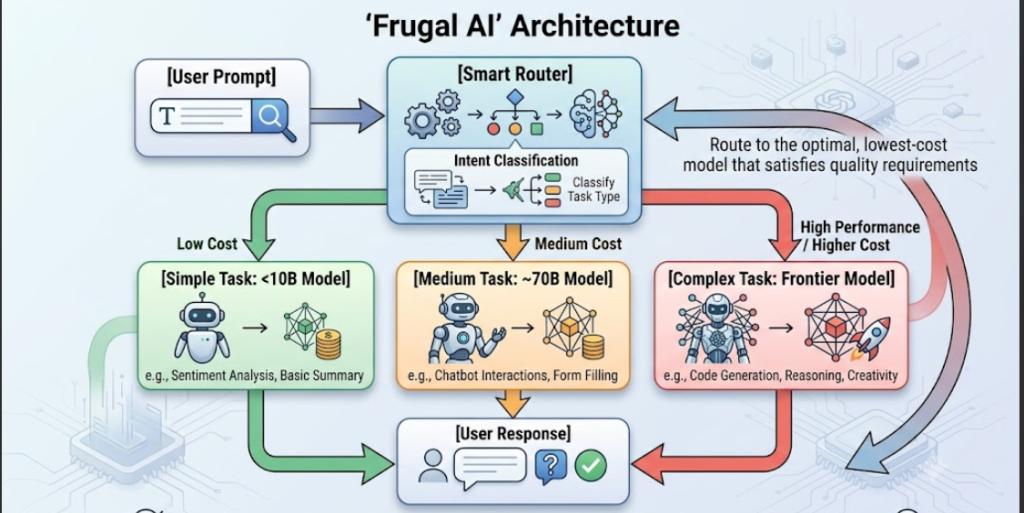
The router analyzes the intent of the prompt, estimates required reasoning depth, and checks historical performance metrics. It then sends the request to the most cost effective model.
The Tiered Model Pool
You must organize your architecture into distinct tiers.
-
- Tier 1 consists of small models. These models have fewer than 10 billion parameters. They cost pennies per million tokens and handle classification or basic data extraction.
-
- Tier 2 contains mid tier models. These models hold around 70 billion parameters. They balance cost and intelligence for general writing and multi step workflows.
-
- Tier 3 holds frontier models. These premium engines process deep reasoning, complex logic, and highly sensitive data.
How to Build a Smart Routing Mechanism
Building a router requires a clear logic system. You can implement routing using three primary methods.
Rules Based Classification
Rules based routing uses keyword triggers and metadata analysis. You inspect the prompt for specific patterns. If a user asks for a simple sentiment score, the system automatically routes the query to a Tier 1 model. If the prompt contains keywords like write code or debug, the system escalates the call to a Tier 3 model. This method introduces zero latency.
Embedding Based Classification
Embedding routers convert incoming prompts into vector mathematics. You compare the vector of the new prompt against a database of historical prompts with known complexity levels.
| # Simple conceptual example of semantic routing using cosine similarity # File: Simple_conceptual example from sentence_transformers import SentenceTransformer, util model = SentenceTransformer(‘all-MiniLM-L6-v2’) # Define reference intents # Route user prompt if score_small > score_large: |
This semantic approach handles variations in human language better than rigid keywords.
Small LLM Evaluators
You can train a tiny, dedicated model to serve as your router. A 1 billion parameter model can read prompts and output a single classification token indicating the destination tier. This method adds a few milliseconds of latency but offers high accuracy for dynamic enterprise workloads.
Real World Implementation Benefits
Smart routing delivers immediate financial and operational advantages.
- Concrete Cost Reductions
Moving routine, high-volume tasks such as ticket classification, basic extraction, and short-form summarization off premium models and onto smaller open-source alternatives is where most of the savings in a tiered system come from, since these tasks typically make up the bulk of query volume in a support or operations pipeline. The exact reduction depends on your traffic mix. An organization where most queries are simple classification will see steeper savings than one where most queries genuinely need frontier-level reasoning. The way to find your number is to log a sample of real queries, tag each by the tier it actually needed, and calculate the blended cost difference against your current single-model baseline before rolling out routing in production.
- Latency Optimization
Smaller models process tokens faster than giant frontier models. When your router sends simple queries to Tier 1 models, your users receive responses much quicker. Your application speed improves, which increases user satisfaction scores.
Building this kind of routing system also requires keeping track of how the models behave in production. Our AI engineers are experienced with model-based automation and cloud workloads, and can help teams design, test, and maintain routing logic as traffic, model performance, and costs change.
Best Practices for Frugal AI
Successfully maintaining a frugal architecture requires ongoing optimization and discipline.
-
- Continuous Evaluation and Drift MonitoringModels change and APIs receive updates. You must log a sample of routed queries and evaluate accuracy over time. If a Tier 1 model starts failing on a specific type of extraction task, update your routing logic to escalate those prompts to Tier 2.
- Implement Fallback MechanicsAlways write defensive code. If a Tier 1 model fails or returns an error, your router must catch the exception and immediately send the prompt to a higher tier. Your users should never see system failures due to budget optimizations.
Frequently Asked Questions
1. What is the ideal number of tiers for an LLM router?
Three tiers provide the best balance for most enterprises. You can easily categorize tasks into small, medium, and large buckets without overcomplicating your routing logic.
2. Does routing add significant latency to user requests?
Rules based routing adds almost no latency. Embedding based routing adds between 10 and 30 milliseconds. Small LLM evaluators add the most latency, but the cost savings usually justify the minor speed trade off.
3. Can I use open source models for the lower tiers?
Yes. Open source models excel at lower tier tasks. You can host them on your own cloud infrastructure to reduce costs even further.
4. How do I know if a task requires a frontier model?
Tasks requiring multi step logic, code generation, creative writing, or deep context synthesis generally require frontier models. Straightforward data manipulation does not.
5. Will frugal AI architecture lower the quality of my app outputs?
No. A well tuned router only sends queries to smaller models when those models can achieve equivalent accuracy to a larger model. Your overall output quality remains steady.
6. How often should I update my routing rules?
Analyze your routing logs and performance metrics once a month. Update your rules or embedding databases whenever you deploy new features or notice accuracy changes.
Conclusion
Frugal AI architecture isn’t a way to cut corners, it’s a way to stop paying frontier prices for work that never needed a frontier model. The router does the differentiation your traffic already has built into it. Most queries are simple, a few are genuinely hard, and cost should track that split instead of ignoring it.
Start with rules-based routing if you want zero added latency and a fast rollout. Move to embedding or small-model evaluators as your query patterns get more varied, and keep fallback logic in place so a routing decision never becomes a user-facing failure.
The teams that get this right treat routing as infrastructure to maintain, not a one-time setup. Logs get reviewed monthly, tiers get adjusted as models and workloads change. That discipline is what turns a one-time cost cut into a durable operating advantage.

