


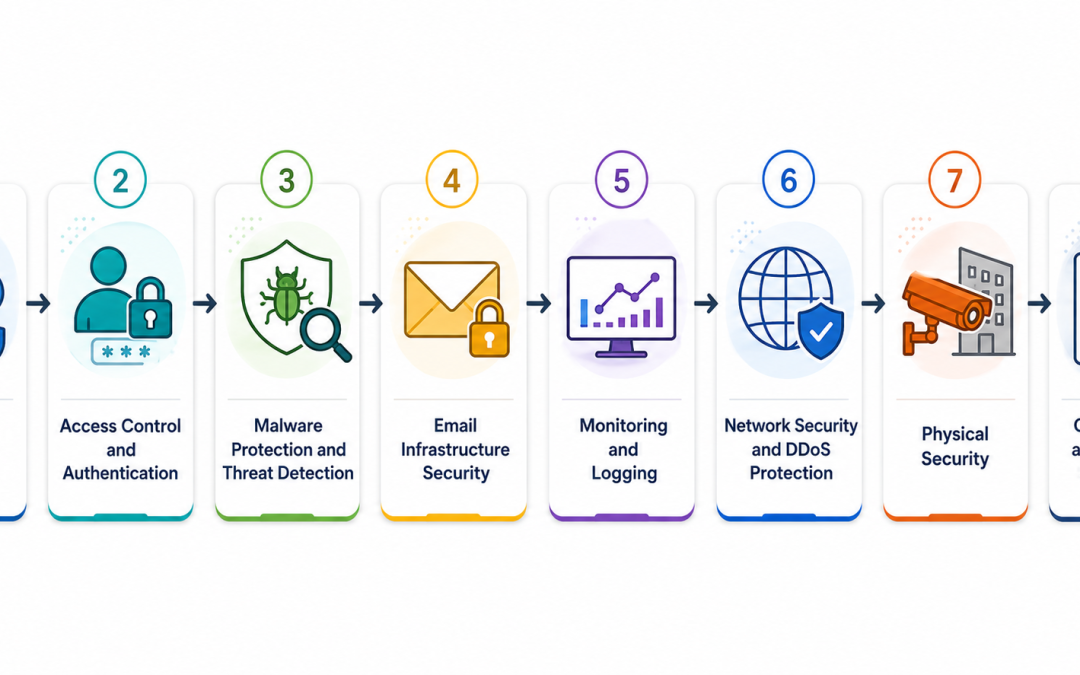
Learn how to evaluate the security of a cloud provider using eight essential criteria, including backups, access control, monitoring, compliance, and more.
Choosing a cloud provider involves more than comparing hardware specifications or pricing. Real-world experience shows that many customer issues arise from backups, security, monitoring, email delivery, and recovery rather than server performance alone. Evaluating these areas helps businesses make informed decisions and prepare for unexpected situations. Bobcares offers Managed Cloud Services to help businesses strengthen cloud security, monitoring, and infrastructure management.
An Overview
Backup Reliability
The first area to evaluate is backup reliability rather than hardware. Backups become most important when websites need urgent recovery or data restoration.
Experience in cloud provider security has shown that having backups alone is not enough. It is equally important to verify that backups complete successfully, maintain multiple restore points, and allow timely restoration when required.
Access Control and Authentication
Access control is another important consideration. Sharing the same WHM login among multiple employees may work initially, but it becomes difficult to identify who made configuration changes or removed an account.
Providers that support user management, activity tracking, and multi-factor authentication make it much easier to troubleshoot security issues.
Malware Protection and Threat Detection
Website compromises often originate from outdated plugins, weak passwords, or neglected applications rather than the hosting platform itself.
However, cloud providers still play an important role. Monitoring tools, malware detection, and security alerts help identify and contain issues more quickly. Additionally, these capabilities improve visibility during security investigations.
Email Infrastructure Security
Email infrastructure is another key part of cloud security. Websites may function normally while email delivery problems continue because of IP reputation or mail delivery policies.
These situations show that security extends beyond preventing attacks. Reliable infrastructure and strong network reputation also contribute to dependable service.
Monitoring and Logging
Monitoring and logging provide valuable insight during performance investigations. A website may become slow even when server resources appear normal.
Reviewing logs can reveal automated processes generating unnecessary requests that are not immediately visible. As a result, effective monitoring helps identify the root cause more efficiently.
Network Security and DDoS Protection
Network protection deserves careful evaluation. Many providers advertise firewall protection and DDoS mitigation, but the real value lies in how these protections perform during an actual attack.
Security features become meaningful when they continue protecting websites during large volumes of unwanted traffic.
Physical Security
Although cloud infrastructure operates virtually, it still depends on physical servers inside data centers.
Access controls, surveillance systems, power redundancy, and environmental safeguards all contribute to overall infrastructure security. Meanwhile, these physical protections remain an important part of evaluating a cloud provider.
Compliance and Security Standards
Compliance is the final area to review. Certifications such as ISO 27001 and SOC 2 do not guarantee complete security.
However, they demonstrate that providers follow documented processes and participate in independent audits.
Conclusion
Evaluating a cloud provider goes beyond comparing performance statistics or pricing. Backup reliability, access control, malware protection, email infrastructure, monitoring, network security, physical security, and compliance all contribute to a secure and dependable environment. These areas often become most important during migrations, security incidents, or data recovery. Bobcares helps businesses strengthen cloud environments through its Managed Cloud Services, supporting secure and reliable cloud infrastructure management.

