


Cloud DevOps services help build and manage embedded Linux environments with scalable build systems, automation, and reliable software delivery.
There’s a question that comes up in almost every embedded project kickoff meeting: “Should we just use Yocto?” Someone usually asks it because Yocto is one of the best-known names in embedded Linux, but the question itself is slightly wrong. There is no single best embedded Linux platform. The right fit depends on your board, team’s skill set, release cadence, and long-term maintenance requirements. Get that fit wrong, and you can spend significant engineering time working around your build system instead of shipping features.
This article walks through the tools engineers commonly use to build Linux-based embedded products, what each one trades away in exchange for what it provides, and a practical way to choose between them for your next board bring-up.
An Overview
- First, separate “embedded Linux” from “Linux on an embedded board”
- The build system camp: Yocto, Buildroot, and PTXdist
- The trimmed general-purpose distro camp
- Where an RTOS fits into this conversation
- A decision framework, not a leaderboard
- Three quick scenarios
- The part people skip: plan the update mechanism before you pick the platform
First, separate “embedded Linux” from “Linux on an embedded board”
Before comparing platforms, it helps to be precise about what you’re building. Two different approaches often get called “embedded Linux”:
- A custom, purpose-built image: You define the packages, libraries, kernel configuration, and other components that go on the device. This approach is common for products that need tightly controlled software images.
- A trimmed general-purpose distro: You take something such as Debian or Ubuntu, remove unnecessary components, and run it on a single-board computer. This approach is common for prototypes, development systems, gateways, kiosks, and some production appliances.
Both are legitimate engineering choices. The mistake is assuming they solve the same problem. A build system that produces minimal images tailored to a custom PCB serves a different purpose from a distribution that gives you apt install and a familiar user space on a Raspberry Pi.
The build system camp: Yocto, Buildroot, and PTXdist
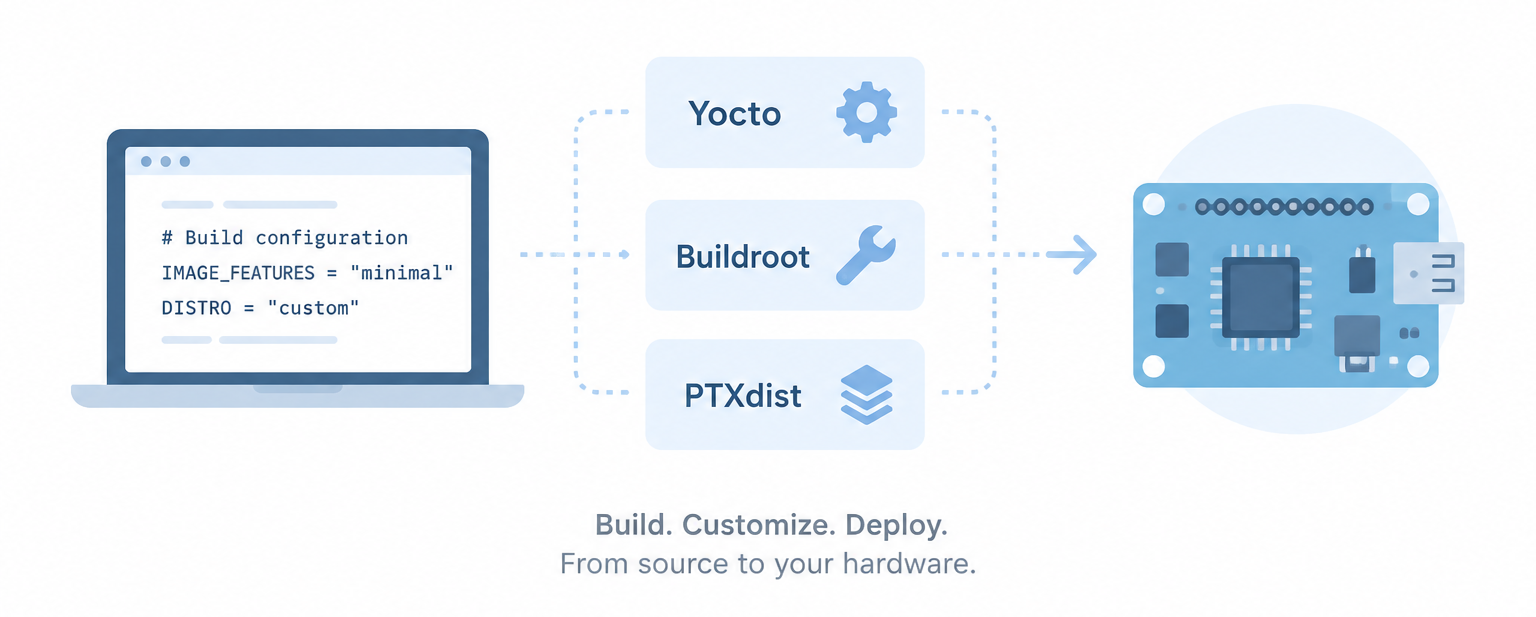
These are not distributions in the traditional sense. You do not normally download an ISO and install them like a desktop operating system. Instead, they provide build frameworks for creating Linux images tailored to your hardware.
Yocto Project
Yocto is less a distribution than a framework for creating a customised Linux-based system. You describe your target through recipes and layers, while BitBake handles tasks such as building the toolchain, kernel, bootloader, and root filesystem.
Chip vendors such as NXP, TI, and AMD provide Yocto-related resources and Board Support Packages for various platforms. This can reduce some of the work involved in bringing vendor hardware into a product build.
What you get in exchange for the learning curve:
- Support for reproducible build practices, which can be valuable for controlled release and audit requirements.
- A layered model that separates board support, middleware, and application-related components, allowing teams to share common software across products.
- A large recipe ecosystem covering many open-source packages.
Talk to us about DevOps.

What it costs you:
- Yocto builds can require substantial disk space and build time, particularly for larger images and graphical environments.
- BitBake syntax and the layering model (bblayers.conf, local.conf, and .bbclass files) require a dedicated learning period for engineers new to the system.
- Debugging a failed recipe can involve several layers of build logic, which can make problems harder to trace.
Yocto is often a strong fit for products with long lifecycles, multiple SKUs sharing a software base, or requirements for controlled and repeatable software builds. It can be unnecessary for a small prototype where a ready-made distribution provides everything the project needs.
Buildroot
Buildroot addresses a similar problem to Yocto with a more streamlined configuration model. Configuration uses a menuconfig-style interface, and the build system can generate a complete embedded Linux image without requiring a package manager on the target.
That constraint is central to Buildroot’s approach. Teams can generate a new image when software changes rather than relying on package management on the device. This works well for products where the software image is treated as a controlled release artifact.
For teams that need package-level flexibility on a running device, this approach can be more restrictive. Customizing packages beyond the available configuration options can also require maintaining Buildroot-specific package configuration or patches, which needs planning when the same base is used across multiple products.
PTXdist
PTXdist is another embedded Linux build system used in some industrial and embedded projects. It uses a Kconfig-based configuration approach and produces customized filesystem images.
It is particularly relevant when you’re joining a project that already uses PTXdist and has established tooling and workflows around it. Teams choosing a new build system from scratch generally compare it against the broader ecosystems and project requirements of alternatives such as Yocto and Buildroot.
The trimmed general-purpose distro camp
Debian and embedded-focused derivatives
Debian can be a practical embedded target when the hardware is a standard SBC, such as a Raspberry Pi or BeagleBone class board, or an x86 industrial computer, rather than a custom board with a specialized SoC.
You gain apt, access to a large package archive, and tooling that many Linux developers already know. The tradeoff is that a general-purpose distribution does not provide the same image customization model as a build system such as Yocto or Buildroot.
Raspberry Pi OS is a prominent example of a Debian-based approach for Raspberry Pi hardware. It can make sense for gateways, kiosks, development systems, and single-purpose appliances where the hardware and software requirements do not justify maintaining a fully custom image build environment.
Ubuntu Core
Ubuntu Core takes a different approach to embedded Linux. It uses snap packages and supports transactional software updates with rollback capabilities. This can be useful for products that need an established mechanism for delivering software updates to devices in the field.
The tradeoff is the snap-based software model. Teams also need to evaluate storage requirements, application packaging requirements, available software, and the update infrastructure that forms part of the Ubuntu Core ecosystem.
OpenWrt
OpenWrt deserves its own category because it is designed specifically around network-focused embedded devices such as routers, gateways, and access points. It provides networking-focused components, hardware support, LuCI for web-based management, and its own package management system.
If you’re building network equipment, OpenWrt can provide a substantial starting point compared with assembling a networking-focused system from a general embedded Linux build environment. Outside networking-focused products, however, its specialized design may provide fewer advantages.
Where an RTOS fits into this conversation
Sometimes the right answer to “which embedded Linux platform” is “none of them.” If your device has strict real-time requirements, such as a control loop with tightly bounded latency requirements, a general-purpose Linux system may not provide the deterministic behavior your application requires.
Linux with PREEMPT_RT can support many real-time workloads, but the suitability depends on the actual latency requirements, hardware, workload, and system validation requirements. For applications requiring stronger deterministic guarantees, technologies such as Zephyr, FreeRTOS, or a vendor-specific RTOS may be more appropriate.
Linux remains a strong option when the product needs networking, filesystems, a broad driver ecosystem, and application-level flexibility. Identifying the real-time requirements early can prevent a costly architecture change later in the project.
A decision framework, not a leaderboard
Rather than ranking these platforms against each other, run your project through these questions:
| Question | Potential fit |
|---|---|
| Custom PCB with vendor-supplied BSP resources? | Yocto |
| Small team and a simple, image-based target? | Buildroot |
| Standard SBC and existing Debian or Ubuntu expertise? | Debian-based / Raspberry Pi OS |
| Need an established OTA and rollback model? | Ubuntu Core |
| Product is a router, gateway, or access point? | OpenWrt |
| Strict real-time requirements? | Evaluate Linux PREEMPT_RT and RTOS options |
| Multiple product SKUs sharing a software base long term? | Yocto |
| Prototype on a Raspberry Pi or similar SBC? | Debian based |
Three quick scenarios
A battery-powered environmental sensor gateway using a custom NXP i.MX-based platform with a multi-year product lifecycle. A Yocto-based approach can provide the customization, build control, and layered software structure needed for a product of this type. Buildroot can also be evaluated depending on the team’s requirements and maintenance model.
A one-off museum kiosk running on a Raspberry Pi 4. Raspberry Pi OS can be a practical choice when the project does not need a highly customized image build system or a complex long term software maintenance process.
A Wi Fi mesh access point built on embedded networking hardware. OpenWrt provides a networking-focused starting point, including its management interface and embedded networking components, reducing the amount of platform work the product team needs to assemble themselves.
The part people skip: plan the update mechanism before you pick the platform
Whichever platform you choose, decide before finalizing the architecture how devices in the field are going to receive security and bug fix updates. Options can include A/B partition updates, image-based systems such as RAUC or SWUpdate, package-based updates, or a vendor-provided OTA service.
This decision interacts directly with the platform choice. Buildroot’s image-based approach can work naturally with image update strategies, while Debian-based systems can support package-based update workflows. Ubuntu Core has its own transactional update model, while OpenWrt provides package management suited to its target devices.
Choosing the platform first and considering the update strategy later can create additional engineering work when the product reaches deployment. The update mechanism should therefore be part of the architecture discussion from the beginning.
Conclusion
The useful question is not “which embedded Linux platform is best?” It is “what does my hardware, my team, and my update strategy require?”
Yocto and Buildroot are options when you’re building a customized Linux image and need control over the software stack. A Debian-based system can suit standard SBC hardware where familiar package management and development tools are useful. Ubuntu Core provides an embedded-focused approach built around transactional updates, while OpenWrt is designed around networking devices. For systems with strict real-time requirements, an RTOS or a Linux real-time configuration may need to be evaluated.
Start with the product constraints, hardware, maintenance model, and update requirements. The platform choice can then follow from those requirements rather than from the popularity of a particular tool.

