


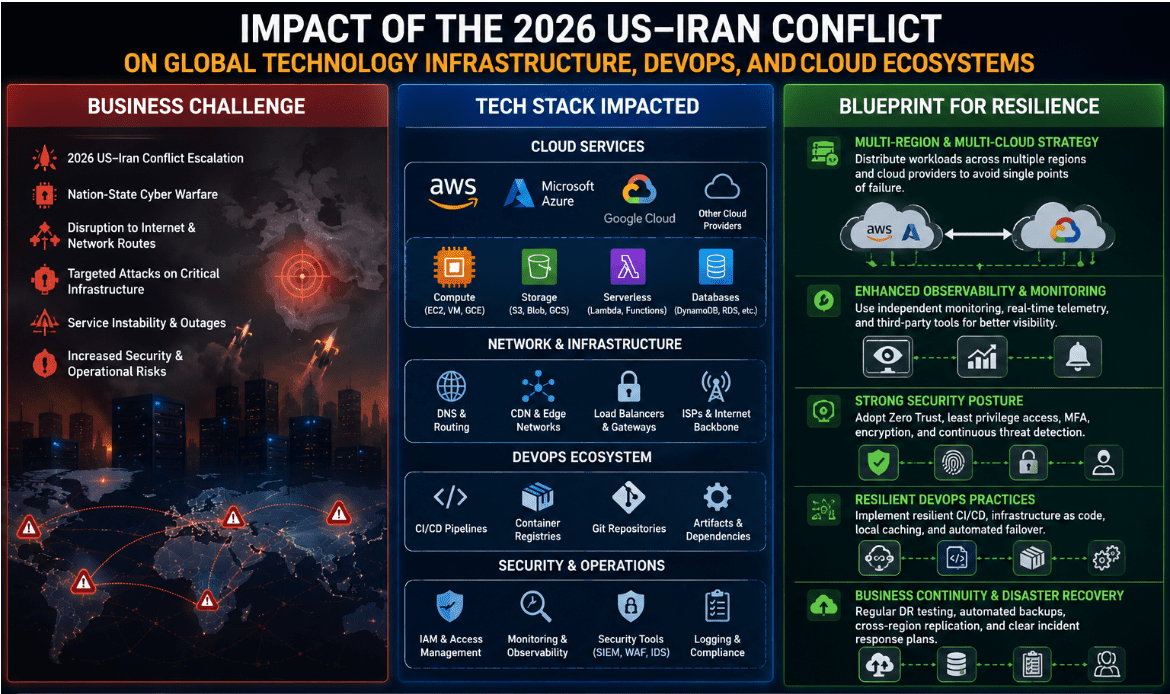
The 2026 US-Iran conflict showed how quickly geopolitical events can affect global technology infrastructure. What began as regional tension extended into cloud infrastructure, internet routing, cybersecurity, and DevOps operations.
Organizations far from the conflict also experienced the impact because modern businesses depend on shared global infrastructure. The crisis highlighted how geopolitical instability can become a direct operational risk.
An Overview
The Digital Battlefield
The escalation turned cyberspace into a parallel battlefield. State-sponsored threat groups and affiliated actors targeted cloud providers, internet exchange points, financial systems, energy infrastructure, telecommunications providers, government systems, SaaS platforms, and DNS infrastructure.
Cybersecurity agencies and network operators reported increased hostile activity as tensions worsened. DDoS attacks, DNS poisoning, BGP route hijacking, ransomware, phishing, supply chain attacks, and cloud credential theft all intensified.
Organizations relying on internet routes through the Middle East faced intermittent connectivity and degraded cloud performance. Applications dependent on low-latency communication experienced cascading errors that were difficult to trace and resolve.
Impact on Cloud Infrastructure
The disruption affected cloud operations in several ways.
- Traffic rerouting increased latency and packet loss. API responses slowed, CDN performance declined, and intermittent service degradation became common.
- Organizations experienced resolution failures, propagation delays, timeout errors, and misrouted traffic. The crisis exposed the dependency on DNS infrastructure.
- Workloads concentrated in Middle Eastern cloud regions or dependent on Europe-Middle East transit corridors faced greater disruption. Organizations without multi-region failover experienced prolonged downtime.
- Authentication failures, unanswered API calls, and stalled synchronization processes affected organizations relying on tightly integrated SaaS platforms.
DevOps and Cybersecurity Risks
Modern CI/CD pipelines depend on Git repositories, container registries, artifact repositories, API gateways, package mirrors, DNS, and cloud authentication. Disruption to these services caused failed deployments, container pull timeouts, authentication errors, and unreliable package access.
Security teams also restricted outbound internet access during periods of heightened risk. However, this affected deployment automation and infrastructure provisioning workflows.
Meanwhile, threat actors targeted DevOps pipelines through credential harvesting, Kubernetes exploitation, cloud IAM abuse, supply chain compromise, API abuse, malware injection, and ransomware.
A compromised pipeline can provide access to infrastructure, source code, secrets, and production environments. This made cloud-native infrastructure a significant target during the crisis.
Cloud Security Gaps
The incident exposed several weaknesses in existing security and resilience strategies.
Organizations relying heavily on a single cloud provider faced greater exposure to regional outages and routing instability. Post-incident reviews also identified hardcoded credentials, excessive IAM permissions, elevated service accounts, and inconsistent MFA enforcement.
Monitoring presented another challenge. Organizations relying entirely on cloud-native monitoring could lose visibility when the cloud itself experienced disruption.
Key Business Continuity Lessons
The crisis highlighted several important lessons:
- Geopolitical risks can become technology risks.
- Multi-region architectures can reduce disruption.
- DevOps requires resilience engineering.
- DNS redundancy and failover testing are important.
- Independent observability can preserve visibility.
- Disaster recovery plans should account for internet-scale disruptions.
- Security and operations must collaborate during geopolitical crises.
How Organizations Responded
Organizations responded by reducing their dependence on individual providers and distributing workloads across AWS, Microsoft Azure, Google Cloud, and hybrid infrastructure.
Zero Trust adoption also accelerated. Businesses introduced identity-based access controls, short-lived credentials, device trust verification, and least-privilege IAM policies.
Additionally, organizations expanded independent monitoring, distributed tracing, network telemetry, and DNS health monitoring. Disaster recovery strategies also moved toward regular failover testing, immutable backups, cross-cloud replication, and air-gapped recovery systems.
Lessons for DevOps and Cloud Teams
Cloud and DevOps organizations can take several lessons from the crisis:
- Assume cloud regions and network paths can fail.
- Treat deployment pipelines as critical infrastructure.
- Use local mirrors, private registries, and internal package repositories where possible.
- Avoid depending only on cloud-native monitoring.
- Resilience strategies need real-world testing.
- Build redundancy and failover planning into infrastructure.
- Security planning must evolve alongside cloud and DevOps modernization.
Conclusion
The 2026 US-Iran conflict showed how closely cloud infrastructure, DevOps ecosystems, and internet services connect to global events. Organizations that had focused mainly on scalability and performance were forced to address resilience, redundancy, continuity, and cyber defense under pressure.
The crisis also highlighted three key realities: cloud providers can experience disruption, internet infrastructure remains an attack surface, and DevOps pipelines require the same security attention as production systems.
Organizations that invest in resilient architectures, secure DevOps workflows, comprehensive observability, and tested continuity planning can better handle future disruptions.

