


Learn how to measure technical debt before it stalls your product. Discover key metrics, warning signs, and a clear plan to take back control of your codebase.
Technical debt often remains invisible to most product teams until something breaks. It often pops up as a release getting delayed, a new feature taking longer than expected, developers flagging parts of the codebase as too risky to touch, and so on. By the time these signals appear, the debt has usually been building for months, sometimes years.
Technical debt is one of the most common reasons product development stalls. Yet most engineering organisations have no formal way of measuring it. They rely on gut feeling, incident reports, or their developers’ frustration levels. This cannot always work out in the long run.
If you are looking for a practical guide to measuring technical debt, you have come to the right place. Today, we will identify the types that actively block your product roadmap, and turn those numbers into a plan you can act on.
An Overview
- What Is Technical Debt
- Why Technical Debt Is Hard to See Until It Is Too Late
- The Types of Technical Debt That Block Product Development
- How to Measure Technical Debt
- Reading the Numbers
- Tools That Help You Measure Technical Debt
- How to Identify Technical Debt That Is Blocking Product Development
- Turning Measurement Into a Plan
- Frequently Asked Questions
What Is Technical Debt?
Technical debt often arises from the “build now, fix later” approach that can drive software development. Developers may choose quick solutions rather than investing the time to build scalable and maintainable code under tight deadlines, limited resources, or changing requirements.
The shortcut might be worth it in the moment. The problem is when that shortcut never gets cleaned up. The codebase gets more complex, new features get layered on top of shaky foundations, and eventually the whole thing starts slowing down. This is a pattern many teams recognise when they start scaling a product that was built quickly. Our MVP to Scale services walk through how to approach that transition without letting early shortcuts define your long-term architecture.
Technical debt becomes especially difficult to manage because it builds up slowly over time. In most cases, teams do not notice it until it starts to affect development speed. In other words, you don’t feel it until it is already a serious problem.
Why Technical Debt Is Hard to See Until It Is Too Late
Although most organisations know technical debt exists, very few are aware of how much debt they actually have.
According to McKinsey & Company, CIOs estimate that technical debt accounts for 20–40% of their entire technology estate before depreciation. Furthermore, 60% of CIOs say their organization’s technical debt is higher today than it was three years ago.
One reason is that technical debt rarely appears all at once. It builds up quietly over time. It can be a missed refactor here or an undocumented workaround there, and so on. Individually, these decisions may not seem urgent. But as more quick fixes accumulate, the codebase gradually becomes more complex and harder to understand.
Over time, this complexity slows development. Developers struggle to locate and fix bugs, adding new features becomes harder, and improving code quality takes longer. Eventually, teams find themselves in a cycle where existing technical debt makes it easier to create even more of it.
This is sometimes called the snowball effect. Small issues compound into large ones, and by the time the impact on delivery is obvious, the effort needed to address it has grown considerably.
Gartner research shows that companies that actively manage technical debt achieve service delivery times at least 50 percent faster. Organisations that fail to do so face higher operating expenses, reduced performance, and longer time-to-market. The cost is not just financial, either. In one survey, 76 percent of respondents said that dealing with technical debt negatively impacted their morale. When developers spend their days untangling legacy problems instead of building new things, motivation drops, and so does the quality of the work.
The Types of Technical Debt That Block Product Development
Some types of technical debt slow you down gradually, while others can bring a product roadmap to a complete halt. A useful way to think about debt is by where it lives in your delivery process and how directly it affects your ability to ship.
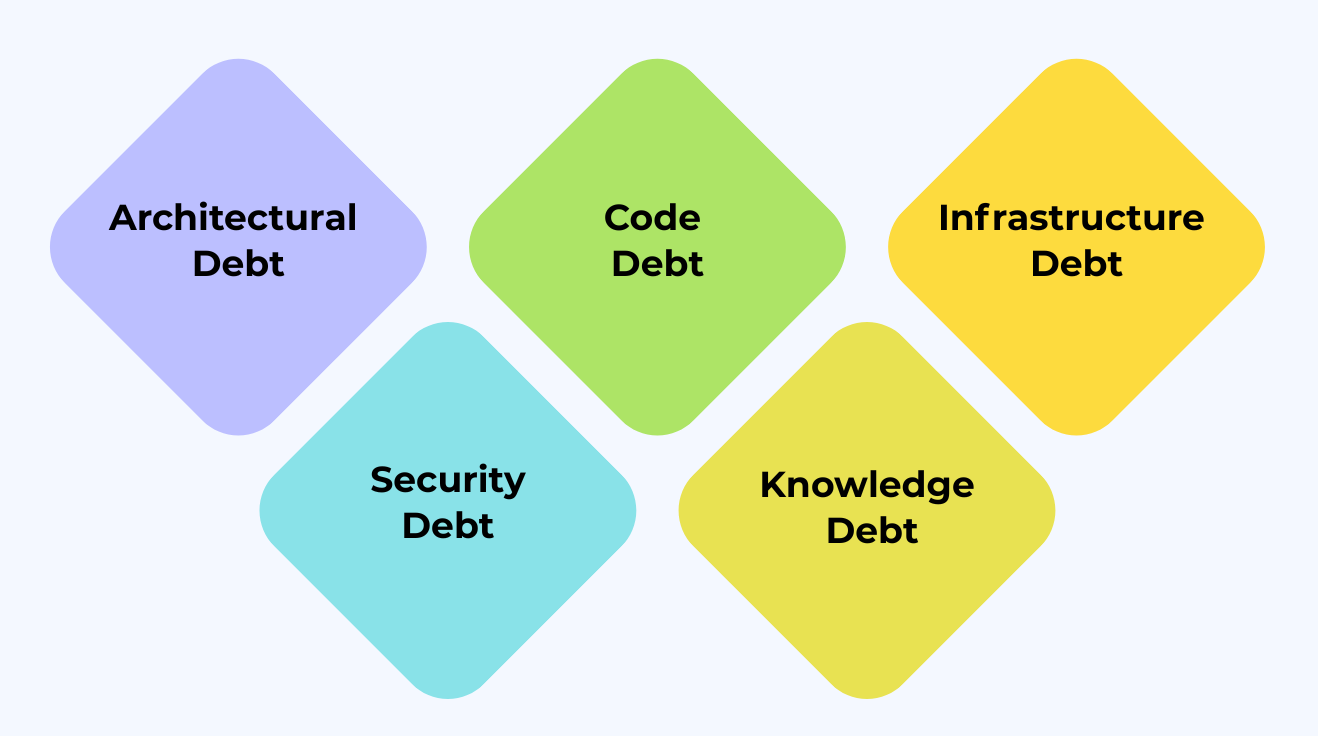
Architectural Debt
This type of technical debt pops up when a system’s foundation lacks scalability, flexibility, or maintainability. Legacy systems, monolithic architectures, and tightly coupled components make updates difficult, increasing the effort required for every development task. When architectural debt is present, even small product changes can require large engineering efforts.
Code Debt
Code debt is common and is often due to rushed development, inconsistent coding practices, and shortcuts that were never revisited. When developers duplicate logic, skip documentation, or fail to follow agreed standards, the technical debt accumulates. Debugging and maintenance become time-consuming, and the codebase gradually becomes a place no one wants to work in.
Infrastructure and DevOps Debt
This debt is often overlooked but highly damaging to delivery speed. It builds up when outdated deployment processes and inefficient CI/CD pipelines are never modernised. It shows up as slow build times, flaky pipelines, and deployments that require manual steps.
Security Debt
Security debt occurs when teams cut corners on encryption, authentication, or vulnerability patching, leaving software exposed to threats and compliance risks. A lack of automated security testing increases the burden on development, making it progressively harder to maintain secure systems.
Knowledge Debt
Knowledge debt occurs when critical information about the system is not adequately shared or preserved within the team. Essential knowledge held by only one or two individuals creates bottlenecks and single points of failure, particularly when those people are unavailable or leave the organisation.
The table below maps each debt type to the delivery problem it most commonly causes and the signal to watch for.
Table 1: Technical Debt Types and Their Impact on Product Delivery
| Debt Type | Common Symptoms | Primary Delivery Impact | Key Warning Signal |
|---|---|---|---|
| Architectural Debt | Structural drift, outdated infrastructure, hidden dependencies | Blocks new features, limits scalability | Simple changes require large engineering efforts |
| Code Debt | Excessive bugs, slow performance, fragile code | Increases bugs, slows development cycles | High defect rates, modules nobody wants to touch |
| Infrastructure / DevOps Debt | Slow builds, manual deployment steps, flaky pipelines | Slows releases, increases deployment failures | Manual steps in pipelines, unstable CI/CD |
| Security Debt | Unpatched vulnerabilities, deferred compliance fixes | Creates compliance risk, defers patches indefinitely | Vulnerabilities carried across multiple releases |
| Knowledge Debt | Missing documentation, single points of failure | Slows onboarding, creates dependency on key individuals | Long ramp-up times, key person dependencies |
How to Measure Technical Debt: Key Metrics Explained
Fortunately, we can measure technical debt with some practical metrics like these:
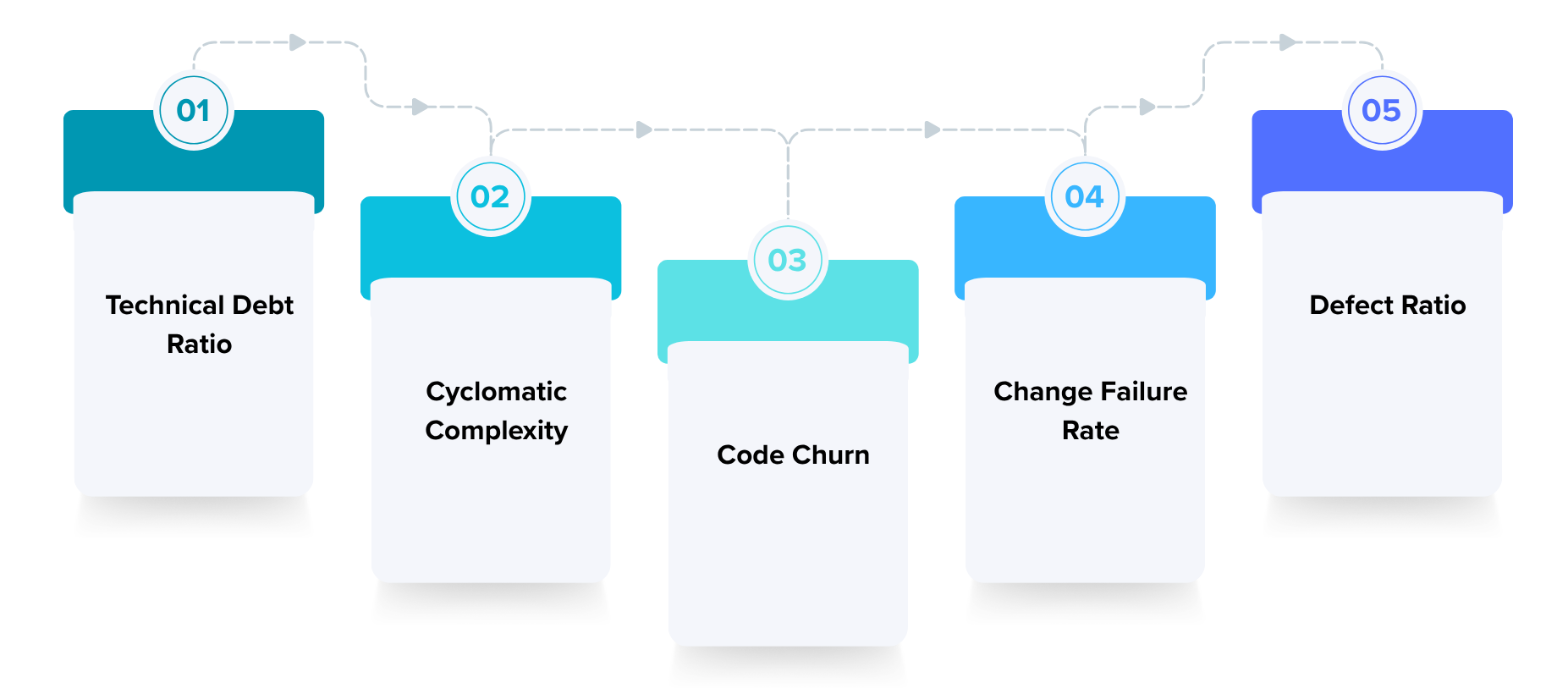
Technical Debt Ratio (TDR)
This is a popular metric for quantifying debt at a system level. At its simplest, it expresses the relationship between the cost to fix existing debt and the cost of building the system in the first place.
Industry benchmarks suggest keeping the Technical Debt Ratio (TDR) below 5%. However, in practice, many organizations operate at 10% or higher as technical debt tends to accumulate over time. TDR won’t give you a perfect picture on its own, but it gives leadership a concrete number to track. If that number is rising quarter over quarter, it tells you that debt is growing faster than it is being addressed.
Cyclomatic Complexity
This metric counts the number of possible execution paths through a piece of code. The higher the score, the more difficult the code becomes to understand, test, and modify safely. High cyclomatic complexity is one of the clearest indicators of code debt. It often signals that a module or function has been patched repeatedly without ever being properly refactored.
Code Churn
Code churn measures how frequently files in the codebase are being changed. High churn in a specific area usually signals instability or a poorly designed system. It also correlates strongly with bug density. Files that are constantly being modified are often the ones accumulating the most debt.
Change Failure Rate
This measures how often a code change causes a failure in production. A great change failure rate points to inadequate testing, fragile architecture, or both. It is a direct signal that your debt is affecting delivery quality, not just speed.
Defect Ratio
The defect ratio tracks the number of bugs or issues relative to the volume of code being produced. A rising defect rate, especially in areas under active development, is a strong sign that technical debt is undermining new work.
Teams with higher TDRs consistently report friction in feedback loops, elevated cognitive load, and reduced developer flow. These are not isolated symptoms. They map to key dimensions of developer productivity: velocity, quality, cognitive load, and feedback loops.
Want to stay ahead of technical debt?

Reading the Numbers: What Your Metrics Are Actually Telling You
Once you measure the metrics, the next step is to know what to do with them. The table below breaks down TDR ranges and what they typically mean for your product development health.
Table 2: TDR Benchmarks and Product Development Impact
| TDR Range | What It Signals | Typical Impact on Product Development | Recommended Action |
|---|---|---|---|
| Below 5% | Healthy, well-maintained codebase | High delivery velocity, low friction in releases | Maintain current practices, monitor regularly |
| 5% to 10% | Manageable debt with areas to address | Some slowdowns, occasional rework, and minor delays | Begin prioritising debt in sprint backlogs |
| 10% to 20% | Debt is accumulating faster than it is being resolved | Noticeable delivery delays, rising bug rates | Formal debt reduction plan required |
| 20% to 40% | Significant structural problems present | Feature development was heavily impacted, causing unpredictable releases | Escalate to leadership, dedicate focused sprints to remediation |
| Above 40% | Critical debt, systemic issues across the codebase | The product roadmap was effectively blocked | Major refactoring initiative needed as a business priority |
It is also worth paying attention to the metric’s direction, not just its current value. A TDR that climbs steadily from 8 to 12 to 16 percent over three quarters is a warning sign, even if none of those numbers looks catastrophic in isolation.
Tools That Help You Measure Technical Debt
Manual measurement will only get you so far. Most teams need automated tooling to get a clear, up-to-date picture of their debt. Here are some of the most widely used options.
SonarQube is the most widely adopted starting point for code-level measurement. It scans the entire codebase and estimates how long it would take to address the issues it finds. It integrates into CI/CD pipelines and surfaces code smells, security gaps, and complexity trends over time.
CodeScene goes beyond static snapshots. It relies on behavioural code analysis to identify high-risk areas, prioritise technical debt by business impact, and track how debt affects project timelines and team velocity. Its standout feature is linking code health to team dynamics, identifying knowledge silos and hotspots that static tools miss.
Teamscale is worth considering for organisations managing large, multi-language codebases. It maps the entire code ecosystem, covering architecture issues, test coverage gaps, and compliance risks. It also supports quality gates that can block pipelines when new code violates pre-set standards.
Kiuwan is another option for teams that need objective, automated debt estimation. It monitors over 60 technical debt metrics and is designed specifically to support debt quantification rather than general code review. It removes the subjectivity of manual estimates, which is important when making a business case to leadership.
The right combination depends on where your debt is concentrated. A team with significant architectural issues needs different tooling than one with a testing coverage problem. Most mature engineering organisations use at least two tools in combination, one for code-level signals and one for architectural or behavioural analysis.
How to Identify Technical Debt That Is Blocking Product Development
It is essential to understand that measuring debt and identifying debt that actively blocks your product development are two different things. A codebase can carry a manageable amount of debt without seriously affecting delivery. The problem is when debt crosses the line from background friction into an active blocker.
Here are a few signals that indicate when technical debt is becoming critical.
Releases are becoming less predictable.
If your team is consistently missing sprint commitments or extending timelines due to unexpected complications, debt is probably the cause. Technical debt makes codebases brittle, opaque, and difficult to change safely. Teams must spend more time understanding the potential impact of changes and testing them to avoid unexpected failures.
New features are breaking old ones.
This is a common symptom of design and architectural debt. The codebase is too tightly coupled, so changes ripple across the system in unpredictable ways. Fixing one thing breaks two others, and releases become a source of anxiety rather than progress.
Developers are avoiding certain parts of the codebase.
When engineers describe areas of the system as off-limits or too risky to change, that is a critical warning sign. The debt in those areas has grown to the point where even experienced developers don’t trust themselves to work in it safely.
Onboarding new developers takes too long.
Documentation debt and code complexity directly impact how quickly new team members become productive. If it takes months rather than weeks for someone to make their first meaningful contribution, it is adding to the debt.
Security patches are being deferred.
When security issues become too costly or complex to address, vulnerabilities end up in production. This results in an endless cycle of patching and ever-higher development costs as the problem builds up.
Beyond technical indicators, there is also a human signal to consider. Technical debt gradually drains energy, motivation, and a sense of ownership among developers. Over time, teams may start treating it as something to work around rather than fix. When that happens, the issue stops being purely technical and becomes an organizational challenge as well.
Turning Measurement Into a Plan
Once you have a clear picture of your technical debt, it is time to turn those insights into a plan your team can actually execute.

Prioritise by impact, not just size.
Focus first on the debt that is actively blocking your product roadmap or creating significant security or reliability risk. Architectural debt typically sits at the top of this list because its effects are systemic and far-reaching.
Build debt reduction into your sprint cycles.
Next, give developers dedicated time to perform additional testing and remediate issues. This prevents problems from compounding later in the development cycle and saves time in the long run.
Make it visible to leadership.
Technical debt is often an invisible cost to anyone outside engineering. Use your TDR and other metrics to build a concrete business case. Showing that debt is consuming 15 percent of your development capacity is far more persuasive than a general complaint that the codebase is messy.
Track your metrics over time.
Use automation to track technical debt over time. This way, you can benchmark debt reduction and understand how your efforts are paying off. Metrics like TDR, change failure rate, and defect ratio should be reviewed regularly, at a minimum on a quarterly basis.
Address the cultural side.
Companies often run into problems because they try to fix technical debt before analyzing the underlying issues that contribute to it. Building a culture that values quality, one that empowers developers to push back on unrealistic deadlines, is critical to preventing debt from compounding in the first place.
No debt reduction plan will succeed if the culture still rewards shipping quickly at any cost. Measurement and process matter, but so does the environment in which developers work every day.
Frequently Asked Questions
1. How do teams actually measure technical debt in real projects?
In practice, teams combine metrics like TDR, code complexity, and defect rates with backlog tracking. Many teams also log technical debt as tickets and estimate the effort required to fix them, making it visible and measurable over time.
2. Should technical debt be measured in time or money?
It can be measured in both. Many teams estimate technical debt in developer hours (remediation time), while leadership often prefers cost-based estimates to understand business impact.
3. How often should technical debt be measured?
Technical debt should be tracked continuously using automated tools, with formal reviews at least once every quarter. Regular monitoring helps detect trends early and prevents debt from accumulating unnoticed.
4. What level of technical debt is considered acceptable?
Industry benchmarks suggest keeping the Technical Debt Ratio below 5%. However, many teams operate between 5% and 10%. Anything above 10% typically indicates growing risk and requires active management.
5. Can technical debt be tracked using a backlog or sprint system?
Yes. Many teams track technical debt as backlog items in tools like Jira or GitHub. Some even allocate a fixed percentage (e.g., 20%) of each sprint to address debt, ensuring it is continuously managed rather than postponed.
6. How do you prioritize technical debt effectively?
A common approach is to score technical debt based on business impact and “interest rate” (how much it slows development over time). High-impact debt that blocks features or causes instability should be addressed first.
7. How do you know which technical debt is worth fixing?
Not all debt needs immediate action. If the cost of fixing it exceeds the impact it causes, it may be acceptable to delay. The goal is to focus on debt that slows delivery, increases risk, or affects customers.
8. Why do many teams struggle to measure technical debt accurately?
Technical debt is not just code-level, it includes architecture, processes, and even team knowledge. No single metric captures everything, so teams need a combination of data, tools, and developer feedback.
Conclusion
Technical debt is one of those problems that feels manageable until it isn’t. By the time it starts visibly blocking your product development, it has often been growing unchecked for years. The good news is that it doesn’t have to reach that point.
By measuring technical debt, engineering leaders and product managers get the visibility they need to make smart decisions about where to invest time and effort.

