


Discover how business idea validation works and why it matters for startups. Learn how to test market demand, gather feedback, and build ideas people want.
Great ideas appear out of the blue every day. The secret lies in turning it into a successful business. Unfortunately, many never reach that stage. The reason is as old as time, the idea looked promising, but the market did not care enough about it.

Building a product takes time, effort, and money. Developers need to build features, marketing campaigns need preparation, and early growth requires resources. All that effort can go to waste if the product’s idea does not solve a real problem.
Business idea validation helps prevent that situation. It lets you test whether an idea has real demand before committing to development. Instead of relying on assumptions, teams collect feedback and real signals from potential customers. Once validation confirms that the idea solves a real problem, the next step is building a Minimum Viable Product (MVP) so early users can interact with the solution and provide practical feedback.
Today, we will explore how business idea validation works and how to validate your business idea step by step.
An Overview
- What Is Business Idea Validation?
- Why does Business Idea Validation Matter?
- Signs Your Business Idea Has Real Market Demand
- Core Areas to Validate Before Building a Product
- Step-by-Step Process for Business Idea Validation
- Practical Methods to Test Your Business Idea
- Common Mistakes During Business Idea Validation
- What to Do If Your Business Idea Fails Validation
What Is Business Idea Validation?
Business idea validation involves testing whether a business concept has real demand in the market before building a full product.
Instead of investing months into development, we have to first gather evidence that the idea solves a meaningful problem and that people are willing to pay for a solution. The validation process often includes market research, customer interviews, early experiments, and simple prototypes.
The purpose is not to prove that the idea is perfect. It is to understand whether the idea is worth pursuing.
Business idea validation focuses on confirming three important things. The problem must exist, customers must care about solving it, and the proposed solution must create value.
Even if we believe the idea is strong, this alone does not guarantee demand. Validation replaces assumptions with feedback from potential customers.
Early validation can happen through interviews, surveys, landing pages, or simple product experiments. Each method provides insights about the problem and how people respond to the solution.
Once enough signals align, it indicates that the idea may have genuine potential.
Difference between idea validation, market research, and product market fit
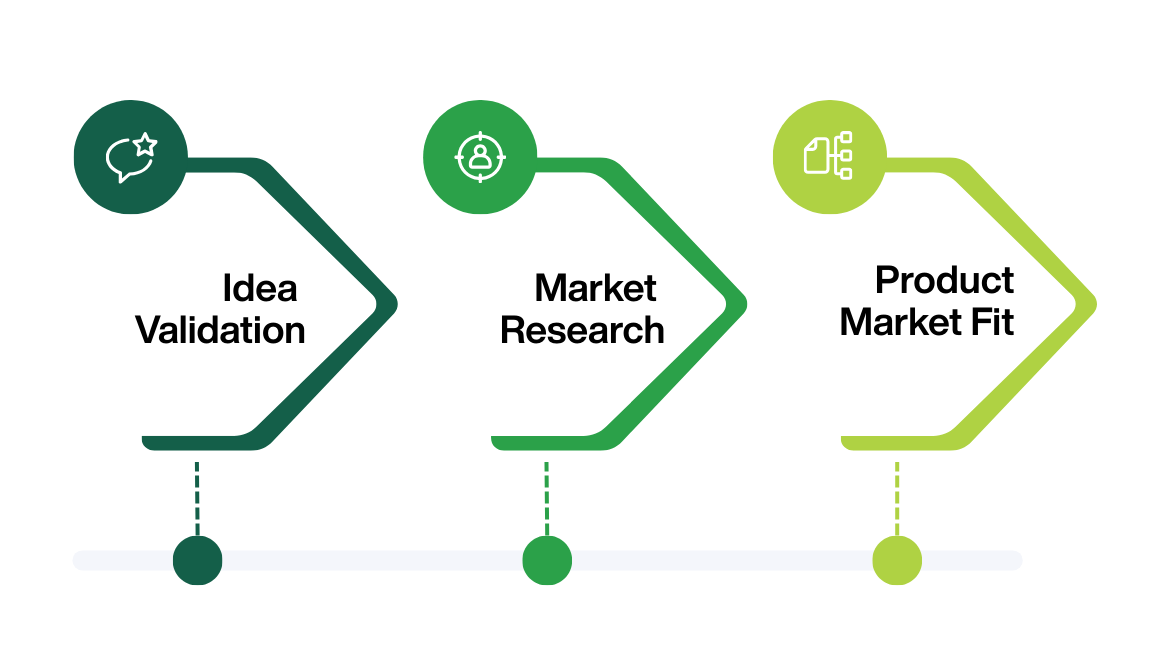
These terms often appear together, but they refer to different stages of the startup journey. Idea validation happens early. It tests whether the concept itself has demand before development begins.
On the other hand, market research focuses on understanding the industry, competitors, customer segments, and market trends. Market research supports idea validation by providing background insights.
Product market fit comes later. This stage occurs when a developed product consistently satisfies a clear customer need and users actively adopt it.
In short, validation checks whether the idea deserves to exist. Product market fit proves that the product actually works in the market.
Not sure if your idea will work in the real world?

Why does Business Idea Validation Matter?
Many startups fail not because the technology is weak or the team lacks talent. They fail because the product does not address a strong enough need.
Building without validation creates a serious risk. Investors invest months into development and only later realize that the market has little interest. Fortunately, idea validation reduces that risk.
Validation helps you understand your customers, refine the concept, and identify potential weaknesses before a major investment. The process also improves product decisions by revealing what people actually want rather than what we assume they want.
Investors often look for validation signals as well. Evidence of demand shows that the founder understands the market and has tested the concept. Early validation also saves resources. Fixing problems during development costs far more than identifying them during research.
| Approach | What Happens | Risk Level | Typical Outcome |
|---|---|---|---|
| Idea validated early | Customer demand confirmed before development | Low | Higher chance of adoption |
| Limited validation | Some feedback collected | Medium | The product may require major adjustments |
| No validation | Product built based on assumptions | High | Weak adoption or failure |
Signs Your Business Idea Has Real Market Demand
Not every idea leads to a viable business, so we need clear signals that show real interest from potential customers. Early signs of demand often appear even before a product exists. Customer conversations, search activity, and interest in early experiments can reveal whether people actually care about the problem and want a solution. These signals help us decide if the idea is worth developing further.
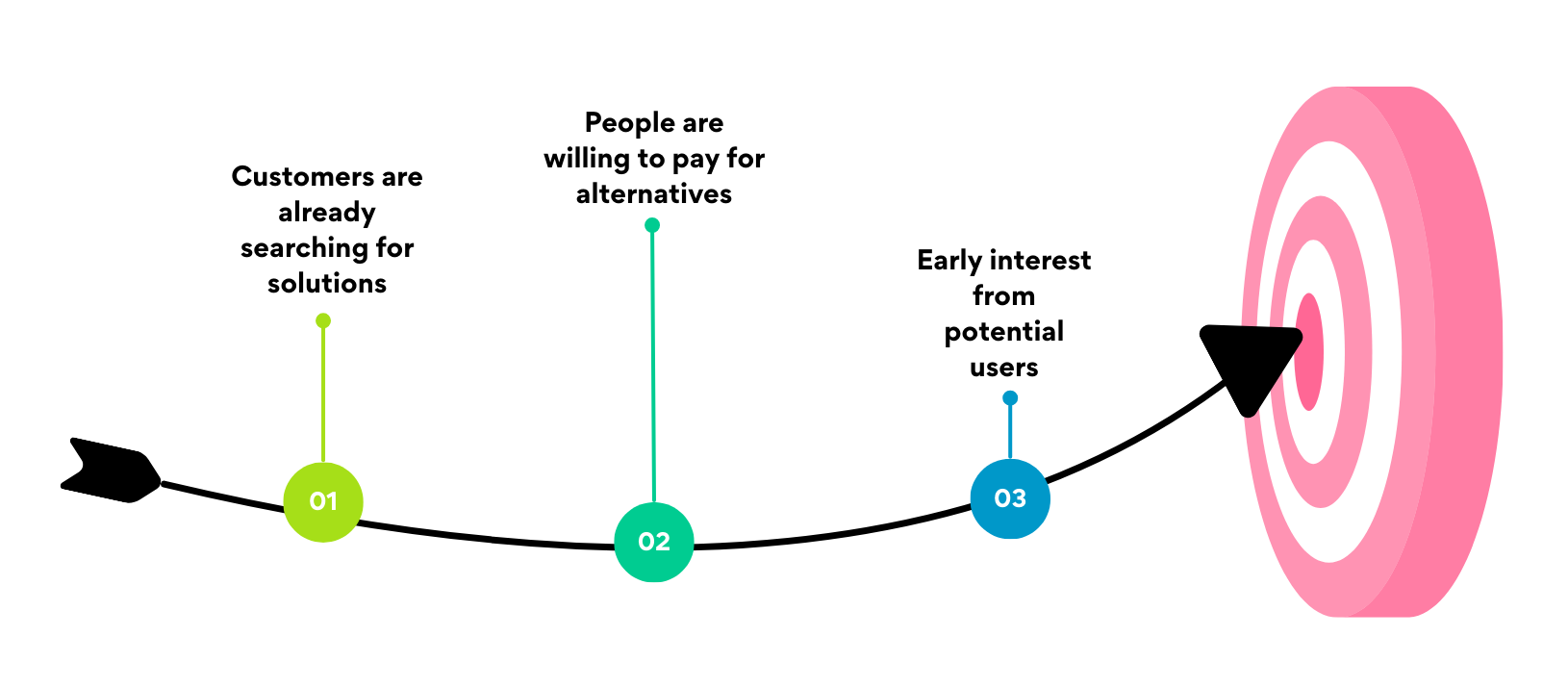
Customers are already searching for solutions
When people actively search for ways to solve a problem, the problem likely matters to them. Search queries, online discussions, and industry forums often reveal common frustrations. High search activity around a topic indicates that many people are trying to solve the same issue. This signal suggests that a market may exist.
People are willing to pay for alternatives
Another strong indicator appears when customers already spend money on imperfect solutions. People may rely on several tools, manual workarounds, or outdated systems to deal with a problem. These behaviors show that the problem has real consequences. If customers already pay for partial solutions, they may pay for a better one.
Early interest from potential users
Interest during early testing often reveals demand. Email signups, waiting lists, and early pilot participation indicate curiosity about the idea. Conversations with potential users may also reveal a strong interest. These signals do not guarantee success, but they show that the idea deserves deeper exploration.
Core Areas to Validate Before Building a Product
Business idea validation involves examining several important areas of the concept. Each area answers a different question about the idea.
Problem validation
The first step focuses on the problem itself. A product should address a meaningful issue that customers experience regularly. If the problem feels minor, customers may ignore the solution.
Problem validation often begins through conversations with potential users. Teams ask about daily challenges, current workarounds, and frustrations. Clear patterns in responses usually reveal whether the problem is worth solving.
Market validation
Even when a problem exists, the market must be large enough to support a business. Market validation explores how many people experience the problem and how strongly they care about solving it.
This step involves industry reports, keyword demand analysis, competitor research, and community discussions. A strong market usually shows multiple indicators of demand.
Business model validation
A good product idea still requires a sustainable business model. Business model validation examines pricing expectations, potential revenue streams, and customer willingness to pay. During early interviews, we ask potential users how they currently spend money on similar solutions. Understanding pricing expectations early helps avoid problems later.
Step-by-Step Process for Business Idea Validation
Business idea validation works best when we follow a structured process. Each stage builds knowledge about the market and the solution.
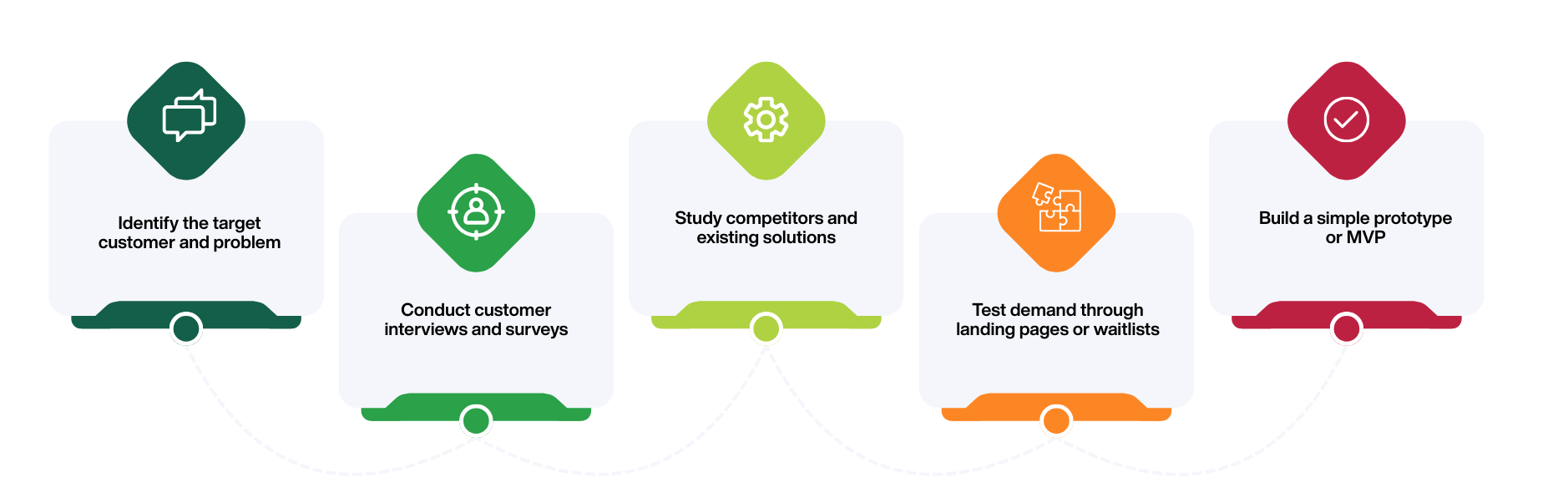
Step 1. Identify the target customer and problem
The first step is identifying the specific group of people who experience the problem. Not every product serves everyone. A narrow audience often provides clearer feedback.
Founders define the target customer by examining industry roles, company types, demographics, or usage patterns. Once the target group is clear, the focus shifts to understanding their daily challenges.
Direct conversations reveal valuable insights. These discussions uncover the problem’s context and its impact on the customer’s work or life. Understanding the problem clearly helps shape the rest of the validation process.
Step 2. Conduct customer interviews and surveys
Customer interviews remain one of the most effective validation methods. During interviews, founders explore how people currently handle the problem and what frustrations they face.
Questions should focus on real experiences rather than hypothetical opinions. Conversations about past behavior often reveal stronger insights than predictions about future actions. Surveys can complement interviews by collecting responses from a larger group. They help identify patterns across many participants. Consistent responses across interviews and surveys usually indicate that the problem affects many people.
Step 3. Study competitors and existing solutions
Competitor analysis reveals how the market currently addresses the problem. Existing solutions may already serve the market, but they may leave important gaps. Teams examine competitor features, pricing strategies, customer reviews, and marketing messages. Reviews often highlight what customers dislike about current solutions. These insights help us understand where their idea could deliver greater value. Competitor research also confirms whether the market already supports similar products.
Step 4. Test demand through landing pages or waitlists
Once the concept becomes clearer, we can test demand through simple experiments. A landing page describing the proposed solution can collect email signups from interested visitors. The page explains the problem, the solution, and the value customers may gain.
Advertising or social media posts can bring traffic to the page. Visitor behavior then provides useful signals. If people sign up for updates or request early access, interest may exist.
Step 5. Build a simple prototype or MVP
After confirming early interest, founders may build a basic version of the product. A minimum viable product focuses on the core value of the idea without unnecessary features. The goal is learning, not perfection. Since MVP development still requires planning and resources, it is useful to understand the MVP development cost before starting.
Early users interact with the prototype and provide feedback about usability, usefulness, and potential improvements. Observing how users interact with the product often reveals insights that interviews alone cannot provide.
Practical Methods to Test Your Business Idea
Fortunately, you do not need large budgets or complex research programs to test out your business idea. There are several simple methods to reveal valuable insights.
Customer interviews
Direct conversations with potential users provide a deep understanding of real problems. Interviews uncover daily challenges, decision processes, and frustrations that surveys may miss. Careful listening during interviews often reveals unexpected insights.
Keyword demand research
Search data offers clues about how people look for solutions. Keyword tools reveal how frequently users search for specific problems. High search activity suggests a strong interest in the topic. This method provides early signals of demand.
Pre-orders and pilot programs
Pre-orders provide strong validation signals. Customers who commit money before a product exists demonstrate clear interest. Pilot programs also allow early users to test the idea in real situations. These programs generate feedback and early revenue at the same time.
Landing page smoke tests
Smoke tests simulate a product launch without building the full product. A landing page describes the idea and invites visitors to sign up or request access. Traffic sources may include social media ads or online communities.
User behavior then reveals how people react to the concept.
| Validation Method | What It Tests | Estimated Cost | Example Outcome |
|---|---|---|---|
| Customer interviews | Problem relevance | Low | Clear insight into user pain points |
| Landing page test | Market interest | Low to medium | Email signups indicate demand |
| Pre-orders | Willingness to pay | Medium | Early revenue signal |
| Prototype testing | Product usability | Medium | User feedback guides improvements |
Common Mistakes During Business Idea Validation
Even founders who attempt validation sometimes make avoidable mistakes.
One common error involves seeking only positive feedback. People often respond politely, especially when discussing ideas with friends or colleagues. Honest feedback requires conversations with real potential customers.
Another common mistake is asking leading questions. Questions should explore experiences and challenges rather than pushing respondents toward agreement.
Building too many features during early testing also creates problems. Early experiments should remain simple so that feedback arrives quickly.
Ignoring negative feedback can also weaken the process. Critical comments often reveal the most valuable insights. Validation works best when we remain curious and open to learning.
What to Do If Your Business Idea Fails Validation
Failure during validation does not mean failure as a founder. It simply means the idea requires adjustment.
Negative signals may reveal that the problem is smaller than expected, that the target audience differs from initial assumptions, or that the solution needs improvement. Teams often respond by refining the concept or exploring a different customer segment.
Sometimes the idea may require a complete pivot. Many successful startups evolved from earlier concepts that did not work. Validation allows us to learn these lessons early when changes remain inexpensive.
Conclusion
Business idea validation plays a critical role in startup success. It allows teams to test their assumptions before committing major resources to development.
Through research, interviews, experiments, and early prototypes, teams gain a clearer understanding of the market and the problem they hope to solve. Teams that validate their ideas carefully build stronger foundations for their businesses.

