


Learn how a reverse proxy routes traffic, improves security, and supports load balancing. Get reliable server administration services for your infrastructure.
Learn about the concept of a reverse proxy, its working and when to use a reverse proxy in your infrastructure. Understand the usefulness of reverse proxies for traffic routing, TLS termination, load balancing, caching and security purposes. Our Server Management Support Team is always on hand to assist you!
An Overview
What Is a Reverse Proxy?
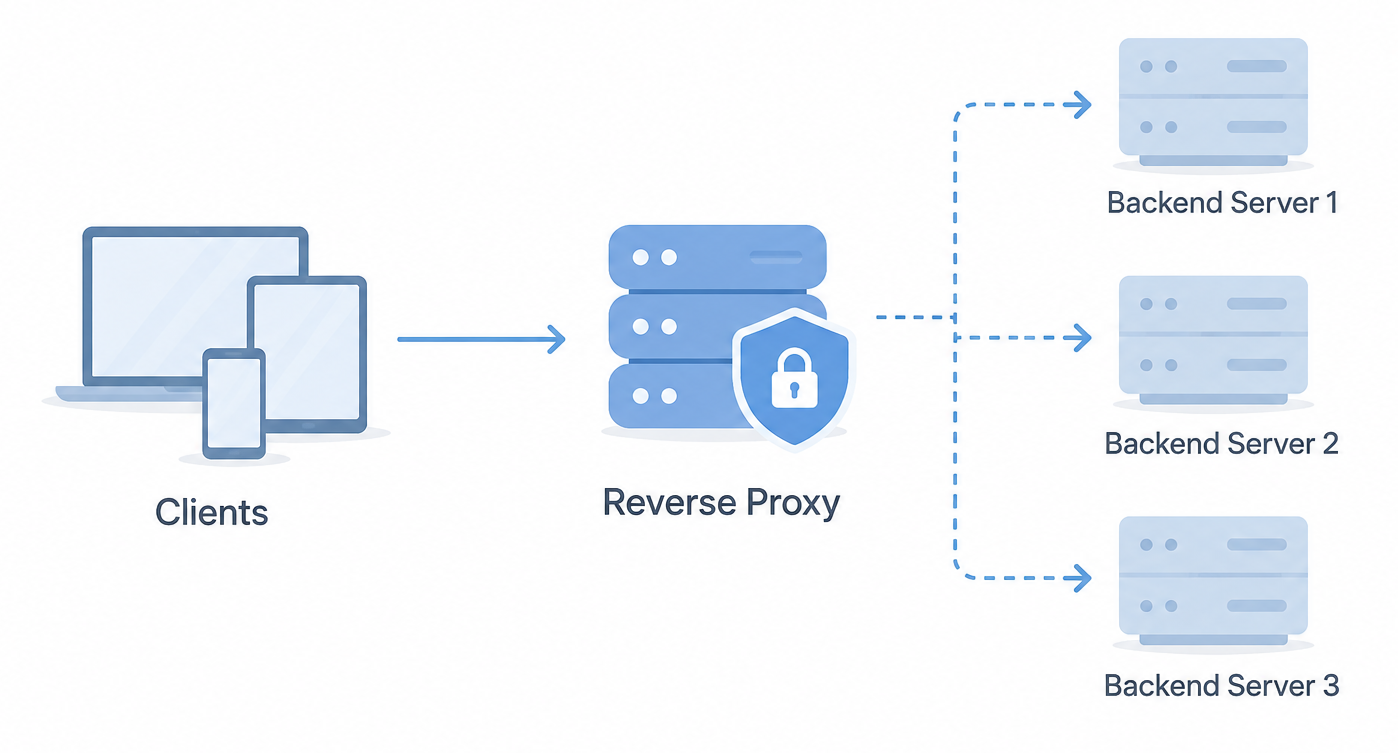
A reverse proxy listens to the requests and routes them to the appropriate back-end servers.
A request for “api.example.com” could first be sent to the reverse proxy. The proxy forwards the request to the right application server based on the hostname, the URL path or other rules specified.
It can also support functions like TLS termination, load balancing, caching, compression, and request filtering.
Forward Proxy vs Reverse Proxy
The main difference is which side the proxy represents.
Forward Proxy
- Located between the client and external servers.
- Delivers a request to destination servers on behalf of clients.
- Usually applied to access control, traffic filtering or privacy.
Strengthen Your Server Infrastructure.

Reverse Proxy
- Stands in the middle of clients and backend servers.
- Receives requests on behalf of backend services.
- Usually deployed for traffic routing, load balancing, security and performance optimisation.
The underlying concepts are similar. Both receive and forward traffic, but they serve different roles in the network.
How Does a Reverse Proxy Work?
- A client sends a request to a public domain or IP address.
- DNS directs the request to the reverse proxy or load-balancing endpoint.
- The proxy evaluates the request using configured rules, such as the hostname, URL path, or headers.
- It selects an appropriate backend server or service.
- The backend processes the request and returns a response.
- The proxy sends the response back to the client.
Depending on how it is configured, the proxy can also terminate TLS, cache responses, compress content, or modify headers.
What Is a Reverse Proxy Used For?
1. Load Balancing
A reverse proxy can send requests to different instances of the application, e.g. by round-robin or least connections. This will make it easier to scale and can help boost availability.
2. SSL / TLS Termination
The proxy handles HTTPS connections and certificate management, while backend services communicate over a controlled internal connection. Organisations can also employ TLS between the proxy and Backend servers in some architectures.
3. Security and Isolation
Servers in the back end can be on a private network, not visible to the public. It’s also possible to implement rate limiting, IP filtering and request filtering with a reverse proxy.
4. Caching and Compression
Often-used content can be stored in the proxy layer, and compression can also minimize the amount of data sent to the client.
5. Routing Multiple Services
Requests to a single public endpoint can be directed to various backend services.
/api/users → user service

/api/orders → order service

/api/products → product service
This is especially handy in a microservices-based architecture.
When Do You Need a Reverse Proxy?
If you have a small application, just a single backend, and simple traffic requirements, you may not need a reverse proxy. However, it becomes useful when:
- You need to distribute traffic across multiple application instances.
- You want centralised TLS / HTTPS management.
- Multiple backend services need to be exposed through a common domain.
- You need caching, compression, or request filtering at the infrastructure layer.
- You want to reduce direct public exposure of backend servers.
- You need a central point for traffic management and access control.
A Quick Mental Model
Client
|
v
Reverse Proxy
|
+—-> Backend Server 1
|
+—-> Backend Server 2
|
+—-> Backend Server 3
The client communicates with the public-facing endpoint, while the reverse proxy determines how the request reaches the backend infrastructure.
Conclusion
Reverse proxies manage traffic and implement security, TLS, load balancing, caching, routing, and other features at a central layer between clients and backend services.
Reverse proxies can be implemented on an ad-hoc basis; however, once an application has outgrown a single service, has multiple instances of an application, or is dealing with stringent security policies, reverse proxies can help a system become more scalable, secure, and manageable.

