


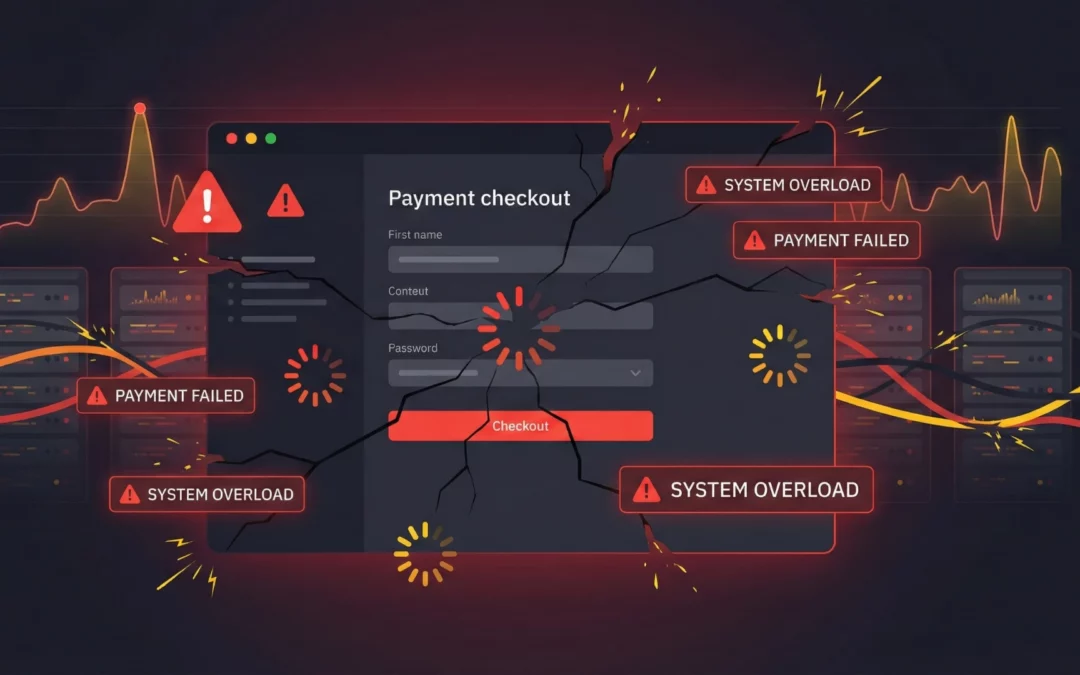
Discover why payment platforms crash and how simple changes in visibility, security, and infrastructure can reduce downtime and prevent customer frustration. Bobcares provides several management and monitoring solutions that help businesses stay stable and online.
Nothing exposes a digital business’s weakness faster than a failed checkout.
It usually happens at the exact moment you expect things to go well. Traffic is high, customers are ready to pay, and your team is hoping for a great sales day.
Then the screen freezes, an error pops up, and the customer leaves. Most never try again. They do not complain. They disappear.
And for the business, the real damage begins after the outage is fixed. When a payment platform goes down, the real loss is not just revenue. It is trust.
Overview
Why These Failures Often Happen During Peak Moments
Platforms rarely fail at random. There is almost always pressure building somewhere in the system. These patterns show up again and again across growing businesses.
1. Sudden spikes in traffic
A holiday sale or partner campaign can bring in thousands of users at once. If the servers are not tuned or ready to scale properly, everything slows down until it breaks.
2. No real visibility into what is happening
Many teams learn about outages only after customers start reporting problems. Without tools like Atop or Netdata, early signs are easy to miss. A rising CPU graph or a slow query might go unnoticed until the platform stops responding.
3. Security threats that overwhelm the system
Bots and attacks often look like real traffic. Without a WAF like Cloudflare or Sucuri, malicious traffic can slip through and drain server resources. This can bring down the platform even when user traffic is normal. Platform reliability often depends on strong infrastructure and proactive optimization. This guide explains how the right outsourced hosting support strategy can help prevent outages and maintain consistent performance.
4. Infrastructure that has not been tuned
Moving to AWS does not automatically solve scaling or performance issues. EC2, RDS, MySQL, and PHP-FPM all need tuning. A single wrong setting can cause delays or full outages.
Want to see how this looks behind the scenes?
If you like understanding things visually, the short video here gives a simple behind-the-scenes look at how outages actually unfold. It also shows how the right fixes help keep a platform steady again. Our expert walks through what happens during an outage, why it escalates, and how a few smart changes can keep the platform stable.
Proactive Monitoring Prevents Downtime
The biggest difference between a team that constantly faces downtime and one that runs smoothly is simple. The second group sees problems before customers feel them.
Real monitoring gives teams the ability to:
- Spot bottlenecks early
- Understand what is slowing the platform
- Notice unusual traffic patterns
- Predict issues before they become outages
Once you can see what is happening inside the system, you can prevent most failures rather than react to them.
Security Controls Reduce Infrastructure Stress
Modern platforms deal with constant scanning bots, repeated login attempts, and automated attacks. If those requests aren’t filtered, they take server capacity away from real users.
A reliable strategy always includes protection from malicious traffic, smart rate limits, and well-tuned backend services.
What to Check After a Payment Platform Outage
Fixing the immediate problem is only the first step. After a payment platform recovers, review what happened and identify the underlying cause.
Check:
- Look for application, database, and server errors during the outage.
- Compare normal traffic with the volume recorded during the incident.
- Review CPU, memory, disk, and database usage to identify resource pressure.
- Check how many transactions failed and whether specific payment methods were affected.
- Review unusual requests, login attempts, or traffic spikes that may have contributed to the issue.
Document the findings and use them to improve monitoring, capacity planning, and security controls. This helps prevent the same problem from becoming another unexpected outage.
Consistency is Key
Most companies fix outages one at a time and then move on. The problem is that this allows the same issues to return later.
Businesses that stay stable long term follow a few simple practices, like:
- Monthly audits
- Automated S3 backups
- Regular performance reviews
- Tuning of critical services
- Careful migration steps when upgrading
These routines may seem small, but together they create a system that remains reliable even under heavy demand. You can also partner with a trustworthy company like Bobcares if you don’t have the bandwidth.
Conclusion
A checkout crash often exposes the real reasons payment platforms fail and makes it clear the system needs deeper attention. The upside is that once you fix these foundational issues, stability returns. Customers stay confident, teams operate with less friction, and the business can focus on growth instead of outages.

