


Explore AI-driven cloud services with AIOps to automate cloud operations, optimize resources, improve security, predict issues, and reduce costs.
Cloud computing is an essential building block for nearly all modern IT. Companies leverage cloud computing for web hosting, application serving, and data storage.
As companies scale, complexities asymptote. Teams are charged with keeping systems live and performant, balancing budgets, and maintaining safe systems that handle increasing inflows of traffic.
This is the sweet spot for Artificial Intelligence (AI).
Cloud environments are ripe for AI because, beyond the need for human creativity to solve complex problems, the majority of cloud systems are straightforward and rote, such as:
- Performing data analysis
- Detecting abnormal system behavior
- Performing repetitive system tasks
AI diminishes the need for cloud engineers to sit and do rote tasks, but it doesn’t eliminate the need for engineers. Most engineers are still focused on higher-order tasks that require analysis.
An Overview
Understanding AI-Driven Cloud Services
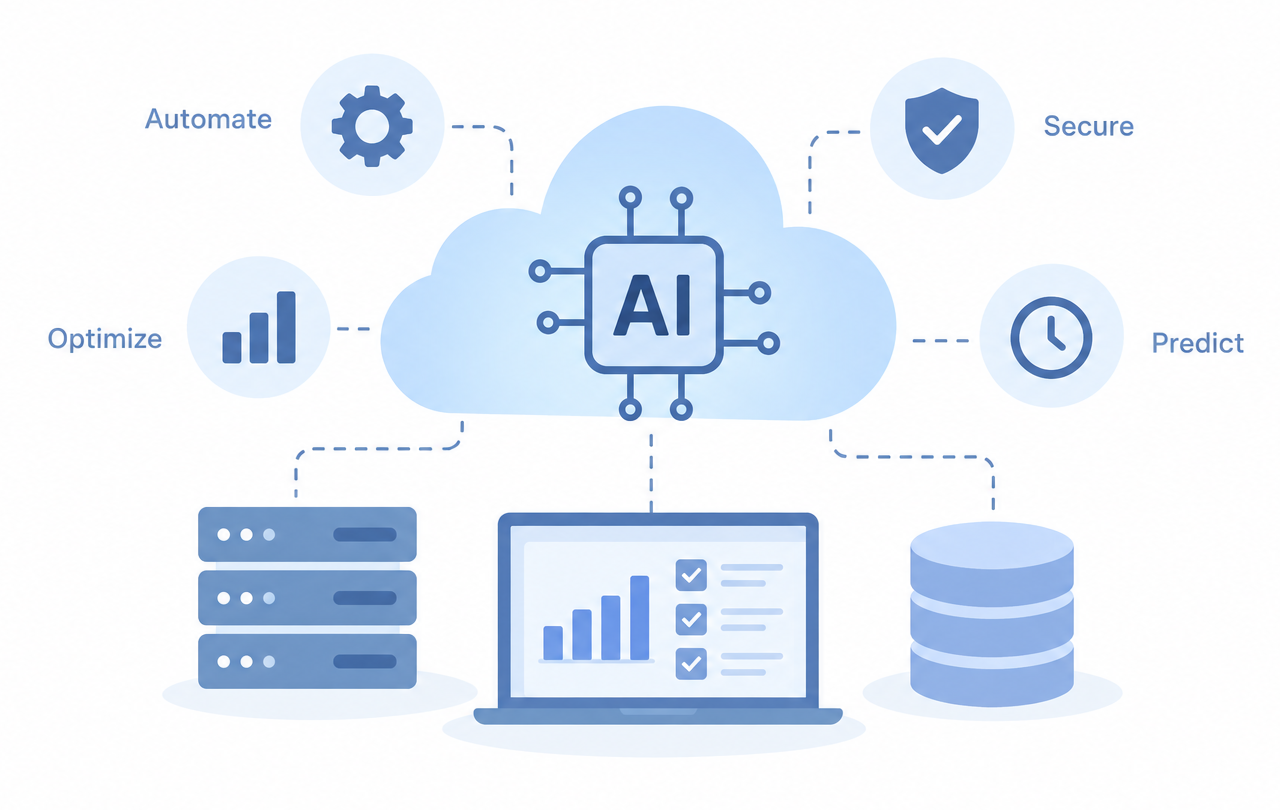
AI Cloud services come from leveraging cloud computing combined with AI and analytics. Each server or application in a network produces data in the order of terabytes. AI excels at sifting through massive amounts of data and finding useful and actionable insights.
Classic automation is rule-based. For instance, a server waits for its CPU to reach an arbitrary threshold before spawning a virtual machine.
AI strives to be more intelligent and thus understands the patterns of the data it is tasked with. If it knows that generally, on Friday evenings, a large number of users hit a web service, it can allocate virtual resources to that service even before the resource depletion is felt.
Explore AIOps Solutions Today.

This leads to a world of much less time and hands-on management of cloud computing.
Smarter Resource Management
AI cloud computing helps achieve the optimal use of resources.
Oversized or unused virtual machines or storage can waste cloud resources and increase costs. Using too few resources can slow responses and affect users.
AI looks at:
- Resource utilization
- Used and available memory
- The storage
- Network activity
AI can help optimize resources based on usage.
Consider the example of a festive promotion. An online business could see an influx of customers and increased business. AI uses the data and adjusts the business infrastructure. The sale could end, and the resources stop being used, so there’s no additional cost.
Predicting Problems Before They Happen
Many IT system issues can show initial signals prior to system failure. Managing a significant number of IT systems can make it hard to review every system to find failure signals.
AI can examine and analyze system data, logs and measurable system data. With the data reviewed, AI can analyse trends and offer system failure solutions before the system affects users.
Some cloud systems can automatically move or change the status of the workloads on the cloud systems. This can minimize temporary system failures and can avoid the need for an IT staff member to be present.
This means your IT staff can focus on preventing and avoiding system failures as opposed to fixing and resolving issues.
Improving Cloud Security
Cloud services can be highly sensitive and complex. Each service offered, and the data processed and analysed, can create system security data that IT staff must monitor.
Manually reviewing security data can be overwhelming and time-consuming. To identify abnormal system use and service security data, AI can analyze normal system use and service security data.
It can identify:
- Multiple login failures from a different country
- Access to sensitive records that is out of the ordinary
AI can also take actions like blocking a suspicious IP address, isolating a compromised system, or prompting for more verification.
AI will never replace the need for experienced security experts. Instead, AI can help reduce the time to identify the issues and create a response.
Helping DevOps Teams Work Quicker
Modern software development progresses at a rapid pace. New software development trends result in teams constantly updating their work products.
AI can help at every point in this cycle by:
- Reviewing application logs
- Finding performance bottlenecks
- Finding abnormalities in behavior after new deployments
- Making deployment suggestions
New software changes that cause increased resource consumption in a group of servers are an example of an issue that AI can identify and notify the development team of after the new software changes are deployed.
In some systems, AI has the ability to stop the new software changes until the issue that prompted the changes is resolved. This empowers teams to confidently engage in more software updates with less risk of negatively impacting users.
Managing Cloud Costs
More organizations than not have increased spending on unintentional cloud services, like virtual machines, that outlast the need for them because teams left them running.
Finding ways to reduce spending is especially important and more challenging for larger cloud services.
AI helps track cloud resource traffic to cut cloud costs via:
- Shutting down unused resources
- Smaller big computes
- Moving data to cheap storage
These won’t cost you a dime, add up in savings and won’t adversely affect your application.
Challenges
AI does a lot for you, but not everything for cloud management.
Most importantly, AI relies on good data. Poor cloud monitoring or bad logging will cost you.
As for integration, it is a challenge in and of itself. Many companies have on-premises systems which work with their newer cloud systems, and this complication makes AI harder to implement.
It is still important to have human oversight. AI recognizes trends and knows how to make decisions, but your engineers still need to:
- Fix hard-to-solve problems
- Deal with security problems
- Create and plan how to deal with problems and changes to the company
This is really why the most advanced companies use AI to assist their employees instead of replacing them.
Real-World Scenarios
AI in the cloud is a big deal in most industries.
- Banks: Use AI to spot potentially fraudulent transactions.
- Health Services: Use AI to help make patient services more available and monitor supportive systems.
- Ecommerce Companies: Use AI to help know when to create more cloud resources during a sale.
- Manufacturing: Use AI to help know when manufacturing systems need to be repaired to avoid system failure.
Each of these industries may have different obstacles to overcome, but they all aim to use AI to better and more rapidly execute important business decisions.
Future of Cloud Platforms
As the years go by, the clouds of today will be even more advanced and may even use technologies such as AIOps, self-healing infrastructures, and AI assistants to perform a majority of the manual tasks required in sophisticated environments.
In the future, cloud platforms may be able to:
- More accurately predict a failure and when it may occur
- Automatically use resources more efficiently and effectively
- Increase security in the environment
- Heal the environment from a number of failures without a human’s help
This automation will not decrease the work of cloud engineers, but will increase the importance and value of their work.
Engineers can shift their focus from maintaining systems to their design to aid in the growth of the business.
Conclusion
AI is revolutionizing the ways in which businesses manipulate their cloud environments.
Cloud environments integrated with intelligent automation can yield:
- Greater reliability of systems
- Decreased costs of overall operations
- Improved security of the environment
- Quicker responses to issues
Integrating AI within a cloud environment goes beyond automation. It allows enterprises to more rapidly and easily manage their cloud environments, shifting IT teams’ focus to higher-value tasks.
As AI cloud environments continue to evolve and become more advanced, AI will transform the way businesses operate, creating more efficient and effective systems.

