Cloud DevOps services streamline cloud operations, automate deployments, improve reliability, and support faster software delivery.
A small team starts with a web app on a single Linux server. When traffic spikes, the server struggles. When the disk fills up at night, nobody notices until customers report the problem.
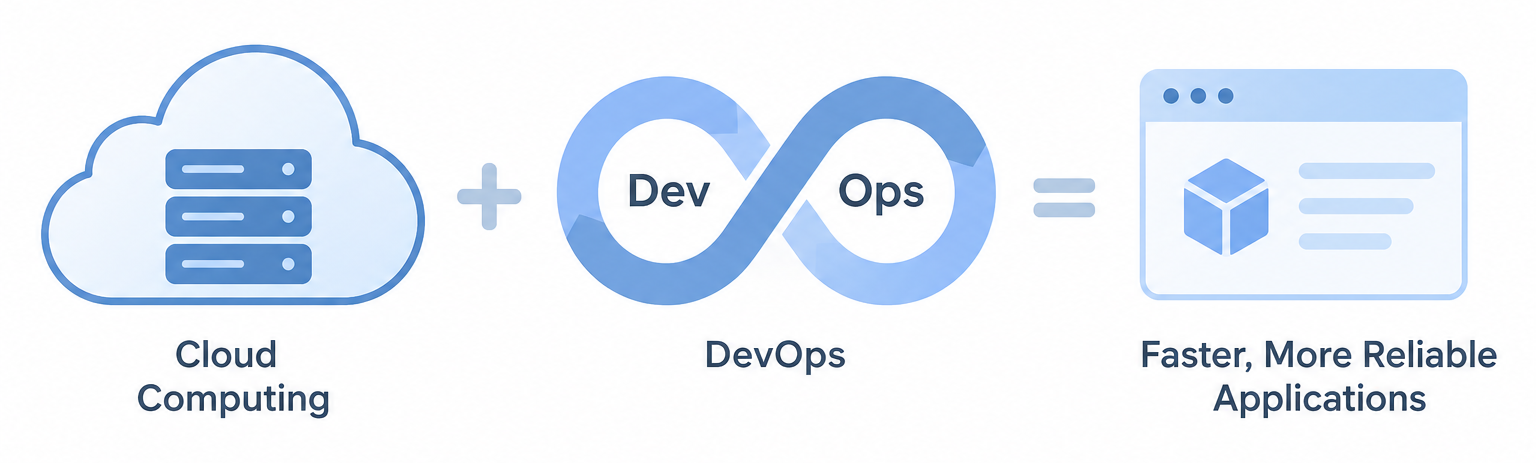
This is where cloud computing and DevOps can make a difference. Teams can quickly deploy servers, automate deployments, monitor systems, and solve problems quickly. They have come together to fundamentally alter the way teams build and run software.
An Overview
What Is Cloud Computing?
Cloud computing is the practice of using computers, storage and networking that are rented from another source rather than purchased and managed by the individual. You are charged for the resources used.
In the pre-cloud era, teams would need to purchase hardware, set up operating systems, set up networks and plan for future traffic. Overprovisioning resources can leave them unused and waste money. Underprovisioning can cause the application to fail during a traffic surge.
Talk to Our Cloud Experts.

There are primarily three types of cloud services:
| Type | What it provides | Examples |
|---|---|---|
| IaaS | Virtual machines and storage | AWS EC2, Google Compute Engine, Azure Virtual Machines |
| PaaS | A platform to deploy applications | Heroku, AWS Elastic Beanstalk, Google App Engine |
| SaaS | Software accessed through the internet | Gmail, Salesforce, Slack |
Most production systems use a mix of these models. For example, an application may run on EC2 or Lambda, use RDS for its database, and use Google Workspace for email.
What Does DevOps Add?
DevOps is a culture and set of practices that enable teams to deliver software faster and more reliably. Instead of separating development and operations, they both share responsibility for software operation.
In practice, DevOps means:
- Taking the path of automation from code to production.
- Capable of undoing changes when problems arise
- Infrastructure as code (IaC)
- Notifying the team if the systems break down
- Improving tests and monitoring following problems
- Sharing responsibility for reliability
These practices are supported by the tools. Use Terraform, Pulumi, and CloudFormation to manage infrastructure. Docker encapsulates applications into containers, and Kubernetes manages containers at scale. CI/CD is supported with GitHub Actions, GitLab CI, CircleCI, Jenkins, and Buildkite.
Teams typically use Prometheus, Grafana, ELK, Loki, Datadog, or Honeycomb for monitoring. OpenTelemetry assists teams in tracing requests across a system.
Where Cloud and DevOps Meet
Cloud platforms provide their services via APIs, and DevOps promotes teams to work with code. This makes the two a natural fit.
A team can manage its infrastructure definition, conduct tests and deploy the change via a pipeline, rather than manually creating a server and installing software.
This is referred to as Infrastructure as Code (IaC).
The application code, infrastructure definitions, pipeline definitions, and policies can reside in a Git repository. This allows teams to see what changes they made, roll back updates, and reproduce an older infrastructure setup when necessary.
Mistakes to Avoid
While cloud and DevOps can make teams more effective, it does not fix all problems.
Do not treat cloud as a guaranteed way to save money. The bill for cloud can add up rapidly. Track resources, establish billing notifications and review costs on a regular basis.
Do not rush into Kubernetes. Kubernetes is complex, and for smaller teams, simpler tools might be more suitable.
Do not delay security. Secrets management, network controls, identity policies, and logging are easier to handle from the start.
Do not treat DevOps as only a job title. Hiring one DevOps engineer will not change how the whole team works. The practice needs shared responsibility.
How to Start Learning
You do not need to learn the entire cloud and DevOps stack at once. Start with Linux and the command line, then learn one cloud provider.
Then create a small web app, connect it to a database and deploy it. Get to know Terraform and Docker, build a simple CI/CD pipeline and add basic monitoring.
After this, learn Kubernetes if it is required for your work. Continue to develop skills in observability, security, and Python or Go scripting.
The best way to learn is to pick a small project and take it from development to deployment. Once you see the complete process, the rest becomes easier to understand.
Conclusion
Cloud computing changed how teams provision and pay for computing resources. DevOps changed how they ship and operate software.
The tools will keep changing, but the basic ideas remain useful: automate where it helps, manage infrastructure through code, monitor systems, and share responsibility for reliability.