


Compare platform engineering and DevOps with cloud DevOps services. Understand key differences, overlaps, ownership models, and use cases for teams.
For the better part of a decade, DevOps was the answer to almost every question about how software teams should ship code. Break down the wall between developers and operations, automate everything you can, and let small cross-functional teams own their services end to end. That pitch worked well when organizations were small enough that “you build it, you run it” didn’t mean every engineer also had to become an expert in Kubernetes, networking, and cloud billing on top of their actual job.
As companies scaled, though, a familiar problem crept back in. Each team was reinventing its own CI/CD pipeline, its own way of provisioning infrastructure, its own monitoring stack. The autonomy that made DevOps appealing started producing duplicated effort, inconsistent security postures, and developers who spent more time fighting YAML than writing features. Platform engineering emerged as a response to that fatigue — not a rejection of DevOps principles, but a more deliberate way of putting them into practice at scale.
This article walks through what each term actually means, where they overlap, where they genuinely diverge, and how to think about adopting one, the other, or both.
An Overview
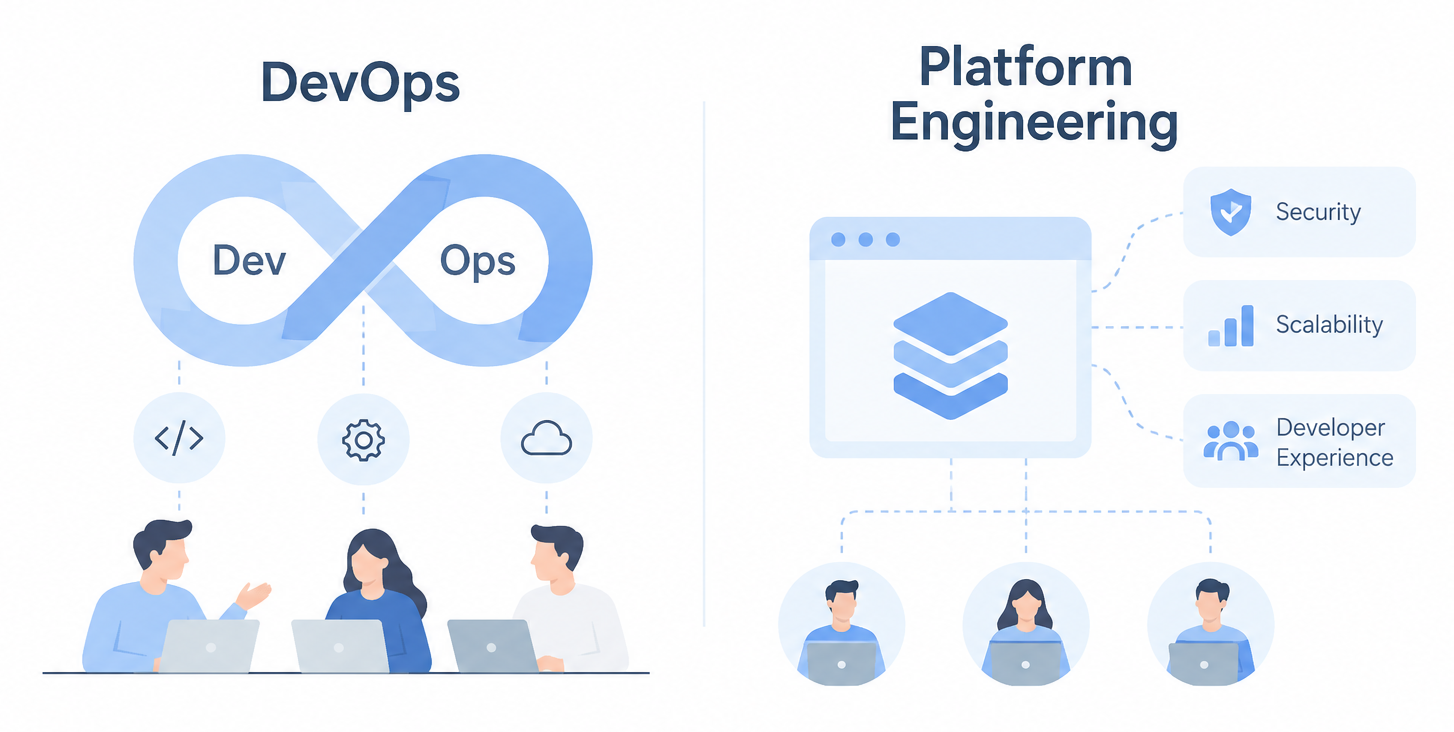
What DevOps Actually Means
DevOps was never a job title or a specific tool — it’s a cultural movement that took shape around 2009, largely credited to a talk by Patrick Debois and Andrew Shafer, and later popularized through books like The Phoenix Project. At its core, DevOps argues that development and operations shouldn’t be separate departments with conflicting incentives. Developers want to ship features fast; operations wants stability. DevOps tries to align those goals by making the same people (or tightly collaborating teams) responsible for both.
The practical expression of this philosophy includes a familiar set of practices:
- Continuous integration and continuous delivery (CI/CD) to reduce the friction and risk of releasing software
- Infrastructure as code so environments are reproducible and version-controlled rather than hand-configured
- Shared on-call responsibility, often summarized as “you build it, you run it”
- Fast feedback loops between writing code and seeing its effects in production
- A blameless culture around incidents, treating failures as learning opportunities rather than something to punish
None of this describes a specific role. In practice, though, companies did hire “DevOps engineers,” and the term slowly drifted from a philosophy into a job description — usually someone who writes Terraform, manages CI pipelines, and gets paged when something breaks. That drift is part of why the industry started looking for a clearer way to describe what these people were actually doing.
What Platform Engineering Actually Means
Platform engineering takes the automation and infrastructure-as-code instincts of DevOps and turns them into a product. Instead of every application team building its own deployment pipeline, secrets management, and observability setup, a dedicated platform team builds an internal developer platform (IDP) — a self-service layer that gives application developers what they need through a consistent, supported interface.
Think of it less as “operations for developers” and more as “developers building for developers.” The platform team’s customers are the engineers writing product code, and their job is to make the easy path the safe, correct, and fast path. A developer shouldn’t need to understand the underlying cloud architecture to spin up a new service; they should be able to request one through a portal, a CLI, or a YAML manifest, and get a working, monitored, compliant environment in minutes.
Talk to us about DevOps.

Common building blocks of a platform engineering setup include:
- A service catalog or developer portal (Backstage is the most widely adopted example) where teams can discover and provision approved resources
- Golden paths — pre-approved, opinionated templates for common tasks like standing up a new microservice or database
- Centralized policy enforcement for security, compliance, and cost controls, often applied automatically rather than through manual review
- Abstracted infrastructure so application teams interact with simple APIs rather than raw cloud primitives
The term gained momentum roughly around 2022, pushed forward by Gartner naming it a top strategic technology trend and by the growing popularity of the CNCF’s Backstage project. But the underlying idea — a dedicated team building tools for other engineering teams — has existed informally for much longer under names like “tools team” or “developer productivity engineering.”
The Core Difference: Philosophy vs Product
The cleanest way to separate the two is this: DevOps is a set of cultural principles and practices distributed across teams, while platform engineering is a discipline that centralizes the implementation of those principles into a reusable, self-service product.
A few concrete distinctions follow from that:
Ownership model. DevOps assumes every team handles its own infrastructure concerns, ideally with automation to lighten the load. Platform engineering assumes a specialized team builds shared infrastructure so other teams don’t have to think about it at all.
The “customer.” In a DevOps culture, there isn’t really an internal customer — everyone is jointly responsible for delivery. In platform engineering, application developers are explicitly treated as the platform team’s customers, and the platform itself is measured by developer experience metrics like time-to-first-deploy or lead time for changes.
Standardization vs autonomy. DevOps tends to favor team-level autonomy — pick the tools that work for you. Platform engineering deliberately narrows choice, offering a smaller set of well-supported golden paths in exchange for consistency, security, and lower cognitive load.
Where the friction shows up. DevOps solves the friction between developers and operations. Platform engineering solves the friction that DevOps itself can create once every team is independently managing infrastructure — sometimes described as “you build it, you also now maintain a small SRE practice for it whether you wanted to or not.”
Where They Overlap
It’s worth being direct about this: platform engineering did not replace DevOps, and the two aren’t competing philosophies. Most organizations doing platform engineering well are still deeply invested in DevOps values — continuous delivery, infrastructure as code, blameless postmortems, and tight feedback loops all remain central. The platform team itself typically operates as a DevOps team internally, applying CI/CD and IaC to the platform’s own codebase.
A useful way to frame it: DevOps tells you what good software delivery looks like. Platform engineering is one way to organize people and tooling to achieve it, particularly once an organization is large enough that duplicated effort across teams becomes more expensive than the cost of building shared infrastructure.
When Each Approach Makes Sense
Platform engineering isn’t automatically an upgrade. For a five-person startup, building an internal developer portal is almost certainly wasted effort — there’s no duplication to eliminate yet, and a dedicated platform team is a luxury the org can’t staff or justify.
DevOps-style autonomy tends to work well when:
- The organization is small enough that a handful of engineers can reasonably own their own infrastructure
- Product requirements and tech stacks vary a lot between teams, so a one-size-fits-all platform would fight against real needs
- The overhead of building internal tooling would outweigh the benefit
Platform engineering tends to pay off when:
- Multiple teams are solving the same infrastructure problems independently, wasting engineering time
- Inconsistent tooling is creating security gaps, compliance headaches, or unpredictable costs
- Developers are reporting that infrastructure complexity is slowing down feature delivery
- The organization is large enough to sustain a dedicated platform team without starving product development
Conclusion
The tension between these two terms says less about a real conflict and more about how the industry keeps rediscovering the same problem: developers want to move fast, and someone needs to make sure “fast” doesn’t come at the cost of stability, security, or sanity. DevOps was the first widely adopted answer. Platform engineering is a more mature, more structured version of that answer for organizations that have outgrown ad hoc automation.
The organizations getting the most value right now generally aren’t picking one over the other — they’re using platform engineering as the delivery mechanism for DevOps principles, giving every team the benefits of automation and self-service without asking every team to become infrastructure experts.

