


Full-stack product development to build, test, deploy, and scale reliable digital products.
There are many aspects of a product that a team must consider when building a digital product. They need to focus on the subsystems of the product, like user experience and software architecture, and think about how they will test, deploy and manage the product.
End-to-end product engineering integrates these aspects. It helps teams build products that are not just reliable, but also constantly adaptive and performant in the long run.
This guide covers the different aspects of product engineering, the benefits and the difficulties teams will face, and the situations in which businesses should consider product engineering. It also covers the framework teams should follow to ensure success.
An Overview
- What Is End-to-End Product Engineering?
- Key Areas of End-to-End Product Engineering
- Benefits of End-to-End Product Engineering
- Challenges of Product Engineering
- When Should You Invest in End-to-End Product Engineering?
- How to Build a Successful Product Engineering Process
- Real-World Product Engineering Applications
- Tips for Better Product Engineering
What Is End-to-End Product Engineering?
End-to-end product engineering spans the entire lifecycle of a product, whereas traditional approaches operate on a define, develop, and deploy sequence for a single feature.
A feature may be performing well on a developer’s local machine, but that does not ensure performance in production. Furthermore, a product needs to perform in all situations, including unforeseen cases, and the ability to integrate with other systems and update the product in the future are also important.
Product engineering addresses the space between working features and production systems.
Key Areas of End-to-End Product Engineering
Product engineering covers five main areas:
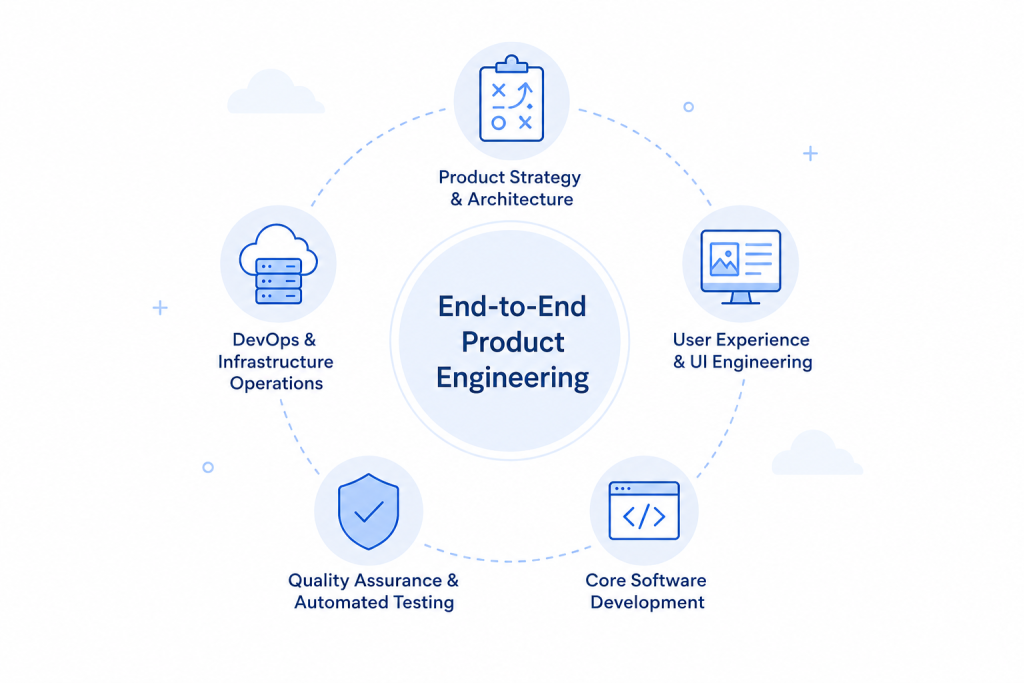
| Area | What It Covers |
|---|---|
| Product Strategy & Architecture | Builds the technical foundation and supports future changes and growth |
| User Experience & UI Engineering | Connects design with frontend development to create practical and easy-to-use interfaces |
| Core Software Development | Builds clean, modular code while reducing technical debt |
| Quality Assurance & Automated Testing | Finds bugs and security issues through automated testing |
| DevOps & Infrastructure Operations | Manages deployment, hosting, pipelines, and system monitoring |
These areas work closely together. As a result, teams can identify technical and product issues earlier.
Build Your Product Today.

Benefits of End-to-End Product Engineering
Faster Product Delivery
The process of integrating designers, coders, and testers from start to end enables teams to better understand limits and efficiencies. This results in less time spent on product development.
Better Software Quality
It can be difficult for QA teams to test for logic and security issues if there are lots of production bugs. By working end-to-end, teams can significantly reduce the number of bugs and save themselves the trouble of late-night bug fixes.
Easier Maintenance
Well-documented and modular codebases become easier to work with in the future and decrease time on feature implementation.
Challenges of Product Engineering
Poor Communication
When teams work separately, they may make decisions based on assumptions. For example, a frontend team may expect real-time backend data without knowing whether the database can handle the required load.
Team Coordination
Developers, designers, and operations teams may have different priorities. Regular communication helps them understand technical limits and product needs.
Legacy Systems
Modern products often need to connect with older databases, systems, or infrastructure. These systems may have limited documentation and can make changes harder.
Technical Debt
Launch time is sometimes too short to do code reviews and implement QA. This leads to cumbersome future development; however, the most important thing to remember is that testing and monitoring should always be prioritized.
When Should You Invest in End-to-End Product Engineering?
This approach becomes useful when problems in the current development process start affecting business results.
Consider it when:
- Product downtime affects revenue.
- Slow pages or failed transactions affect users.
- Releases require several teams to handle deployment issues.
- A successful prototype becomes difficult to change.
- Legacy system migrations keep falling behind.
- Developers spend more time fixing integration issues than building features.
- Staging environments differ greatly from production.
However, not every project needs this level of engineering. A simple landing page or short-term internal tool may work well with a lightweight setup.
How to Build a Successful Product Engineering Process
1. Define the Problem First
Before choosing a framework or starting development, define the problem clearly.
Ask:
- What problem are we solving?
- Who is the user?
- What does success look like?
Clear goals help teams build products that solve real business needs.
2. Start With the Right Scale
Do not build for millions of users before you have a real need for that scale.
A clean, modular monolith can provide a simpler starting point. Teams can keep clear boundaries between modules and later split services when traffic and business needs justify it.
3. Automate Testing
Run automated tests whenever developers push code to the repository.
These tests can include:
- Unit tests
- Integration tests
- Basic security scans
This helps teams find bugs soon after they enter the codebase.
4. Make Deployments Reliable
A deployment should not require several engineers to stay on standby.
Use automated build and deployment pipelines. Also, keep staging environments close to production so teams can find configuration problems before they affect users.
5. Monitor Production Performance
Development does not end when the product goes live.
Monitor the system to find:
- Slow database queries
- API failures
- Resource bottlenecks
- Performance problems
This helps teams address issues before they affect users.
6. Use Real Product Data
Production data can guide future product decisions.
By reviewing user behavior along with system data, teams can decide which updates matter most instead of guessing what users need.
Real-World Product Engineering Applications
Handling High-Traffic Retail Sales
A retail brand faced checkout crashes during high-volume sales. The frontend sent multiple nested requests to the backend, which placed heavy load on the database.
The engineering team found an unindexed query, improved the backend request structure, and added basic autoscaling. The next promotion handled three times the traffic without a slowdown.
Moving a Legacy System to the Cloud
A logistics provider moved its dispatch system from an older desktop application to a cloud platform.
The team released the new web application in smaller phases, allowing operations to continue during the migration. The new system reduced order entry time and supported real-time traffic data for routing.
Supporting Compliance From the Start
A fintech startup needed a payments application with strict compliance needs.
Instead of waiting until the end for a security audit, the team added automated compliance checks to the build pipeline. Each code change was scanned for vulnerabilities, while audit trails remained available.
Tips for Better Product Engineering
Keep Designers and Developers Connected
While the limits of technical solutions are being discussed, factory designs should not be built. This will help teams avoid designing situations that could possibly lead to poor performance or even worse, difficult-to-implement designs.
Keep Code Simple
Easy-to-understand code helps developers work with your code and is also easier to make changes to.
Stabilize Processes Before Automating Them
Automating a broken workflow not only doesn’t solve the problem, but also creates issues. Automation is only useful, and should only be used, on repeatable steps.
Track Business and Technical Metrics
Technical metrics are good and helpful, but offer very little context. Something other teams should do alongside technical metrics is track business KPIs.
The reason this is important is that server response time could decrease while the conversion rate could decrease.
Conclusion
Software engineering that focuses on end-to-end products treats software as a complete product and not a bunch of separate tasks. It also focuses on the product development experience, the product’s strategy, and user interface, and their integration with product management as well as user experience.
Product development teams can aim to make code simpler, improve the product deployment experience, consistently offer rapid development, rapid deployment, and automated testing, and keep products capable of delivering value with user and business requirement changes.

