Bobcares Logo
Search Phone User Profile Emergency Contact
Bobcares Logo
Search Phone User Profile Emergency Contact
Case Studies
About
Blog
Emergency Contact Client Portal
SOLUTIONS
Product Engineering
MVP Build
MVP to Scale
Product Maintenance
Digital Transformation
Process Digitization & Automation
Systems Integration & Workflow Orchestration
Data Enablement & Decision Support
Application & Platform Modernization
Transformation Execution
AI Services
AI Readiness & Use-Case Discovery
AI Integration & Application Enablement
Intelligent Automation & AI Workflows
Infrastructure Management
Always-On Infrastructure Management
Proactive Monitoring & Incident Prevention
Cloud Cost Control & Optimization (FinOps)
Outsourced IT & End-User Support
Managed Infrastructure Execution Support
DevOps & Automation
CI/CD & Release Automation
Infrastructure as Code & Platform Standardization
Reliability Engineering & Observability
DevSecOps Enablement

Mount Azure Blob Storage in Kubernetes | Guide

by Nikhath K | Oct 4, 2023 | Kubernetes, Latest | 0 comments

Please Note: This article is part of our historical archive. Because it was published a while ago, some of the information, links, or context may now be outdated.

Learn how to mount Azure Blob Storage in Kubernetes. Our Kubernetes Support team is here to help you with your questions and concerns.

Mount Azure Blob Storage in Kubernetes | Guide

Did you know that mounting Azure Blob Storage in Kubernetes includes creating a connection between the Kubernetes pods and Azure Blob Storage containers?

This allows our pods to access and manipulate data stored in Azure Blob Storage like it is a local file system. We can do this via Kubernetes volumes and volume mounts.

Let’s take a look at how to mount Azure Blob Storage in Kubernetes:

  1. To begin with, we have to set up an Azure Blob Storage account. This includes creating a storage account in our Azure subscription. It provides us with a storage account name and access keys.
  2. Our experts recommend storing the access keys as Kubernetes secrets. So, we can create a secret with the access keys as seen here:
    kubectl create secret generic azure-blob-storage-secret \
    --from-literal=account-name= \
    --from-literal=account-key=
  3. Then, head to our pod specification and define a volume of type “azureFile” or “azureBlob” depending on our use case.

    For example, to use “azureBlob” as the volume type:
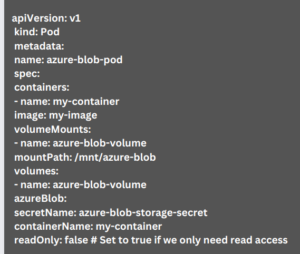
    Mount Azure Blob Storage in Kubernetes | Guide

    Here, the azure-blob-volume is created and mounted to the /mnt/azure-blob path in the my-container container. The volume is configured using the secret we created earlier.

  4. Now, we can access it within our container using the path in the mountPath field. Our container will be able to read from and write to this directory.
  5. Next, apply the pod specification with kubectl apply -f pod-spec.yaml to create the pod with the Azure Blob Storage volume mounted.

Mounting Azure Blob Storage comes in handy for sharing data across pods, persisting data beyond the lifecycle of individual pods, and handling data that needs to be accessed by multiple pods.

[Need assistance with a different issue? Our team is available 24/7.]

Conclusion

In brief, our Support Experts demonstrated how to mount Azure Blob Storage in Kubernetes.

PREVENT YOUR SERVER FROM CRASHING!

Never again lose customers to poor server speed! Let us help you.

Our server experts will monitor & maintain your server 24/7 so that it remains lightning fast and secure.

GET STARTED

Related posts:

    1. Kubernetes Disable Autoscaling: How to Setup?
    2. Kubernetes cluster on CloudStack | Integration
    3. Kubernetes Args Multiline: A short Guide
    4. Kubernetes Deployment Backofflimit: A Detailed Guide

Submit a Comment Cancel reply

Your email address will not be published. Required fields are marked *

Recent Posts

  • Kubernetes StatefulSets and Persistent Volumes: Managing Stateful Applications
  • Why Developers Ship Code While Ops Fight Fires
  • Application Architecture for Scalability: Avoid Costly Growth Bottlenecks
  • Stabilizing APIs Before Customers Notice: Why Every New Integration Breaks Something Else
  • How to Reduce Latency on Cloud VMs

Categories

  • Advanced Vulnerability
  • AI Services
  • AI Support
  • AIOps
  • Amazon Web Services (AWS)
  • Apache
  • API Integration
  • Application Development
  • Azure
  • Cloud Cost Optimization
  • Cloud Management
  • Cloud-Native Application
  • Cloudflare
  • cPanel
  • cPanel migration
  • Cyberpanel
  • DDoS
  • Development Service
  • DevOps
  • DevOps Consulting
  • DevSecOps
  • Digital Transformation
  • DigitalOcean
  • DirectAdmin
  • Docker
  • Drupal
  • Ecommerce
  • Filezilla
  • FTP
  • Google cloud platform
  • HAProxy
  • Headless CMS Integration
  • Hosting Support
  • IIS
  • Infrastructure Management & Optimization
  • Kubernetes
  • KVM
  • Laravel
  • Latest
  • Legacy Application Modernization
  • Linode
  • Litespeed
  • LXC/LXD
  • Magento
  • Microservices Architecture
  • Mobile App Development
  • MongoDB
  • Moodle
  • MySQL
  • NFS
  • Nginx
  • OnApp
  • Outsourced Support
  • OVH
  • ovirt
  • Performance Optimization & Monitoring
  • pfsense
  • Plesk
  • PostgreSQL
  • PowerDNS
  • Product Engineering
  • Proxmox
  • RedHat
  • Redis
  • Sendmail
  • Server Administration
  • Server Management
  • Software Development
  • Software Testing
  • SQLServer
  • Technical Support
  • UI/UX
  • Virtualizor
  • VMware
  • VPN
  • Vulnerability Scanning
  • Vultr
  • Web Development
  • Windows
  • WordPress
  • WordPress Hosting
  • WordPressHA

Subscribe to our newsletter

Footer newsletter

Email sales@bobcares.com | Phone 1-800-383-5193

Product Engineering

  • MVP Build
  • MVP to Scale
  • Product Maintenance

Digital Transformation

  • Process Digitization & Automation
  • Systems Integration & Workflow Orchestration
  • Data Enablement & Decision Support
  • Application & Platform Modernization
  • Transformation Execution & Delivery Enablement

AI Services

  • AI Readiness & Use-Case Discovery
  • AI Integration & Application Enablement
  • Intelligent Automation & AI Workflows

Infrastructure Management

  • Always-On Infrastructure Management
  • Proactive Monitoring & Incident Prevention
  • Cloud Cost Control & Optimization (FinOps)
  • Outsourced IT & End-User Support
  • Managed Infrastructure Execution Support

DevOps & Automation Services

  • CI/CD & Release Automation
  • Infrastructure as Code & Platform Standardization
  • Reliability Engineering & Observability
  • DevSecOps Enablement
Product Engineering +
Web Development MVP to Scale Builds Microservices Architecture Agile & Dev Team Augmentation Mobile Apps Ecommerce UI/UX Design QA & Test Automation
Digital Transformation +
Legacy Modernization Workflow Automation Data-Driven Dashboards CRM / ERP Integration Business Process Re-engineering
AI Services +
AI & Machine Learning AIOps Intelligent Automation Business Intelligence & Analytics AI Installation & Compute
Infrastructure Management +
Cloud Setup Cloud Migration Managed Cloud Services Server & Hosting Cost Optimization Performance Optimization Outsourced Support
DevOps & Automation Services +
CI/CD Setup Kubernetes & Docker Infrastructure as Code Cloud-Native Migration DevSecOps
Cybersecurity & Compliance Services +
Security Hardening VAPT Incident Response Backup & DR

© 2026 Bobcares. All Rights Reserved.

  • Careers
  • |
  • Cookie Policy
  • |
  • GDPR
  • |
  • Privacy Policy
  • |
  • Terms of Service
  • LinkedIn
  • YouTube
  • Instagram
  • Facebook

Preview of the new Bobcares experience
NEW UPDATE
See What’s New
at Bobcares

Discover a faster, clearer view of our services and expertise.


Explore the New Experience
Arrow Right