


Compare multi-cloud and hybrid cloud with hybrid cloud management. Understand the key differences, benefits, and challenges.
As companies expand their cloud initiatives, multi-cloud and hybrid cloud have become two common architecture strategies. Although people often use these terms interchangeably, they work in different ways.
Both approaches offer benefits, but they also bring different challenges related to control, cost, complexity, and compliance.
An Overview
- What Is Multi-Cloud?
- Key Characteristics of Multi-Cloud
- Challenges of Multi-Cloud
- Benefits of Multi-Cloud
- What Is Hybrid Cloud?
- Key Characteristics of Hybrid Cloud
- Challenges of Hybrid Cloud
- Benefits of Hybrid Cloud
- Multi-Cloud vs Hybrid Cloud
- Can an Environment Be Both Multi-Cloud and Hybrid Cloud?
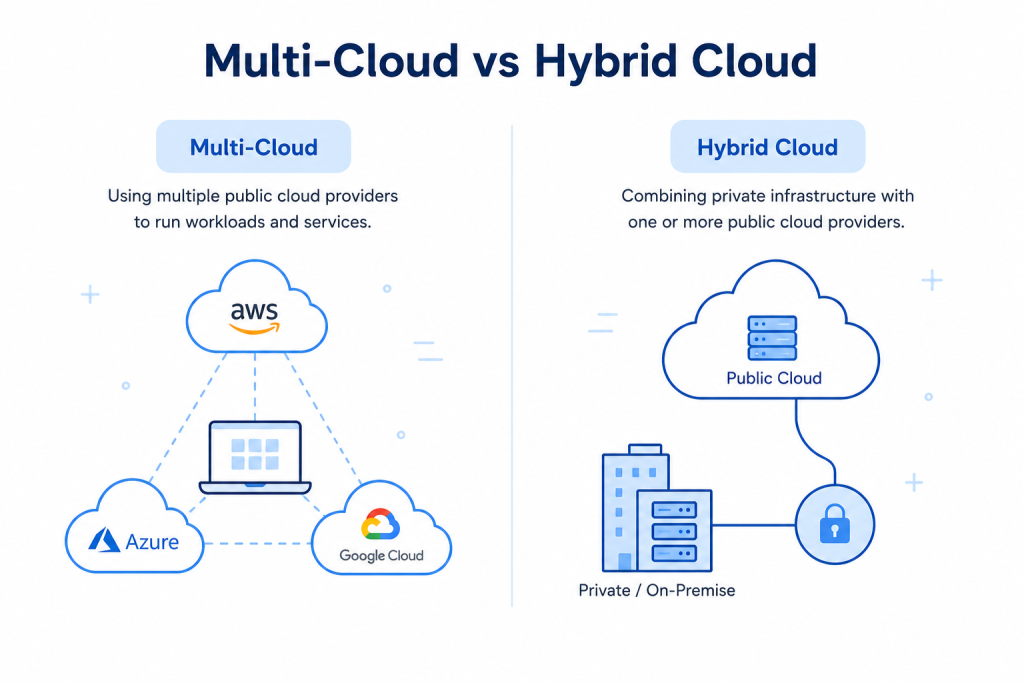
What Is Multi-Cloud?
Multi-cloud is the adoption of two or more public cloud platforms, e.g. AWS, GCP, Azure. Organizations can deploy workloads, services or regions to multiple clouds, according to their requirements.
The primary objectives are to prevent vendor lock-in, leverage multiple vendors and enhance resilience.
Key Characteristics of Multi-Cloud
The typical multi-cloud environment is stateless and typically utilizes cloud-based containerized workloads. Cloud-agnostic tools like Terraform can be employed by organizations for provisioning, while service meshes like Istio can be used for traffic control.
In parallel, enterprise businesses are able to select cloud services for their advantage. They can use AWS Bedrock, GCP BigQuery or Azure OpenAI for specific requirements, for instance.
Manage Your Hybrid Cloud Better.

Challenges of Multi-Cloud
Flexibility comes with the price tag of complexity and higher management costs with Multi-cloud.
The main challenge is data gravity. Transferring data between clouds may lead to higher egress costs and latency, particularly for real-time workloads.
Teams must also manage different:
- Identity systems
- API surfaces
- Billing consoles
- Logging pipelines
- Security audit trails
- Observability tools
Benefits of Multi-Cloud
Multi-cloud can help organizations:
- Avoid vendor lock-in and gain pricing flexibility
- Access best-of-breed services from different providers
- Improve disaster resilience through cloud redundancy
- Support global deployments
- Meet geographic and regulatory requirements
What Is Hybrid Cloud?
Hybrid cloud combines private infrastructure with one or more public cloud providers. Private infrastructure can include on-premises data centers or private clouds.
Organizations connect these environments through secure networking to create an integrated solution. This approach allows them to modernize infrastructure while keeping existing systems and sensitive workloads where needed.
Key Characteristics of Hybrid Cloud
Hybrid cloud connects workloads across on-premises data centers, private clouds, and public cloud platforms.
Organizations can use VPNs, dedicated links such as AWS Direct Connect or Azure ExpressRoute, and software-defined networking to connect these environments.
They may also use Kubernetes, OpenShift, VMware Cloud, or cloud management platforms to manage workloads across environments.
Challenges of Hybrid Cloud
The main challenge is complexity. Teams must maintain consistent networking, security, and identity controls across private and public environments.
In addition, latency can affect workloads that communicate between environments. Data synchronization can also add overhead.
Organizations must also plan for:
- Disaster recovery
- Application portability
- Compliance controls
- Management of both infrastructures
Benefits of Hybrid Cloud
Hybrid cloud can help organizations:
- Maintain control over sensitive data and workloads
- Meet industry and government regulations
- Move to the cloud gradually
- Support cloud bursting during peak demand
- Retain existing on-premises investments
- Improve business continuity and disaster recovery
- Place workloads where they best meet performance needs
Multi-Cloud vs Hybrid Cloud
Although both approaches use cloud technology, their main focus differs.
| Multi-Cloud | Hybrid Cloud |
|---|---|
| Uses two or more public cloud providers | Combines private infrastructure with public cloud |
| Helps reduce vendor lock-in | Helps retain control over sensitive workloads |
| Supports access to services from different providers | Supports gradual cloud migration |
| Can provide redundancy across clouds | Can support cloud bursting |
| Can increase cross-cloud management complexity | Can increase private and public infrastructure management |
Can an Environment Be Both Multi-Cloud and Hybrid Cloud?
Yes. An organization can employ several public cloud service providers in addition to their private infrastructure.
For instance, a company can deploy its on-premises resources and infrastructure using AWS and Azure. It is a multi-cloud and Hybrid Cloud setup.
The main difference is quite straightforward: hybrid cloud is all about mixing public cloud and private cloud, while multi-cloud is about multiple cloud providers.
Conclusion
Multi-cloud and hybrid cloud are different things.
Organizations can benefit from multi-cloud by mitigating vendor lock-in and leveraging services from multiple clouds, while enabling cloud resilience.
For organizations, hybrid cloud can allow them to keep existing infrastructure, secure important workloads and work their way to the cloud.
So, companies ought to evaluate their workload, data, infrastructure, compliance, and management needs prior to selecting an approach.

